Pickleball slang terms can sound confusing when you are new to the sport. Players often use short, funny, or informal words during games, in group chats, on social media, and at pickleball courts.
Terms like dink, kitchen, third-shot drop, Erne, ATP, banger, and golden pickle can make pickleball sound like a different language. This guide explains common pickleball slang terms, their meanings, where players use them, and how they are used in real conversations.
You will also learn which terms describe shots, players, court areas, and game situations. If you are new to pickleball or play often, knowing these terms makes conversations easier to understand.
Quick Answer:
Pickleball slang terms are informal words and phrases players use to describe shots, strategies, court positions, players, and common situations during pickleball games.
What Does Pickleball Slang Mean?
Pickleball slang is the casual language used by players to talk about the sport. Some terms are shortened forms, while others are nicknames for specific shots or situations.
For example, a player may say, “Nice dink!” after a soft shot near the net. Another player might say, “Stay out of the kitchen,” referring to the non-volley zone.
These terms are not usually meant to be confusing. They developed because players need quick ways to describe common actions during a fast game.
You may hear pickleball slang:
- At local pickleball courts
- During recreational games
- In pickleball clubs
- In coaching sessions
- In text messages between players
- On Instagram and TikTok
- In Reddit pickleball communities
- In online pickleball groups
Some terms are also used humorously outside the game.
Common Pickleball Slang Terms
Here are some of the most common pickleball terms beginners may hear:
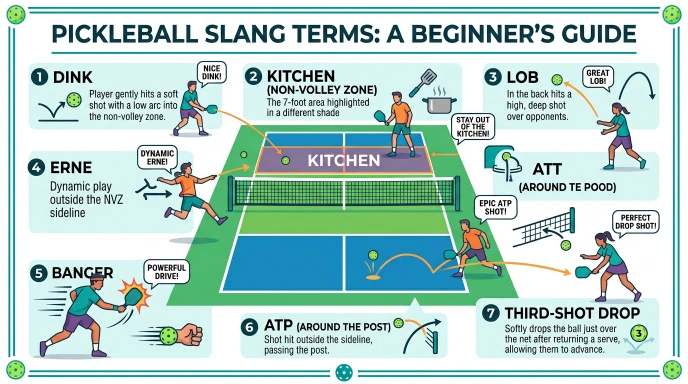
| Slang Term | Simple Meaning |
| Dink | A soft shot that lands near the net |
| Kitchen | The non-volley zone near the net |
| Banger | A player who likes powerful shots |
| Erne | A special shot played near or outside the kitchen |
| ATP | A shot hit around the side of the net |
| Third-shot drop | A soft shot used to move toward the net |
| Lob | A high shot over an opponent |
| Drive | A fast, hard shot |
| Pickle | A game where one team scores zero |
| Golden pickle | A game where the losing team scores zero and the winner also meets the required margin |
| Stack | A positioning strategy used by doubles teams |
| Poach | Taking a ball that your partner could have played |
| Shake and bake | A coordinated third-shot drop and attack |
| Reset | A soft shot that slows down a fast exchange |
| ATP | Around-the-post shot |
| Dead ball | A ball that is no longer in play |
Not every term is technically slang. Some are standard pickleball terms. However, players often use them casually, so beginners may hear them described as pickleball slang.
Dink
A dink is one of the most important words in pickleball.
It describes a soft shot that travels over the net and lands in or near the opponent’s kitchen. The goal is usually to make the opponent hit upward instead of giving them an easy attack.
A dink is not about hitting hard. It is about control, placement, and patience.
Example: “Keep dinking until they make a mistake.”
Players often use “dink” as both a noun and a verb.
Example: “That was a great dink.” “Try to dink it crosscourt.”
For beginners, learning the dink is one of the best ways to understand the softer side of pickleball.
Kitchen
The kitchen is the informal name for the non-volley zone, the seven-foot area on both sides of the net.
The name sounds funny, but it is extremely common among pickleball players.
A player cannot normally volley the ball while standing in the kitchen. A volley means hitting the ball before it bounces.
Example: “Don’t step into the kitchen when you volley.”
The term is so common that many players use “kitchen” more often than “non-volley zone.”
Banger
A banger is a player who prefers powerful, fast shots.
Instead of using many soft dinks and controlled shots, a banger may try to hit the ball hard and force a quick reaction.
The word is usually informal and can be playful. It is not automatically an insult.
Example: “He’s a real banger, so stay ready for hard drives.”
Some experienced players also use the term when discussing different playing styles.
A banger is often more comfortable with speed and power, while a softer player may focus more on placement and patience.
Erne
An Erne is a special attacking shot played near the sideline. The player moves outside the kitchen area and hits the ball close to the net.
The shot is named after Erne Perry, a player associated with popularizing the move in pickleball.
You may hear players say:
“Watch for the Erne.”
It usually means the opponent may suddenly move toward the sideline to attack the ball.
The Erne can be difficult to execute because timing, footwork, and positioning all matter.
ATP
ATP stands for around the post.
It describes a shot that travels around the side of the net instead of going over the top of it.
This can happen when the ball is hit at an angle that allows it to pass outside the net post.
Example: “That ATP was unbelievable!”
ATP shots are exciting because they can surprise opponents. They also require good court awareness and timing.
Third-Shot Drop
The third-shot drop is one of the most discussed terms in pickleball.
It is usually a soft shot hit after the serve and return. The goal is to make the ball land softly in the opponent’s kitchen.
This gives the serving team a better chance to move toward the net.
Example: “Her third-shot drops are really consistent.”
Beginners sometimes think the third shot should always be powerful. In many situations, control is more useful than speed.
Lob
A lob is a high shot sent over an opponent’s head.
Players can use a lob defensively to create time or offensively to move an opponent away from the net.
Example: “He hit a great lob over my partner.”
A lob can be effective, but a poorly placed lob may give the opponent an easy attacking opportunity.
Drive
A drive is a fast and relatively hard shot.
Players often use drives to put pressure on an opponent or make the return difficult.
Example: “Her forehand drive is very strong.”
The word “drive” is common in pickleball discussions, coaching, and game conversations.
Pickle
A pickle is commonly used to describe a game in which one team scores zero points.
The term is informal and is often used humorously.
For example:
“We won the first game, but the second was a pickle.”
The exact use can vary in casual conversation, so beginners should listen to the surrounding context.
Golden Pickle
A golden pickle is a playful term for a shutout win with the required winning margin.
The term is not as universally standardized as basic terms like dink or kitchen.
Because informal pickleball vocabulary can vary between groups, it is best to ask what someone means if the context is unclear.
Poach
To poach means to move across the court and hit a ball that your doubles partner might normally have played.
A successful poach can put pressure on the opponent and create a better attacking position.
Example: “She poached the ball and finished the point.”
Poaching is common in doubles pickleball and requires good communication with your partner.
Stack
Stacking is a doubles strategy where players choose positions that let them use their stronger side.
It is not simply random movement. Teams use stacking to create tactical advantages.
Example: “They stack because the stronger forehand player likes to cover the middle.”
You may hear this term frequently in competitive doubles play.
Shake and Bake
Shake and bake is a playful name for a coordinated attacking strategy.
It often involves a third-shot drop or drive followed by an aggressive move toward the net and an attack by the partner.
The exact execution can vary between players.
Example: “They tried a shake and bake on the first point.”
The phrase sounds humorous, which is part of the personality of pickleball vocabulary.
Reset
A reset is a soft shot used to slow down a fast exchange and regain control.
For example, if an opponent hits a hard drive, a player may use a soft shot to take speed out of the rally.
Example: “She used a perfect reset instead of trying to hit the ball harder.”
Resetting is especially useful during fast hands battles at the net.
What Are the Most Common Pickleball Slang Terms for Beginners?
If you are new to pickleball, you do not need to memorize every term immediately.
Start with these:
- Dink soft shot near the kitchen.
- Kitchen non-volley zone.
- Drive fast, hard shot.
- Lob high shot over an opponent.
- Banger player who likes powerful shots.
- Poach taking a ball from your partner’s side.
- Third-shot drop soft third shot used to approach the net.
- ATP shot around the net post.
- Erne attacking shot near the sideline.
- Reset soft shot that slows the rally.
Knowing these words will help you understand most casual pickleball conversations.
Is Pickleball Slang Rude or Offensive?
Most pickleball slang is neutral, playful, or sports-related.
Words such as “dink,” “lob,” “kitchen,” “drive,” and “reset” are not offensive. They simply describe parts of the game.
Some words describing players can depend on tone.
For example, calling someone a banger can be friendly:
“You’re becoming a serious banger!”
But it could sound critical if someone says it during an argument.
As with most slang, tone and context matter.
Where Is Pickleball Slang Commonly Used?
Pickleball slang is most common where players communicate directly.
You may see it in:
- Pickleball clubs
- Recreational games
- Tournaments
- Coaching sessions
- Team group chats
- Facebook communities
- Reddit discussions
- Instagram posts
- TikTok videos
- YouTube tutorials
- Sports forums
On social media, players often use slang because it makes posts shorter and more relatable.
For example:
“That ATP was 🔥.”
A pickleball player would understand that the writer is praising a great around-the-post shot.
Real-Life Examples of Pickleball Slang
Friendly Example
Player 1: “Nice dink!”
Player 2: “Thanks! I’m finally getting the hang of it.”
This is a simple and positive use.
Casual Example
Player: “He’s a banger, so don’t stand too close.”
Here, “banger” describes a player’s style.
Competitive Example
Coach: “Work on your third-shot drop before attacking.”
This uses pickleball vocabulary in a training situation.
Doubles Example
Player: “I’ll poach the next one.”
This tells the partner that the player plans to move across and take the ball.
Social Media Example
Caption: “Finally hit my first clean ATP!”
This would be a natural caption for a pickleball player sharing a successful shot.
Friendly Joke
Player: “Welcome to the kitchen!”
This can be playful when an opponent steps into the non-volley zone illegally.
Pickleball Slang vs. Regular Pickleball Terms
Not every informal word used by pickleball players is technically slang.
Some terms are official or widely recognized parts of pickleball terminology.
| Term | Type | Simple Meaning |
| Dink | Common pickleball term | Soft shot near the net |
| Kitchen | Informal/common term | Non-volley zone |
| Drive | Standard term | Fast shot |
| Erne | Specialized term | Attack near the sideline |
| Banger | Slang | Power-focused player |
| Poach | Strategy term | Taking a partner’s ball |
| ATP | Shortened term | Around-the-post shot |
| Shake and bake | Informal phrase | Coordinated attack |
| Reset | Strategy term | Soft shot that slows play |
This difference matters because some terms are part of normal pickleball instruction, while others are more casual.
Why Do Pickleball Players Use Slang?
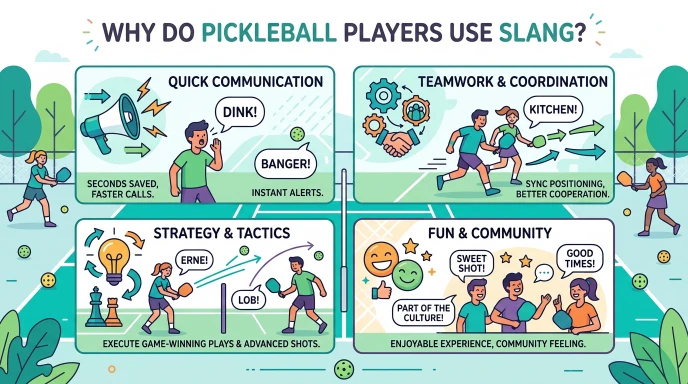
Players use slang because it makes communication faster and easier.
Imagine a player explaining:
“Hit a soft shot toward the non-volley zone and then move forward.”
That is much longer than saying:
“Dink and get up.”
Short terms help players communicate quickly.
Slang also creates a sense of community. Players who understand terms such as “dink,” “kitchen,” and “banger” feel more familiar with the sport.
Another reason is humor. Pickleball has many unusual terms, and players often enjoy using them casually.
When Should You Avoid Pickleball Slang?
You usually do not need to avoid pickleball slang, but context matters.
In a casual game, slang is perfectly normal.
In formal writing or when speaking to beginners, explain special terms when needed.
For example, instead of only saying:
“Use an ATP.”
You could say:
“Try an ATP, or around-the-post shot, when the angle is available.”
This makes the message easier for beginners to understand.
Pickleball Slang on Social Media
Pickleball slang works especially well on social media because it is short and recognizable to players.
A TikTok video might say:
“POV: Your opponent is a full-time banger.”
An Instagram caption might say:
“That dink battle was intense.”
A YouTube coach might title a video:
“3 Ways to Improve Your Third-Shot Drop.”
On Reddit, players may discuss stacking, resets, Ernes, or doubles strategies in much more detail.
The meaning usually comes from the sport, not from general internet slang.
Is Pickleball Slang Safe for Social Media?
Yes. Most pickleball slang is harmless and suitable for normal social media content.
Terms such as dink, kitchen, lob, drive, Erne, ATP, reset, and banger are generally sports vocabulary or playful expressions.
However, the tone can change if someone uses a term to insult another player.
When posting publicly, it is better to focus on the game rather than attack a person.
For example:
Good: “That banger was impossible to return!”
Less friendly:
“That player is terrible.”
The first focuses on the action, while the second directly attacks someone.
How Pickleball Slang Helps New Players
Learning the vocabulary can make a new player feel more comfortable.
Imagine joining a game and hearing:
“Dink it, reset, then look for the Erne.”
Without knowing the terms, this may sound confusing.
After learning the vocabulary, the instruction becomes much clearer:
- Dink it = use a soft shot.
- Reset = slow down the rally.
- Look for the Erne = watch for an attacking move near the sideline.
This is why learning basic pickleball slang is not just about sounding knowledgeable. It helps players understand strategy and communicate better.
FAQs
What are pickleball slang terms?
They are informal words players use for shots, strategies, court areas, and game situations.
What does “dink” mean in pickleball?
A dink is a soft shot that lands near or inside the opponent’s kitchen.
Why do pickleball players call it the kitchen?
“Kitchen” is the common informal name for the non-volley zone near the net.
What does “banger” mean in pickleball?
A banger is a player who prefers fast, powerful shots rather than relying mainly on soft shots.
What does ATP mean in pickleball?
ATP means around the post. It is a shot that travels around the side of the net.
What does “poach” mean in pickleball?
Poaching means moving across the court to hit a ball that your doubles partner might otherwise play.
Is pickleball slang only used by professional players?
No. Recreational players, beginners, coaches, clubs, and online communities all use common pickleball terms.
Is pickleball slang offensive?
Most pickleball slang is harmless and sports-related. A few player descriptions can sound negative depending on tone and context.
Conclusion
Pickleball slang terms make it easier for players to talk about shots, strategies, court areas, and game situations. Terms like dink, kitchen, banger, Erne, ATP, lob, and drive are common in pickleball.
Some terms are true slang, while others are standard pickleball vocabulary that players use casually. The difference is not always strict, and usage can vary between clubs and communities.
For beginners, start with the basic terms instead of trying to learn everything at once. Once you understand words like dink, kitchen, drive, and third-shot drop, conversations on the court become much easier to follow.
You may also see these terms on TikTok, Instagram, Reddit, YouTube, and pickleball group chats. In most cases, their meaning comes directly from the sport and the situation where they are used.
The best way to learn pickleball slang is to hear it in real games and connect each word with the action it describes. With practice, these terms will become easy to understand and use.
Read more about!
- Bar Slang: What Does “Bar” Mean in Slang?
- Blud Slang: What Does “Blud” Mean?
- Hood Slang: What Does “Hood” Mean in Slang?

Hi, I’m Ryan Holden, a content writer with over 8 years of experience creating clear, engaging, and easy-to-understand content. I specialize in slang meanings, internet language, text abbreviations, and modern English expressions. My goal is to explain complex words in simple English with real-life examples so readers can quickly understand and use them correctly. I enjoy researching how language changes across social media, online communities, and everyday conversations, ensuring every article is accurate, helpful, and easy to read.