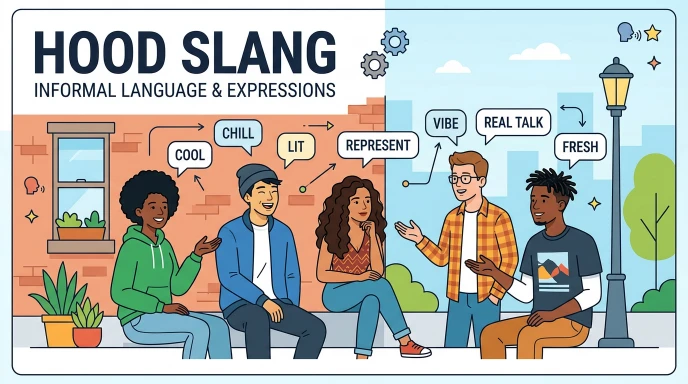
Hood slang can be confusing because the word may describe a neighborhood, a person’s background, or a certain style depending on the sentence.
You may see it in texts, social media captions, songs, movies, memes, and casual conversations.In slang, “hood” is short for “neighborhood.” It can also refer to a low-income urban area and its culture.
People often search for the hood meaning slang because the word does not always mean simply “neighborhood.” Tone and context matter. A person might use it proudly when talking about where they grew up, while someone else could use it in a negative or stereotypical way.
Quick Answer:
In slang, “hood” usually means “neighborhood,” especially an urban area or community. Depending on context, it can also describe the culture, lifestyle, or identity associated with that area.
What Does Hood Mean in Text?
In texting and casual online communication, “hood” is usually a short form of “neighborhood.”
For example:
“I’m heading back to the hood.”
This means the speaker is going back to their neighborhood or local area.
The word can also have a deeper meaning. “The hood” may refer to an urban neighborhood with a strong local identity. Merriam-Webster also defines “hood” informally as a neighborhood, especially an inner-city area.
Importantly, “hood” does not always mean a dangerous or criminal place. Its meaning depends on the context and how people use it.
Common Meanings of “Hood”
| Meaning | Simple Explanation |
|---|---|
| Neighborhood | A short way to say neighborhood |
| Local community | The area and people someone identifies with |
| Urban area | Sometimes refers to an inner-city neighborhood |
| Background | Can mean the place someone grew up |
| Hood culture | Cultural styles, experiences, or traditions linked to a community |
“Hood” can also appear in words like hoodlum, but that is a separate meaning.
Hood Slang Full Form
The most common hood slang full form is “neighborhood.”
It is created by shortening the ending of the word neighborhood.
Neighborhood → hood
You may also see it written as ’hood, especially when the writer wants to make the shortened form clear.
For example:
- “Welcome to the hood.”
- “I grew up in this hood.”
- “Everybody in my hood knows him.”
- “She moved out of the hood.”
The word is informal, so neighborhood is usually better in formal writing.
What Does Hood Stand For?
If someone asks “what does hood stand for?” in a slang or texting context, the simplest answer is:
Hood stands for “neighborhood.”
However, “stands for” can be slightly misleading because hood is not normally an acronym. It is a clipped or shortened form of neighborhood.
That distinction is useful if you are learning English slang.
Is Hood Rude, Offensive, or Neutral?
The word hood is not automatically rude or offensive.
Its tone depends on context.
Someone talking about their own community might use the word naturally and positively:
“I still love my hood.”
Another person might use it to describe a neighborhood in a negative way:
“That area is really hood.”
The second example may sound judgmental because it can suggest the area is poor, unsafe, or linked to crime.
This is where cultural context becomes important. “Hood” can refer to inner-city or low-income neighborhoods.
When “hood” can sound positive
It can communicate:
- Community
- Pride
- Familiarity
- Childhood memories
- Loyalty to one’s neighborhood
- A shared cultural identity
When it can sound negative
It may sound offensive or stereotypical when someone uses it to label an unfamiliar community as:
- Dangerous
- Poor
- Criminal
- Uneducated
- Violent
So, the safest approach is to look at the speaker’s relationship with the place and the tone of the conversation.
Where Is Hood Commonly Used?
You can encounter hood slang in many informal settings, including:
- Text messages
- Instagram captions
- TikTok comments
- Snapchat
- Reddit discussions
- Discord chats
- YouTube comments
- Rap and hip-hop lyrics
- Movies and television
- Gaming conversations
- Casual speech
It is common in American slang and is linked to urban and hip-hop culture.
However, not every online use has the same meaning. Some people use “hood” simply to mean neighborhood, while others use it to describe community or urban culture.
Real-Life Examples of Hood Usage
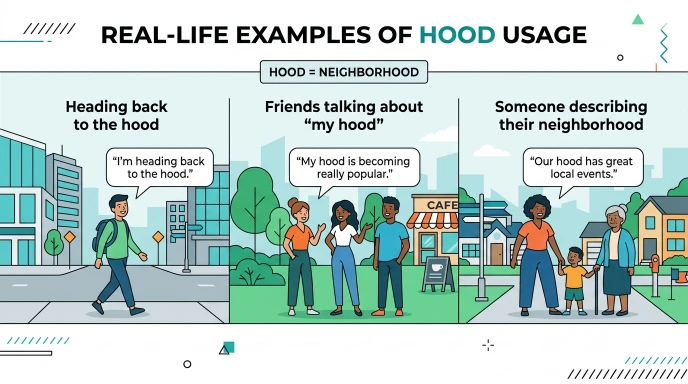
The easiest way to understand hood meaning slang is to look at different contexts.
Friendly Example
“I’m back in the hood visiting my old friends.”
Here, “hood” refers to the speaker’s old neighborhood. The tone is friendly and nostalgic.
Casual Example
“What’s going on in the hood tonight?”
The speaker is asking what is happening around their local neighborhood.
Community Example
“Everyone in the hood knows that family.”
Here, the word emphasizes familiarity within a local community.
Proud Example
“Never forget where you came from. Represent your hood.”
This usage expresses pride or loyalty toward one’s community.
Social Media Example
“Back in my hood after five years.”
The person is talking about returning to the neighborhood where they previously lived.
Gaming Context
“Our squad controls this hood.”
In a game, “hood” may be used loosely to describe a territory, neighborhood, or area controlled by a group. This is highly context-dependent and does not necessarily refer to a real neighborhood.
Argumentative Example
“You don’t even know this hood, so stop talking about it.”
Here, the word is connected to local identity and authenticity. The speaker is challenging another person’s knowledge of the community.
What Does “From the Hood” Mean?
The phrase “from the hood” usually means that someone grew up in or comes from a particular urban neighborhood.
For example:
“He’s from the hood, so he knows everyone around here.”
Depending on context, the phrase can communicate background, community identity, or life experience.
It does not automatically mean that someone is a criminal or involved in gangs.
That stereotype is one reason context matters when interpreting the phrase.
What Does “In the Hood” Mean?
“In the hood” generally means in the neighborhood or local area.
For example:
“I’m in the hood right now.”
The exact implication depends on the speaker. In some conversations, it may simply mean their neighborhood. In others, it may specifically refer to an economically disadvantaged urban area.
What Does “Hood” Mean When Describing a Person?
This is where things can become more complicated.
Sometimes people use hood as an adjective to describe someone’s behavior, appearance, speech, or style.
For example:
“That joke was so hood.”
This can mean the speaker thinks something reflects a particular urban or street-oriented style.
However, using hood to describe a person can easily become stereotypical. If it is used to call someone uneducated, aggressive, criminal, or inferior, it can become offensive or derogatory.
Therefore, this use requires more caution than simply saying “my hood” to mean “my neighborhood.”
Origin and Background of Hood
The slang sense of hood comes from shortening neighborhood. Merriam-Webster records the informal neighborhood meaning and gives 1966 as its first known use for that sense.
The word later became strongly associated with American urban culture and popular entertainment. It appears frequently in hip-hop, rap, movies, television, and everyday informal speech.
The cultural meaning is broader than geography. For many people, “the hood” can reflect memories, friendships, struggles, identity, and community.
That is why translating hood = neighborhood is technically useful but sometimes incomplete.
Hood vs. Neighborhood
These words are closely related, but they are not interchangeable in every situation.
| Feature | Hood | Neighborhood |
| Meaning | Neighborhood or local area | Local residential area |
| Style | Informal slang | Standard English |
| Tone | Casual, cultural, context-dependent | Neutral |
| Formal writing | Usually avoid | Appropriate |
| Texting | Common | Very common |
| Cultural meaning | Can carry additional associations | Usually straightforward |
| Possible negative implication | Sometimes | Usually neutral |
For example:
Casual:
“I grew up in the hood.”
Neutral:
“I grew up in that neighborhood.”
The second sentence sounds more neutral and suitable for formal communication.
Hood vs. Ghetto
These terms should not be treated as exact synonyms.
Hood can simply mean someone’s neighborhood. It can also have cultural or community associations.
Ghetto, on the other hand, has a more strongly negative and historically loaded meaning in many modern contexts. Calling a neighborhood “the ghetto” can sound derogatory.
For that reason, replacing hood with ghetto can change the tone of a sentence significantly.
When Should You Avoid Using Hood?
You should be careful with the word when you do not know the cultural context.
Avoid using it casually to label someone else’s neighborhood as “hood” simply because it looks different from your own area.
For example, saying:
“That whole neighborhood looks hood.”
may sound judgmental or stereotypical.
A neutral alternative would be:
“That neighborhood has a different urban character.”
Similarly, avoid assuming that someone is “from the hood” based on their appearance, accent, clothing, or race.
The slang word describes language and context; it should not be used as a shortcut for assumptions about people.
Polite Alternatives to Hood
If you want to keep your meaning neutral, several alternatives work well:
- Neighborhood
- Local area
- Community
- Area
- Part of town
- Home area
- Hometown
For example:
Slang:
“I’m going back to the hood.”
Neutral:
“I’m going back to my neighborhood.”
Casual:
“I’m heading back to my area.”
The best choice depends on the relationship between the speaker and the place.
Why Do People Use Hood Slang?
People use hood because slang can make communication feel shorter, more casual, and more expressive.
Instead of saying:
“I grew up in my neighborhood.”
someone might say:
“I grew up in the hood.”
The second sentence can communicate more than location. Depending on the speaker, it can reflect memories, identity, community, or culture.
Slang also helps people signal familiarity with a certain style of speech. That is why “hood” is common in music, entertainment, memes, and casual online chats.
Impact of Using Hood in Communication
Using slang can make communication feel natural among people who understand the same expressions.
For example, close friends might comfortably say:
“What’s good in the hood?”
But the same phrase may sound strange in a business email.
The main issue is not grammar. It is audience and context.
Consider these situations:
- Texting friends: Usually fine.
- Social media: Usually fine when context is clear.
- Casual conversation: Often fine.
- School assignment: Better to use “neighborhood” unless discussing slang.
- Business email: Use standard language.
- Professional presentation: “Neighborhood” is usually safer.
- Talking about another culture: Be especially careful about stereotypes.
Is Hood Safe for Social Media?
Generally, the word itself is not inherently unsafe for social media.
It is a common slang term, and its basic meaning is not inherently abusive or threatening.
However, the sentence around it matters.
For example:
“Love my hood ❤️”
is very different in tone from a post that uses “hood” to insult or stereotype a group of people.
Social platforms judge content based on the overall context rather than simply if one slang word appears in a post.
Using the word naturally is usually fine, but avoid using it in a way that may sound insulting or discriminatory.
Common Mistakes With Hood
1. Assuming it always means a dangerous area
“Hood” can refer to a neighborhood without necessarily saying that the area is dangerous.
2. Treating it as an acronym
It is better understood as a shortened form of neighborhood, not a conventional acronym.
3. Using it in formal writing
In professional or academic writing, neighborhood is usually the better choice.
4. Assuming it describes a person’s character
Being “from the hood” does not tell you if someone is good, bad, dangerous, or involved in crime.
5. Using it to stereotype communities
The word can become offensive when it is used to make broad assumptions about race, income, crime, or intelligence.
FAQs
What does hood mean in slang?
In slang, hood usually means neighborhood, especially when referring to an urban or local community.
What does hood stand for in texting?
In texting, hood is commonly short for neighborhood. It is a clipped slang form rather than an acronym.
Is hood a bad word?
No. Hood is not inherently a bad word, but it can sound negative or offensive depending on how someone uses it.
What does “the hood” mean?
“The hood” usually means a neighborhood or community, often referring to an urban or low-income area.
Does hood mean ghetto?
Not exactly. Hood can mean neighborhood, while “ghetto” has a more specific and often more negative or derogatory meaning. They should not automatically be treated as synonyms.
Can I use hood in a text message?
Yes.It is best for casual texts and informal conversations when the meaning is clear. For formal communication, use “neighborhood.”
Conclusion
Understanding hood slang requires more than knowing that it is short for “neighborhood.” In everyday texting and casual speech, hood usually refers to a neighborhood, local area, or community. It can also reflect urban culture, identity, background, and community pride.
The tone is especially important. “My hood” can show pride, but calling someone else’s area “hood” may sound judgmental. The word is not offensive by itself; context matters.
“Hood” sounds natural in casual talks, texts, and social media. In formal or sensitive situations, “neighborhood” or “community” is better.
Read more about!
- 2020s Slang: Popular Words, Meanings & Text Examples
- Head in Slang: Meaning, Text Usage & Examples
- Backdoor Meaning Slang: Complete Guide with Examples

Hi, I’m Zunaira Shafiq, a slang writer and language enthusiast. I enjoy exploring modern slang, internet expressions, texting abbreviations, and social media terms, then explaining them in simple, easy-to-understand English. My goal is to help readers understand the meaning, origin, and correct usage of popular slang words through clear definitions and real-life examples. I love making online language easier for students, language learners, and anyone who wants to stay updated with modern communication.