RT in text usually means “retweet” or “real talk,” depending on the conversation. People use it in messages, on TikTok, Snapchat, Instagram, and other social platforms to share a post, agree with an opinion, or emphasize that something is honest and serious.
If someone sends you “RT” in a chat, the meaning depends on what you were discussing. For example, a friend might write “RT, that was hilarious” to show agreement, while someone talking about an old Twitter post might use RT to mean retweet.
Because this abbreviation has more than one meaning, it can be confusing when you see it for the first time. Understanding the conversation around it usually makes the meaning much easier to recognize.
In this guide, you will learn what RT means in text messages, how people use it on different social media platforms, and how to respond naturally when someone sends it to you.
RT Meaning in Text
RT is an abbreviation that can have different meanings in online conversations. Two common interpretations are “retweet” and “real talk.” However, its meaning is not always the same, so it helps to look at the surrounding words.
1. RT Means Retweet
The most established social media meaning of RT is retweet. It refers to sharing another person’s post with your own audience on Twitter, now known as X.
For example:
- “RT this if you agree.”
- “Thanks for the RT!”
- “I saw your RT yesterday.”
In these examples, RT relates to sharing or reposting content. People may still use the abbreviation when discussing older tweets, reposts, or social media habits.
2. RT Can Mean Real Talk
In some informal conversations, people may use RT to represent “real talk.” This phrase introduces an honest opinion, a serious point, or a straightforward statement.
For example:
- “RT, you did a great job today.”
- “RT, I think we should tell him the truth.”
- “We need to have some RT about this.”
This interpretation is less standardized than the retweet meaning. Some people use RT as personal shorthand, while others write the full phrase “real talk” or simply use “fr” to express agreement or sincerity.
If someone sends only “RT,” do not automatically assume they mean real talk. Check if the conversation is about social media, honesty, or something else.
3. Is RT Slang, an Acronym, or an Abbreviation?
RT is best described as an abbreviation or initialism whose meaning depends on context.
When it stands for “retweet,” it is a social media abbreviation. When someone uses it for “real talk,” it functions as informal chat shorthand.
People sometimes call all shortened internet expressions slang, but there is a small difference. Slang usually involves informal vocabulary or expressions, while an abbreviation shortens a longer word or phrase.
RT can fit into casual internet language, but it does not have one universal meaning across every platform or conversation.
4. What Does RT Mean in Everyday Chat?
In everyday messaging, RT may communicate agreement, refer to a shared post, or represent shorthand understood by a particular group of friends.
Consider these examples:
Example 1:
A: “Everyone deserves a friend who listens.”
B: “RT!”
Here, the sender may be agreeing with the statement or referring to the idea of reposting it.
Example 2:
A: “Did you share my post?”
B: “Yeah, I gave it an RT.”
Here, the meaning is clearly “retweet.”
Example 3:
A: “I think we should be honest about what happened.”
B: “Real talk.”
In the third example, the person writes out the phrase rather than using RT, making the intended meaning clearer.
The key lesson is simple: RT does not always mean the same thing. The topic, wording, and platform help you understand it.
Where People Use RT
People encounter RT in social media posts, comments, private messages, and discussions about online content. Its meaning can change depending on where it appears.
RT on TikTok
On TikTok, people may encounter RT in comments, captions, or conversations about reposting videos. Someone might use it when talking about sharing a clip or spreading a particular opinion.
For example:
“RT this video if you agree with the message.”
In this sentence, RT means retweet in the broader sense of sharing content, although TikTok itself has its own repost feature.
Someone might also write RT to express agreement with a statement. However, this is not a universally recognized TikTok meaning, so the rest of the comment matters.
Example:
A: “This video explains the situation perfectly.”
B: “Facts!”
A person could also write “RT” to indicate agreement, but “facts,” “same,” or “so true” may be clearer to a wider audience.
RT on Snapchat
Snapchat is mainly associated with private messages, Snaps, and Stories rather than retweets.
If you see RT on Snapchat, it may refer to reposting something elsewhere, or it could be shorthand used by the person messaging you.
For example:
A: “Did you see the post I sent you?”
B: “Yeah, RT!”
The meaning is not completely clear from this short exchange alone. The sender might be agreeing, suggesting that the post should be shared, or using a personal abbreviation.
If the context is confusing, asking “What do you mean by RT?” is perfectly normal.
RT on Instagram
On Instagram, RT may appear in comments, captions, direct messages, or discussions about reposting content.
Instagram has sharing and reposting features, but RT is not the platform’s main official term for every type of share.
For example:
A: “Everyone should read this post.”
B: “RT, this is important.”
Here, the sender is encouraging people to spread the message or showing agreement with it.
You may also see RT in a discussion about Twitter or X, particularly when someone refers to a post that was shared from another account.
RT on WhatsApp
On WhatsApp, RT can appear in private conversations or group chats. Because WhatsApp is built around messaging, the abbreviation may depend heavily on the people using it.
For example:
A: “Our teacher explained the assignment really well.”
B: “RT!”
The sender may be agreeing with the statement, but this is not a guaranteed or universal interpretation.
In another conversation, someone might write:
“Can you send me the RT of that post?”
They could be referring to a retweet or repost from another platform.
WhatsApp does not assign one official meaning to RT. When the intended meaning is unclear, a quick follow-up question can prevent misunderstandings.
RT in SMS Text Messages
In ordinary SMS messages, RT can be used as informal shorthand, but it is not as universally recognizable as abbreviations such as IDK or BRB.
For example:
A: “That movie was better than I expected.”
B: “RT!”
The sender might be expressing agreement, although some people may not understand what they mean.
If someone is talking about a post on X, RT is more likely to mean retweet. In a conversation about honesty, it might be intended as real talk.
When texting someone who is unfamiliar with internet abbreviations, using the complete phrase is often easier.
10 Real Chat Examples of RT
The following examples show how RT might appear in different conversations. Since the abbreviation has multiple interpretations, each example includes enough context to make the intended meaning easier to understand.
Example 1: Talking About a Social Media Post
A: “I posted that funny video yesterday.”
B: “I saw it!”
A: “Can you RT it?”
Meaning: The sender is asking the other person to retweet or share the post.
Example 2: Agreeing With an Opinion
A: “People should be kinder to each other online.”
B: “RT.”
A: “Exactly, there’s too much negativity.”
Meaning: The sender may be expressing agreement or suggesting that the message deserves to be shared.
Example 3: Sharing Important Information
A: “This announcement has the updated event details.”
B: “I’ll RT it so everyone sees it.”
A: “Thanks, that helps a lot.”
Meaning: RT means retweet or share the announcement.
Example 4: Discussing an Old Tweet
A: “I found that tweet you mentioned.”
B: “Did you RT it back then?”
A: “Yeah, it was really popular.”
Meaning: The conversation is about retweeting a post on Twitter or X.
Example 5: Agreeing With a Friend
A: “Getting enough sleep makes a difference during exams.”
B: “RT, honestly.”
A: “I need to stop staying up so late.”
Meaning: RT is being used as informal agreement. The intended meaning may be “real talk,” although the sender’s personal usage is not guaranteed.
Example 6: Talking About a Funny Meme
A: “This meme describes our class perfectly.”
B: “RT 😂”
A: “I’m sending it to the group chat.”
Meaning: The sender agrees that the meme is relatable or worth sharing.
Example 7: Discussing a Serious Situation
A: “I think we should tell everyone what actually happened.”
B: “Real talk, we should.”
A: “Okay, let’s explain it clearly.”
Meaning: The phrase “real talk” introduces an honest or serious opinion. This example shows the full phrase rather than assuming RT is universally understood.
Example 8: Talking About a Trending Topic
A: “Have you seen the post everyone is sharing?”
B: “Yeah, I gave it an RT.”
A: “That explains why it keeps showing up.”
Meaning: RT means retweet.
Example 9: Messaging in a Group Chat
A: “Please share the notice about tomorrow’s event.”
B: “RT!”
A: “Thanks, more people will see it now.”
Meaning: In this context, RT refers to sharing or spreading the announcement.
Example 10: An Unclear Abbreviation
A: “RT?”
B: “What do you mean?”
A: “I meant retweet the post.”
Meaning: The example shows why asking for clarification can be helpful. Short abbreviations are not always understood by everyone.
These examples demonstrate an important point: the meaning of RT becomes clearer when you consider the topic of the conversation instead of interpreting the letters alone.
How to Reply When Someone Says RT
Your response depends on if the sender is agreeing with you, asking you to share a post, or referring to something else.
You do not need to use another abbreviation to reply. A short, natural message is usually enough.
Funny Replies
If the conversation is casual and the other person is joking, try one of these responses:
- “RT approved 😂”
- “Say it louder!”
- “Putting that on the internet noticeboard.”
- “You want the whole world to see this? 😂”
- “Consider it shared!”
Use these replies when the conversation is lighthearted. If the person is talking about something serious, a joke might not be appropriate.
Casual Replies
These responses work well in everyday conversations:
- “Got it.”
- “Sure, I’ll share it.”
- “Yeah, exactly.”
- “I agree.”
- “Okay, done.”
If the sender asks you to retweet something, “Sure, I’ll share it” is clearer than replying with another abbreviation.
Friendly Replies
If you want to sound warm and supportive, you could say:
- “Totally agree with you!”
- “That’s a good point.”
- “I was thinking the same thing.”
- “Thanks for sharing that.”
- “You’re right about that.”
These replies communicate agreement without relying on internet slang.
Neutral Replies
Sometimes you may want to respond without sounding overly excited or casual.
Try:
- “Understood.”
- “What do you mean by RT?”
- “Are you asking me to share the post?”
- “Could you explain that abbreviation?”
- “Do you mean retweet?”
A neutral question is especially useful when you do not know which meaning the sender intended.
What If You Do Not Understand RT?
There is no need to pretend that you understand an abbreviation when you do not.
You can simply ask, “What does RT mean here?” This gives the other person an opportunity to explain what they meant.
Internet slang changes between communities, and even frequent social media users may be unfamiliar with certain abbreviations.
Is RT Rude or Offensive?
RT is not generally considered rude or offensive by itself. Its tone depends on the conversation, the intention behind the message, and the content being discussed.
Is RT Safe to Use With Friends?
Yes, it is generally fine to use RT with friends when everyone understands the intended meaning.
For example, asking a friend to share a funny post is a normal social media interaction. Using an abbreviation to show agreement can also be harmless.
However, remember that the recipient may not understand the abbreviation. If the meaning matters, write the complete phrase instead.
Is RT Appropriate at School?
In casual conversations with classmates, RT may be acceptable when discussing social media or messages.
In school assignments, presentations, or formal communication with teachers, it is better to use complete words. For example, write “share the post” rather than “RT the post” if the reader might not recognize the abbreviation.
The same rule applies to classroom group chats where clear instructions are important.
Is RT Appropriate at Work?
In a casual workplace chat, RT may be understood by colleagues who frequently use social media terminology.
However, in emails, reports, client messages, and formal documents, avoid abbreviations that could cause confusion.
Instead of writing:
“Please RT the announcement.”
You could write:
“Please share the announcement with the team.”
The second version is direct and professional.
Can RT Sound Rude in a Conversation?
The letters themselves are not normally offensive, but the surrounding message can affect the tone.
For example, replying with a short abbreviation to a long, serious message might seem dismissive if the recipient expects a thoughtful response.
That does not make RT inherently rude. It simply means that short replies can sometimes communicate less emotion or attention than intended.
Who Uses RT?
RT is used by people who communicate online, particularly those familiar with social media terminology. However, its familiarity varies by age, platform, and personal experience.
Does Gen Z Use RT?
Gen Z users may encounter RT while browsing social media, discussing viral posts, or reading comments about sharing content.
Some may use it to refer to retweeting, while others may understand it through context or use it as informal shorthand.
However, RT is not exclusive to Gen Z. People from older generations also use it, especially if they have experience with Twitter or other online communities.
It would be inaccurate to say that every young person uses RT or understands it in exactly the same way.
Do Millennials Use RT?
Millennials who used Twitter before it became known as X may be familiar with RT as an abbreviation for retweet.
The term became recognizable through the platform’s culture of sharing other people’s posts. Users often discussed retweets, retweet counts, and posts spreading to wider audiences.
That background helps explain why RT remains recognizable even when people discuss older social media content.
Which Platforms Use RT Most Often?
RT is particularly associated with Twitter and X because of its historical connection to retweeting.
It can also appear in discussions on Instagram, TikTok, Snapchat, Reddit, WhatsApp, Discord, and SMS messages. However, the abbreviation may be used differently on each platform.
Some people use it when referring to a repost, while others use it as personal shorthand in conversations.
How Common Is RT Online?
RT is a recognizable abbreviation in social media discussions, but its frequency depends on the context.
People talking about Twitter or X are more likely to use RT to mean retweet than people having an unrelated private conversation.
In everyday texting, abbreviations such as IDK, IMO, and BRB may be more immediately recognizable to a broad audience.
If you are unsure if your audience knows RT, use the full word or phrase.
Origin of RT
The most clearly established online use of RT comes from Twitter’s early culture of sharing other users’ posts.
When users wanted to pass a message along to their own followers, they could identify it as a retweet. RT became a convenient abbreviation for that action.
How Did RT Become Popular?
Twitter encouraged users to share posts beyond their original audience. As people discussed this activity, they began using shorter expressions such as RT in posts and replies.
The abbreviation was useful because social media messages were often brief, and users wanted a quick way to refer to sharing content.
Over time, RT became familiar to people who followed online conversations, viral posts, and internet trends.
Although the Twitter platform is now called X, the older abbreviation remains recognizable in discussions about its earlier features and online culture.
Does RT Have More Than One Origin?
RT can have different meanings in different communities, so it does not have one origin that explains every use.
The connection between RT and “retweet” is well established in social media. By contrast, interpreting RT as “real talk” is more context-dependent and less universally standardized.
People sometimes create their own abbreviations or use existing letters in a particular way within a friend group.
For that reason, it is best to distinguish a documented platform-related meaning from a possible interpretation in casual messaging.
Why Does the Meaning Keep Changing?
Online language develops as people communicate through new platforms, trends, and communities.
An abbreviation that begins in one setting can take on additional meanings when people use it elsewhere. Some meanings become widely recognized, while others remain limited to particular groups.
RT is a good example of why context matters. The same letters can refer to a social media action in one conversation and informal shorthand in another.
RT vs. IDK, IDC, IMO, and BRB
RT belongs to the wider world of internet abbreviations, but it serves a different purpose from several other common chat expressions.
The table below compares their typical meanings and uses.
| Term | Meaning | Type | Usage | Popularity |
| RT | Retweet; sometimes used for real talk | Social media abbreviation or contextual shorthand | Sharing posts or expressing agreement, depending on context | Recognizable, especially in social media discussions |
| IDK | I don’t know | Initialism | Showing uncertainty or lack of knowledge | Very common |
| IDC | I don’t care | Initialism | Expressing indifference | Common in casual chats |
| IMO | In my opinion | Initialism | Introducing a personal view | Common in online discussions |
| BRB | Be right back | Initialism | Telling someone you will return shortly | Very common |
RT vs. IDK
IDK has a fairly stable meaning: “I don’t know.”
RT is more context-dependent. It may refer to retweeting or, in some conversations, another expression.
For example:
- “IDK what time the event starts.” : The sender does not know the time.
- “Please RT my announcement.” : The sender wants the announcement shared.
RT vs. IDC
IDC means “I don’t care.” Depending on the tone, it can sound neutral, dismissive, or blunt.
RT does not normally express indifference. Its intended meaning depends on if the conversation involves sharing content or another use of the abbreviation.
RT vs. IMO
IMO stands for “in my opinion.” People use it to introduce a personal view.
For example:
“IMO, this is the best song on the album.”
RT, when used to mean retweet, describes sharing content rather than introducing an opinion. When someone uses it to signal agreement, it may serve a related conversational purpose, but the meanings are not identical.
RT vs. BRB
BRB means “be right back.” It tells someone that the sender will temporarily leave the conversation.
RT does not have that meaning in ordinary social media use.
Understanding these differences makes online messages easier to interpret, particularly when several abbreviations appear in the same chat.
Real-World Usage Example
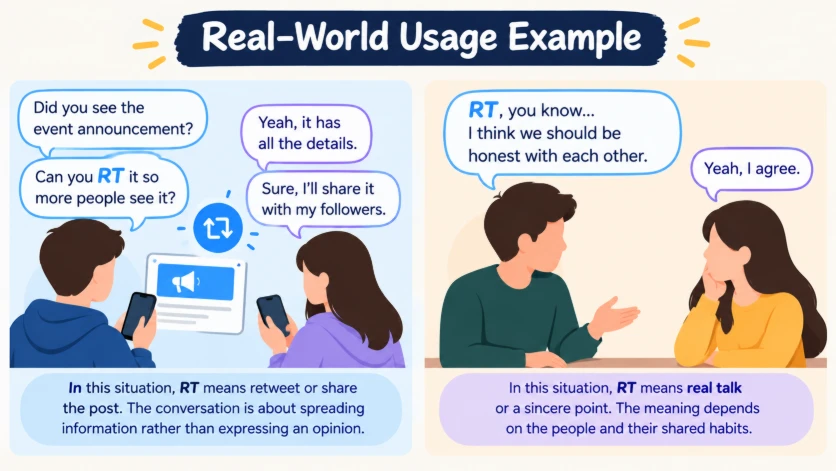
Imagine that a student finds an announcement about a school event on a social media account. The announcement contains the date, time, and location, and the student wants classmates to see it.
The student messages a friend:
Student A: “Did you see the event announcement?”
Student B: “Yeah, it has all the details.”
Student A: “Can you RT it so more people see it?”
Student B: “Sure, I’ll share it with my followers.”
In this situation, RT clearly means retweet or share the post. The conversation is about spreading information rather than expressing an opinion.
Now imagine a different situation. Two friends are discussing the importance of being honest with each other. One writes “real talk” to introduce a serious point.
In that second conversation, the phrase communicates sincerity rather than a request to share content. If someone shortened it to RT, the other person might understand, but the meaning would depend on their shared habits.
These examples show why the topic of a message matters more than the abbreviation alone.
Common Mistakes When Understanding RT
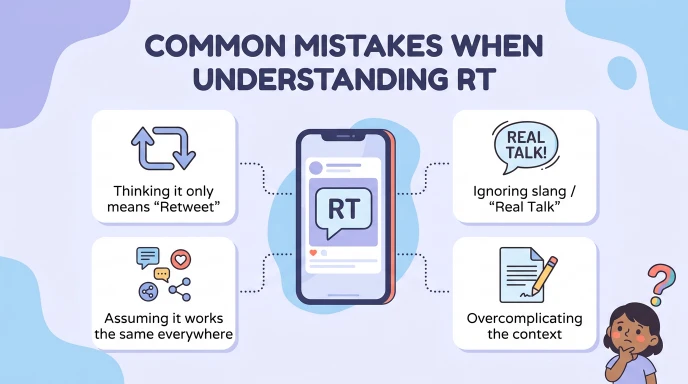
Even a short abbreviation can cause confusion when people assume it has only one meaning.
Here are some common mistakes to avoid.
1. Assuming RT Always Means Retweet
Retweet is the most established social media interpretation, but people may use the letters differently in private messages.
Read the surrounding sentence before deciding what the sender means.
2. Assuming RT Always Means Real Talk
“Real talk” is a possible interpretation in some informal contexts, but it is not the universal meaning of RT.
If the message involves sharing a post, retweet is a more likely interpretation.
3. Treating RT as an Official Feature on Every Platform
RT is strongly associated with Twitter and X. Other platforms have their own sharing and reposting features, and users may use RT informally when discussing them.
Do not assume every platform uses the abbreviation as an official button or feature name.
4. Using RT in Formal Writing
Abbreviations are useful in casual conversations, but they can make professional or academic writing less clear.
When writing to a teacher, manager, or client, use a complete phrase unless the abbreviation is already understood by everyone involved.
5. Assuming Someone Is Being Rude
A short reply can seem abrupt, but RT is not inherently insulting. Consider the relationship, topic, and tone before interpreting the message negatively.
If necessary, ask the person what they meant.
Frequently Asked Questions
What does RT mean in text messages?
RT can mean “retweet,” especially when a conversation involves sharing social media posts. In some informal chats, people may use it to mean “real talk” or another context-specific expression.
What does RT mean on TikTok?
On TikTok, RT may refer to sharing or reposting content, or it may be used as informal shorthand in comments. Its exact meaning depends on the video and conversation.
Is RT slang?
RT is an abbreviation or initialism commonly associated with internet culture. It can function as informal shorthand, but its meaning depends on the context in which it appears.
Is RT rude or offensive?
No, RT is not generally rude or offensive by itself. However, a very short response can sometimes seem dismissive, depending on the conversation.
How should you reply to RT?
If someone means retweet, you can reply, “Sure, I’ll share it.” If you are unsure what they mean, ask, “Do you mean retweet?” or “What does RT mean here?”
Conclusion
RT is an abbreviation most strongly associated with “retweet,” the act of sharing someone else’s post on Twitter or X. In some informal conversations, people may also use it to mean “real talk,” although this interpretation is less standardized.
You may encounter RT on TikTok, Instagram, Snapchat, WhatsApp, and in ordinary text messages. The intended meaning depends on the platform, the surrounding words, and the topic being discussed.
It is generally safe to use in casual conversations, but it may be unclear in formal writing or when talking to someone unfamiliar with internet abbreviations. When in doubt, use the complete phrase or ask the sender to clarify.
Understanding the context is the easiest way to interpret RT correctly and avoid unnecessary confusion.
READ MORE!
- FOH Meaning in Text: Definition, Examples, and Slang Usage
- ISTG Meaning in Text: Definition, Examples & Uses
- Ops Meaning Slang: Meaning in Text, Examples, and Usage

Hi, I’m Ryan Holden, a content writer with over 8 years of experience creating clear, engaging, and easy-to-understand content. I specialize in slang meanings, internet language, text abbreviations, and modern English expressions. My goal is to explain complex words in simple English with real-life examples so readers can quickly understand and use them correctly. I enjoy researching how language changes across social media, online communities, and everyday conversations, ensuring every article is accurate, helpful, and easy to read.