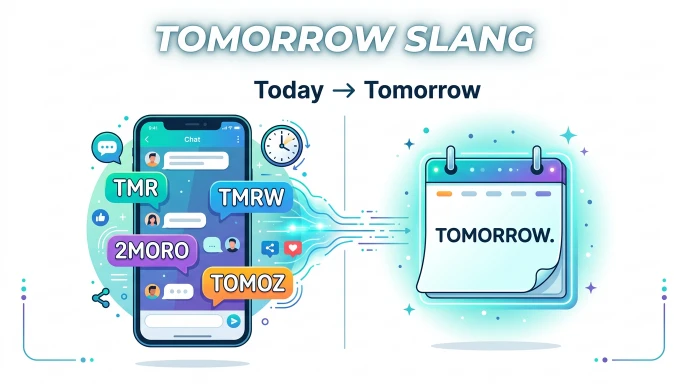
Tomorrow slang can be confusing because people often shorten the word when texting, chatting, gaming, or posting online.
Instead of typing the full word “tomorrow,” people may use forms such as “tmr,” “tmrw,” “tmrw,” “2moro,” or “2mrw.” These shortcuts are usually informal rather than true slang words with a separate meaning. Their main purpose is to make messages faster, shorter, and more casual.
This guide explains common ways to write tomorrow in texts, their meanings, uses, and the best forms for different situations. You will also see examples, comparisons, common mistakes, and common questions about tomorrow slang.
Quick Answer:
Tomorrow slang usually means shortened or informal ways to write “tomorrow,” such as tmr, tmrw, 2moro, or 2mrw. These forms are mostly used in casual texts and online chats.
What Does Tomorrow Slang Mean in Text?
In texting, tomorrow slang usually refers to shortened spellings of the word tomorrow.
The most common examples include:
- tmr tomorrow
- tmrw tomorrow
- tmrw another shortened form of tomorrow
- 2moro tomorrow
- 2mrw tomorrow
These forms normally have the same basic meaning as the full word. There is usually no hidden or offensive meaning.
For example:
“See you tmr!”
simply means:
“See you tomorrow!”
The main difference is style. The shortened version feels quicker and more casual.
Is “Tomorrow” Itself Slang?
No. Tomorrow is a standard English word, not slang.
The word refers to the day after today. However, people often shorten it when communicating online.
This matters because “tomorrow slang meaning” can refer to the word or its texting shortcuts.
For example:
- Tomorrow = standard English
- Tmr = texting abbreviation
- Tmrw = informal texting shortcut
- 2moro = phonetic/texting spelling
So, if someone asks for the tomorrow slang full form, the answer is usually simply tomorrow.
Common Tomorrow Slang and Texting Shortcuts
Different people use
| Slang or Shortcut | Meaning | Common Use |
| tmr | Tomorrow | Texting and casual chats |
| tmrw | Tomorrow | Texting and social media |
| tmrw | Tomorrow | Informal online messages |
| 2moro | Tomorrow | Casual texting |
| 2mrw | Tomorrow | Informal texts |
| tomoz | Tomorrow | Casual or regional usage |
| tom | Tomorrow | Very informal shorthand in some chats |
different forms, and there is no single official abbreviation.
Not every form is equally common. Tmr and tmrw are common, while 2moro may feel more playful or old-fashioned.
What Does “TMR” Mean?
TMR commonly means “tomorrow” in texts and online conversations.
For example:
“Are you free tmr?”
This means:
“Are you free tomorrow?”
TMR is short, easy to type, and usually understood from context.
It is most suitable for casual communication, such as texting a friend or chatting with someone online.
You would normally avoid it in a formal email, school assignment, business report, or professional document.
What Does “TMRW” Mean?
TMRW is another common texting shortcut for tomorrow.
Example:
“I’ll send it tmrw.”
Meaning:
“I’ll send it tomorrow.”
The letters remove the vowels and shorten the word while keeping it recognizable.
TMRW can appear in:
- Text messages
- Group chats
- Social media comments
- Direct messages
- Gaming chats
- Casual online conversations
It is informal but generally easy to understand.
What Does “2MORO” Mean?
2MORO is a phonetic texting form of tomorrow.
The number 2 represents the sound of “to,” while “moro” represents the remaining sound.
Example:
“See u 2moro.”
This means:
“See you tomorrow.”
This style became popular with older forms of text messaging where people often tried to save typing space.
Today, it may still appear in casual messages, but tmr and tmrw are often simpler and more natural in modern online communication.
What Does “2MRW” Mean?
2MRW is another informal way to write tomorrow.
Example:
“Game 2mrw?”
This means:
“Game tomorrow?”
It is short and casual, but not everyone uses it.
If someone does not know texting shortcuts, writing tomorrow is clearer.
What Does “TOMOZ” Mean?
Tomoz is a casual way to write tomorrow, often used in informal English.
For example:
“Catch you tomoz.”
The meaning is:
“See you tomorrow.”
Unlike tmr, which is mainly a written shortcut, “tomoz” can also reflect the way some people casually pronounce or spell the word.
Its use can vary by region and social group, so it should not be treated as a universal abbreviation.
Is Tomorrow Slang Rude or Offensive?
No. Tomorrow slang is generally neutral and harmless.
Short forms such as tmr and tmrw are simply informal ways to communicate.
They are not normally rude or offensive.
However, using texting shortcuts in the wrong setting can make a message look too casual.
For example:
“I will submit the report tmr.”
This may look unprofessional in a formal workplace email.
A better version would be:
“I will submit the report tomorrow.”
The issue is not that “tmr” is offensive. It is simply less formal.
Where Is Tomorrow Slang Commonly Used?
These shortcuts are mainly used in informal digital communication.
You may see them in:
- Text messages
- Instagram DMs
- Snapchat
- TikTok comments
- Discord chats
- Gaming messages
- Reddit discussions
- Group chats
- Casual emails
- Online communities
The exact form depends on the person and platform.
For example, a gamer might write:
“Ranked tmr?”
A friend might say:
“See u tmr!”
Someone on social media might post:
“Big day tmr 😭”
All three use a shortened form to mean tomorrow.
Why Do People Use Tomorrow Slang?
The biggest reason is speed.
Typing tmr takes less time than typing tomorrow. In a fast conversation, small shortcuts can make messages easier to type.
People also use these forms because they feel:
- Casual
- Friendly
- Relaxed
- Informal
- Natural in texting
- Common in online communities
Another reason is habit. People who regularly text may automatically use shortcuts without thinking about them.
The meaning usually stays exactly the same.
Real-Life Examples of Tomorrow Slang
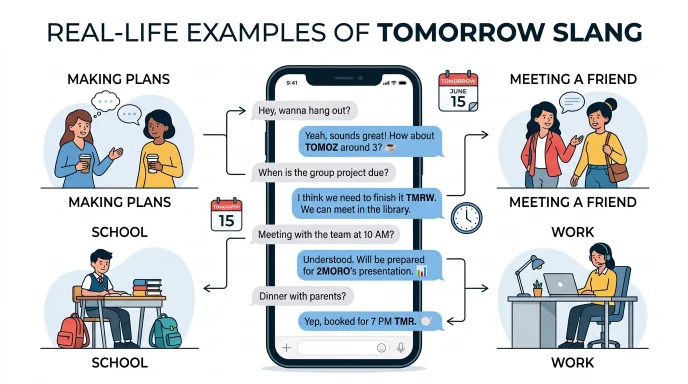
Friendly Example
“See you tmr!”
This is a simple and friendly way to say goodbye.
Casual Example
“What are you doing tmr?”
The speaker is simply asking about the other person’s plans for tomorrow.
Social Media Example
“New video dropping tmr!”
This tells followers that a new video will be posted the next day.
Gaming Example
“You playing tmr?”
This could mean:
“Are you playing tomorrow?”
The exact game does not matter. The shortcut simply saves typing time.
Group Chat Example
“Meeting tmr at 10?”
This is a quick way to ask if the group has a meeting tomorrow at 10.
Friendly Reminder
“Don’t forget tmr!”
The person is reminding someone about something happening the next day.
Informal Planning
“Let’s go tmr instead.”
This means:
“Let’s go tomorrow instead.”
Casual Social Post
“Exam tmr 😭”
The person is saying that they have an exam tomorrow. The emoji adds emotion but does not change the meaning of “tmr.”
Tomorrow Slang in Different Tones
The meaning normally stays the same, but the tone can change depending on the message.
Friendly:
“See you tmr 😊”
Excited:
“Concert tmr!!!”
Worried:
“Big test tmr 😭”
Casual:
“You free tmr?”
Gaming:
“Tournament tmr?”
Professional but informal:
“Can we finish this tmr?”
The surrounding words and punctuation often tell you more about the speaker’s mood than the abbreviation itself.
Tomorrow Slang vs. Standard English
The biggest difference is formality, not meaning.
| Form | Meaning | Style |
| Tomorrow | The next day | Standard |
| Tmr | Tomorrow | Very casual |
| Tmrw | Tomorrow | Casual |
| Tmrw | Tomorrow | Casual |
| 2moro | Tomorrow | Casual/playful |
| 2mrw | Tomorrow | Casual |
| Tomoz | Tomorrow | Informal/regional |
If you are talking with friends, these shortcuts are usually fine.
If you are writing something important or formal, use tomorrow.
Is “TMR” Always Short for Tomorrow?
Not necessarily.
Abbreviations can have different meanings in different contexts. However, in ordinary texting, TMR commonly means tomorrow.
For example:
“See you tmr.”
There is very little confusion because the context clearly relates to time.
If you see TMR in a special context, check the message to understand its meaning.
Context is always important with abbreviations.
When Should You Use Tomorrow Slang?
Use shortcuts such as tmr or tmrw when the conversation is casual.
They work well when:
- Talking to friends
- Messaging family
- Chatting in a gaming group
- Posting casually online
- Sending quick reminders
- Talking in group chats
For example:
“I’ll call you tmr.”
This sounds natural in a casual text.
When Should You Avoid Tomorrow Slang?
Avoid texting shortcuts when the message needs to sound professional or formal.
This includes:
- Job applications
- Business emails
- School assignments
- Academic writing
- Official notices
- Professional reports
- Formal customer communication
Instead of:
“I’ll send it tmr.”
Write:
“I’ll send it tomorrow.”
The full word is clearer and more professional.
Is Tomorrow Slang Safe for Social Media?
Yes. Common shortcuts such as tmr and tmrw are generally harmless.
They do not normally contain offensive or inappropriate meanings.
People use them on Instagram, Snapchat, TikTok, Discord, and Reddit to keep messages short.
Still, remember that social media has different audiences. If your post is aimed at a professional audience, standard English may be a better choice.
Origin and Background of Tomorrow Texting Shortcuts
Shortened forms of words became especially popular with texting and online communication.
Early mobile texting encouraged people to use shorter forms because typing on phone keypads could be slow. As online chatting became more common, many abbreviations became part of everyday digital language.
Forms such as 2moro use numbers and letters to represent sounds. Other forms, such as tmr and tmrw, remove unnecessary letters while keeping enough of the original word to make the meaning clear.
Modern smartphones have made typing easier, but these shortcuts remain because they have become part of casual digital communication.
Why Can Tomorrow Slang Be Confusing?
The main problem is that there is no official universal spelling for texting slang.
One person may write:
“tmr”
Another may write:
“tmrw”
Someone else may use:
“2moro”
They can all mean the same thing.
This is why beginners sometimes wonder if each form has a different meaning.
Usually, it does not.
The context tells you what the writer means.
Common Mistakes With Tomorrow Slang
Mistake 1: Thinking Every Shortcut Is a Different Word
Most forms simply mean tomorrow.
Fix: Check the context before assuming there is a special meaning.
Mistake 2: Using Text Slang in Formal Writing
“Tmr” may look too casual in a professional email.
Fix: Write the full word tomorrow when formality matters.
Mistake 3: Assuming Everyone Understands Every Shortcut
Not all readers know every texting abbreviation.
Fix: Use the full word if your audience may be unfamiliar with slang.
Mistake 4: Treating “Tomorrow” as Slang
The word tomorrow itself is standard English.
Fix: Distinguish the normal word from its texting shortcuts.
Mistake 5: Assuming TMR Has Only One Meaning
TMR usually means tomorrow, but it can have other meanings in some contexts.
Fix: Always look at the surrounding conversation.
Polite Alternatives to Tomorrow Slang
If you want to sound clear and polite, simply use the full word:
- Tomorrow
- The next day
- Tomorrow morning
- Tomorrow afternoon
- Tomorrow evening
For example:
Casual:
“See you tmr!”
Clear and neutral:
“See you tomorrow!”
Professional:
“I look forward to speaking with you tomorrow.”
The best choice depends on your audience.
What Is the Difference Between “TMR” and “TMRW”?
Both usually mean tomorrow.
The difference is mainly spelling and personal preference.
TMR is shorter and quicker.
TMRW keeps more of the original word, so some people may find it easier to recognize.
Neither has a special meaning that makes it different from the other in normal texting.
What Is the Difference Between “2MORO” and “2MRW”?
Both are informal ways of writing tomorrow.
2MORO is more phonetic because it uses “2” for “to.”
2MRW combines a number with shortened letters.
Both can be understood from context, but their popularity may vary between age groups and online communities.
Tomorrow Slang in Modern Online Communication
Digital communication continues to change how people write.
TikTok, Instagram, Snapchat, Discord, and Reddit often use short, quick messages. As a result, abbreviations remain common even though modern phones can easily handle longer words.
However, not every shortcut is equally popular everywhere.
One group may use tmr, while another may prefer simply writing tomorrow. Online language changes quickly, so popularity can shift over time.
The safest approach is to understand the meaning without assuming that every form is universal slang.
FAQs
What does “tmr” mean in text?
Tmr usually means tomorrow in casual texting and online chats.
What does “tmrw” mean?
Tmrw is an informal abbreviation for tomorrow.
Is “tomorrow” a slang word?
No. Tomorrow is a standard English word. Short forms such as tmr and tmrw are informal texting shortcuts.
What does “2moro” mean in texting?
2moro is a playful texting form of tomorrow.
Is TMR rude?
No. TMR is normally neutral and simply means tomorrow. It can seem too casual in formal writing, but it is not normally rude.
Can I use TMR in a professional email?
It is better to write tomorrow in professional emails. The full word is clearer and more appropriate.
What does “tomoz” mean?
Tomoz is a casual way to write tomorrow, often used in informal English.
Are TMR and TMRW the same?
Yes. In normal texting, both usually mean tomorrow.
Conclusion
Tomorrow slang mainly refers to informal shortcuts people use when they mean tomorrow. Common examples include tmr, tmrw, 2moro, 2mrw, and tomoz. These forms generally do not create a new meaning. They simply make messages shorter, faster, or more casual.
The most important thing to remember is that tomorrow itself is not slang. It is a normal English word. The slang or texting element comes from shortened forms used in casual digital communication.
You may see these shortcuts in texts, group chats, gaming chats, Instagram, Snapchat, TikTok, and Discord. Their popularity can vary, so context is important.
For casual conversations, tmr or tmrw can be perfectly understandable. For school, work, business, or formal communication, writing tomorrow is the safer choice.
In short, when you see tmr, tmrw, or 2moro in a casual message, the writer most likely means tomorrow. The meaning is simple; the spelling is just more informal.
Read more about!
- Bip Meaning Slang: What Does “Bip” Mean in Text?
- Bomb Meaning Slang: What Does “Bomb” Mean in Text?
- Rat Meaning Slang: What Does “Rat” Mean?

Hi, I’m Zunaira Shafiq, a slang writer and language enthusiast. I enjoy exploring modern slang, internet expressions, texting abbreviations, and social media terms, then explaining them in simple, easy-to-understand English. My goal is to help readers understand the meaning, origin, and correct usage of popular slang words through clear definitions and real-life examples. I love making online language easier for students, language learners, and anyone who wants to stay updated with modern communication.