Ops meaning slang is a phrase people often search for after seeing “ops” in a text message, social media comment, or online conversation. The word can have different meanings depending on the situation, the people talking, and the topic being discussed.
In slang, “ops” often means “opponents” or “opposition,” referring to rivals, enemies, or people someone has a problem with. However, it can also be shorthand for “operations” in gaming, work, and other online discussions.
You might come across this term in rap lyrics, TikTok videos, Instagram captions, Snapchat messages, or gaming chats. Understanding the context is important because a sentence about “the ops” can sound serious, playful, or simply humorous.
In this guide, you will learn the different meanings of ops, how people use it in conversations, where it comes from, and how to understand it without confusing it with similar slang terms.
Quick Answer:
In slang, “ops” usually means opponents, rivals, or enemies. In other contexts, it can mean “operations,” so the surrounding conversation helps determine its intended meaning.
What Does Ops Mean in Text?
The slang term “ops” most commonly refers to opponents, enemies, or people viewed as rivals. It is especially common in hip-hop culture, street slang, and online conversations where people discuss conflict, competition, or rivalry.
The meaning can change depending on how it is used. For example, someone might say “watch out for the ops” when talking about rivals, while a gamer might use “ops” to refer to operations or missions.
Here are the main meanings:
- Opponents or enemies: People someone considers rivals or adversaries.
- Rival groups: A group of people seen as being against another person or group.
- Operations: Tasks, missions, or organized activities, particularly in gaming and work-related discussions.
- Other context-specific meanings: In some communities, the abbreviation may have a different meaning based on local habits or the topic being discussed.
The most important clue is the sentence surrounding the word. If someone says “the ops are here,” they may be talking about rivals. If someone says “let’s start the next ops mission,” they may mean an operation or task.
Ops Full Form and Definition
The slang full form of “ops” is often understood as “opposition” or “opponents,” and it is commonly associated with the word “opps.”
However, there is no single official full form that applies to every use. “Ops” is an informal expression, and its meaning depends on the context.
In everyday online conversations, you may see these variations:
| Term | Common meaning | Typical context |
| Ops | Opponents or rivals | Social media, rap, casual slang |
| Opps | Opponents, enemies, or rivals | Hip-hop, street slang, texting |
| Op | One opponent or rival, depending on context | Informal conversation |
| Ops | Operations | Gaming, business, technology |
One important distinction is that “ops” and “opps” are not always interchangeable in every community. “Opps” is a particularly recognizable spelling for rivals or enemies in contemporary slang, while “ops” can also refer to operations.
For example, “I don’t trust the opps” usually expresses distrust toward rivals. On the other hand, “IT ops” commonly refers to information technology operations.
Is Ops Rude, Offensive, or Neutral?
The word “ops” is informal, but it is not automatically rude or offensive. Its tone depends on what the speaker means and how the word is used.
When it refers to rivals or enemies, it can sound confrontational. In a friendly conversation, it may simply be a joke between friends who pretend to be competing against each other.
When Ops Is Used Casually
Friends might use the term humorously while talking about a game, a sports rivalry, or a harmless disagreement.
Example:
Friend A: “You joined the other team? You’re with the ops now!”
Friend B: “It’s just a game. Relax!”
Here, the term is playful because the speakers are joking about opposing teams.
When Ops Sounds Aggressive
The word can have a more serious meaning when someone uses it to describe real-world enemies or an ongoing conflict.
Example:
“Stay away from those people. They’re the ops.”
In this sentence, the speaker describes certain people as rivals or threats. The exact seriousness depends on the situation and the relationship between the people involved.
Is Ops a Bad Word?
No. “Ops” is not a swear word by itself. However, calling someone an enemy or rival can create tension, especially if the conversation already involves a disagreement.
It is best to understand the tone before assuming that the person is joking or being hostile.
Where Is Ops Commonly Used?
The term appears in several online and offline settings, although its meaning may vary from one community to another.
1. TikTok
On TikTok, “ops” or “opps” may appear in captions, short videos, jokes, reaction clips, and discussions influenced by hip-hop or street slang.
For example:
“POV: The ops see you winning.”
This caption presents rivals as people who might dislike someone’s success. It may be a joke, a dramatic setup, or a reference to an actual rivalry.
2. Instagram
Instagram users may include the term in Stories, Reels captions, comments, or direct messages.
Example:
“Working on myself while the ops keep watching.”
This suggests that the speaker believes rivals are paying attention to what they do. Depending on the post, the statement could be serious or simply intended to sound confident.
3. Snapchat and Text Messages
In private messages, the term is often short and informal. Friends may use it while discussing social groups, arguments, school rivalries, or online jokes.
Example:
Person A: “Why are you sitting with them?”
Person B: “They’re not the ops. We’re cool now.”
The second person explains that the people being discussed are no longer considered rivals.
4. Rap and Hip-Hop Culture
The term is strongly associated with some hip-hop lyrics and street-influenced language. In this context, “the opps” generally refers to rivals, enemies, or opposing groups.
However, the meaning is not identical in every song or community. Some artists use it to describe serious conflict, while others use it as part of a competitive image or playful wordplay.
5. Gaming and Online Communities
In gaming, “ops” can mean different things depending on the game.
It may refer to opposing players or teams in an informal conversation. In other cases, it means operations, missions, or a set of organized tasks.
Example:
“We need to finish the ops before the event ends.”
Here, “ops” likely means operations or missions rather than enemies.
6. Reddit and Discord
On Reddit and Discord, the intended meaning usually depends on the discussion.
The meaning of “ops” depends on the context. In music and online slang, it can refer to rivals or enemies. In technology, it may mean operations, while in gaming, it can describe opponents or specific missions.
Always consider the topic before deciding what the abbreviation means.
Real-Life Examples of Ops in Different Situations
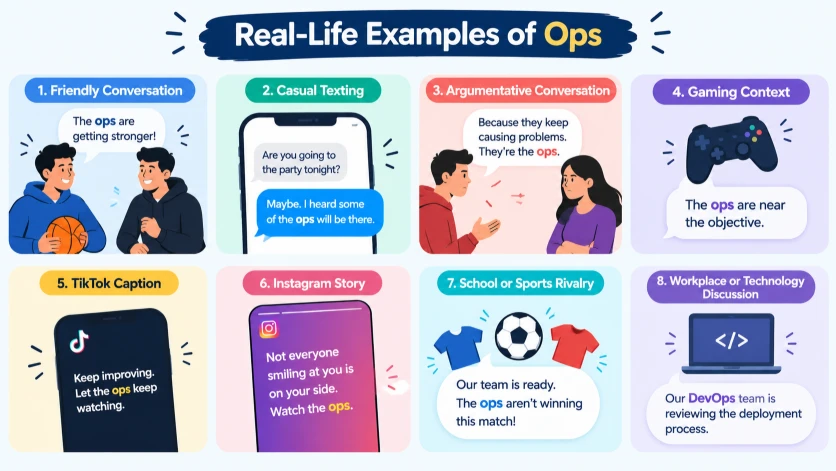
Examples make it easier to understand how the term works in everyday communication. The following sentences illustrate common contexts; they are original examples rather than quotations from specific social media posts.
1. Friendly Conversation
In a friendly conversation, “ops” may be used as a joke between people who are competing or teasing each other.
Example:
Friend A: “You beat me in basketball again.”
Friend B: “The ops are getting stronger!”
Meaning: The speaker jokingly describes the other player or opposing team as rivals.
2. Casual Texting
In casual texting, the word may refer to people the speaker does not trust or get along with.
Example:
Person A: “Are you going to the party tonight?”
Person B: “Maybe. I heard some of the ops will be there.”
Meaning: The person is referring to people they consider rivals or enemies.
3. Argumentative Conversation
In an argument, the term may sound more serious because it labels another person or group as an opponent.
Example:
Person A: “Why do you keep talking about them?”
Person B: “Because they keep causing problems. They’re the ops.”
Meaning: The speaker considers the people being discussed to be rivals or a source of conflict.
4. Gaming Context
Gamers may use “ops” to describe opponents or refer to operations and missions.
Example:
Player A: “Where is the other team?”
Player B: “The ops are near the objective.”
Meaning: The speaker is referring to opposing players or enemies in the game.
Another example:
“We have two more ops to complete tonight.”
Meaning: Here, “ops” likely means operations or missions.
5. TikTok Caption
Example:
“Keep improving. Let the ops keep watching.”
Meaning: The caption suggests that rivals are observing the speaker’s progress. It may be motivational, humorous, or deliberately dramatic.
6. Instagram Story
Example:
“Not everyone smiling at you is on your side. Watch the ops.”
Meaning: The speaker is warning about people they perceive as rivals or untrustworthy individuals.
This wording can sound suspicious or confrontational, so its tone depends on the situation.
7. School or Sports Rivalry
Example:
“Our team is ready. The ops aren’t winning this match!”
Meaning: The speaker jokingly or competitively refers to the opposing team as rivals.
In this context, the term is not necessarily connected to serious conflict.
8. Workplace or Technology Discussion
Example:
“Our DevOps team is reviewing the deployment process.”
Meaning: In this technical context, “Ops” is related to operations, not enemies.
This example highlights why context matters when interpreting abbreviations.
Origin and Background of Ops Slang
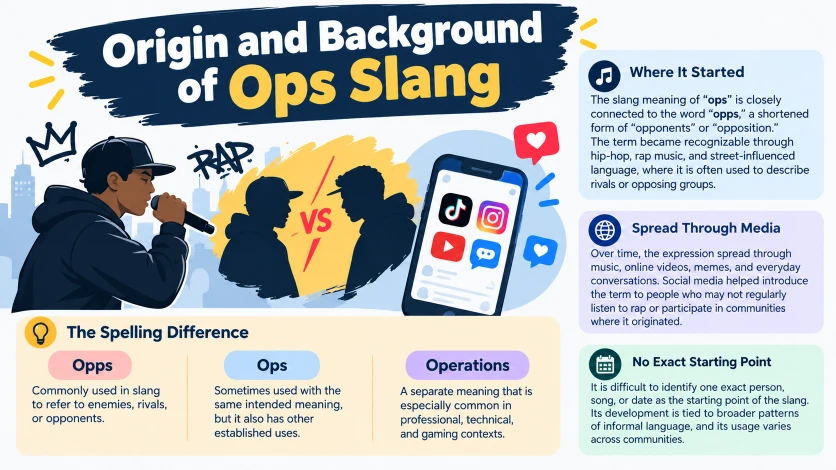
The slang meaning of “ops” is closely connected to the word “opps,” a shortened form associated with “opponents” or “opposition.” The term became recognizable through hip-hop, rap music, and street-influenced language, where it is often used to describe rivals or opposing groups.
Over time, the expression spread through music, online videos, memes, and everyday conversations. Social media helped introduce the term to people who may not regularly listen to rap or participate in communities where it originated.
However, it is difficult to identify one exact person, song, or date as the starting point of the slang. Its development is tied to broader patterns of informal language, and its usage varies across communities.
The spelling difference is also worth understanding:
- Opps: Commonly used in slang to refer to enemies, rivals, or opponents.
- Ops: Sometimes used with the same intended meaning, but it also has other established uses.
- Operations: A separate meaning that is especially common in professional, technical, and gaming contexts.
Not every person who uses “ops” intends to communicate hostility. Some people borrow the term from memes, music, or jokes without using it to describe an actual conflict.
Ops vs. Similar Slang Terms
Several informal words can describe rivals, opponents, or people someone does not trust. Although they overlap, they are not always used in the same way.
| Slang term | Meaning | How it differs from ops |
| Opps | Rivals, enemies, or opponents | Often the closest spelling and meaning to slang “ops.” |
| Enemies | People who oppose someone | More direct and widely understood. |
| Haters | People who criticize or dislike someone | Focuses on negative attitudes or criticism. |
| Rivals | People competing against one another | Can describe friendly or serious competition. |
| Beef | A disagreement or conflict | Describes the conflict itself rather than the people involved. |
| Ops (operations) | Tasks, missions, or organized activities | A different meaning used in work, technology, and gaming. |
What Is the Difference Between Ops and Opps?
“Ops” and “opps” can refer to the same thing when someone is using them to mean rivals or enemies. However, “opps” is a more recognizable spelling for this particular slang meaning.
For example:
- “The opps are talking about us.”
- “The ops are talking about us.”
Both sentences may mean that rivals are talking about the speaker or their group.
By contrast, in a phrase such as “network operations,” the word “ops” has nothing to do with enemies.
When Should You Avoid Using Ops?
Although “ops” is informal slang rather than a swear word, it is not appropriate for every situation.
Consider avoiding it in the following circumstances:
- Formal writing: Use clear words such as “opponents,” “competitors,” or “operations” in professional documents.
- Serious disagreements: Calling someone an enemy may make a disagreement worse.
- Unfamiliar audiences: People who do not know the slang may misunderstand what you mean.
- Professional communication: In emails, reports, or business meetings, spell out the intended meaning.
- Sensitive situations: Avoid using the term to label people as enemies when the situation could be misunderstood or taken seriously.
For example, writing “The ops are causing problems” in a workplace report is unclear. The reader may not know if you mean opposing people or an operations team.
A clearer version would be:
“The competing team is causing delays.”
Or, if you mean the operations department:
“The operations team is investigating the delays.”
Choosing precise language makes communication easier and reduces unnecessary confusion.
Polite Alternatives to Ops
If you want to communicate the same general idea without using slang, several alternatives may work better.
The best choice depends on if you mean rivals, people you distrust, or organized tasks.
| Instead of saying | You can say |
| “The ops are here.” | “Our rivals are here.” |
| “I don’t trust the ops.” | “I don’t fully trust those people.” |
| “The ops lost again.” | “The opposing team lost again.” |
| “Watch out for the ops.” | “Be careful around those people.” |
| “Let’s start the ops.” | “Let’s start the operations or missions.” |
These alternatives are more specific and easier for people outside slang-speaking communities to understand.
You do not need to avoid informal language altogether. Simply choose words that fit your audience and the situation.
Why Do People Use Ops Slang?
People use slang because it can make conversations feel shorter, more expressive, and more connected to a particular community.
There are several reasons someone might use “ops” instead of a more formal word.
1. To Communicate Quickly
Short expressions are convenient in text messages and online chats. Instead of explaining a rivalry in detail, someone may use “ops” when the other person already understands the situation.
2. To Express a Strong Attitude
The word can communicate distrust, frustration, competition, or a sense of opposition. Its tone may sound more dramatic than simply saying “rivals.”
3. To Participate in Online Culture
People often learn slang through music, memes, video captions, gaming communities, and conversations with friends. Using familiar terms can make their messages feel more natural within those groups.
4. To Make a Joke
The term is sometimes used humorously for harmless situations, such as competing with friends in a game or teasing someone about supporting another sports team.
5. To Show Group Identity
Certain expressions are associated with particular communities, interests, or styles of communication. Using them can signal familiarity with those environments, although it does not necessarily mean someone belongs to a particular group.
What Is the Impact of Using Ops in Communication?
Slang can make communication more expressive, but it can also create misunderstandings.
Positive effects:
- It can make casual conversations feel natural.
- It can communicate an idea quickly when everyone understands the term.
- It can add humor or personality to a message.
- It can help people recognize shared internet or music culture.
Possible drawbacks:
- Some readers may not know what the word means.
- The term can sound hostile when used to describe real people.
- Different interpretations can lead to confusion.
- A joke may be misunderstood as a serious accusation.
For example, a friend might call another team “the ops” during a friendly match. Someone unfamiliar with the joke could interpret the statement as a genuine expression of hostility.
The best approach is to consider your audience, the topic, and the tone before using slang.
Is Ops Safe to Use on Social Media?
Generally, yes. The word “ops” is not inherently harmful or inappropriate for social media. People can use it in captions, comments, messages, and videos to discuss rivals, competition, or operations.
However, the surrounding message matters more than the word alone.
A harmless sports caption such as “The ops lost the match again” is different from a message that targets a real person or encourages others to harass them.
When using the term online:
- Keep jokes respectful and avoid targeting people unfairly.
- Do not assume someone is threatening you simply because they use the word.
- Consider if your audience will understand the intended meaning.
- Avoid escalating personal disagreements through hostile captions or comments.
- Remember that slang can have different meanings across communities.
If someone sends you a message containing “ops,” read the whole sentence before deciding if it is a joke, a reference to rivals, or a completely different use of the abbreviation.
Frequently Asked Questions
What Does OPS Mean in Gen Z Slang?
In Gen Z slang, OPS usually refers to rivals, enemies, or people someone has a conflict with. For example, “Stay away from the ops” means avoiding people who may cause trouble.
What Does OPS Stand for in Texting?
In texting, OPS may be used as a variation of “opps,” meaning opponents or rivals. However, in other contexts, “ops” can be short for “operations.”
What Does OPS Mean in UK Slang?
In UK slang, ops can refer to rivals or enemies, particularly in street culture and music. Its meaning depends on the conversation and the people using it.
What Does OPPS Mean in Gen Z Slang?
In Gen Z slang, opps is short for “oppositions” and refers to enemies, rivals, or people someone has a disagreement with. For example, “The opps are here” means that rivals or enemies have arrived.
What Does OPS Mean?
OPS has several meanings depending on the context. In slang, it may refer to rivals or enemies. In workplaces and technology, it commonly means “operations.” It can also have other meanings in gaming and specific online communities.
What Is OPS in the Hood?
In street slang, ops usually refers to rival individuals or groups considered opponents or enemies. The term is common in some rap lyrics and street-culture conversations. Its meaning can vary depending on the location and context.
Conclusion
Understanding ops meaning slang is easier when you pay attention to the surrounding conversation. The term most commonly refers to opponents, rivals, or enemies, especially in slang influenced by hip-hop culture and social media. However, it can also mean “operations” in gaming, technology, and professional settings.
Although “ops” is informal and not inherently offensive, its tone can range from playful to confrontational. A joke between friends may have a completely different meaning from a serious statement about real-world rivals.
When you see “ops” in a text message, TikTok caption, Instagram post, or gaming chat, look at the topic and the speaker’s intention before interpreting it. Context is the key to understanding the correct meaning and using the term appropriately.
READ MORE!
- PS Mean in Text: Meaning & Examples
- Meaning of OT Slang: Explained With Examples
- RCS Mean in Text Message: Meaning, Uses & Examples

Hi, I’m Zunaira Shafiq, a slang writer and language enthusiast. I enjoy exploring modern slang, internet expressions, texting abbreviations, and social media terms, then explaining them in simple, easy-to-understand English. My goal is to help readers understand the meaning, origin, and correct usage of popular slang words through clear definitions and real-life examples. I love making online language easier for students, language learners, and anyone who wants to stay updated with modern communication.