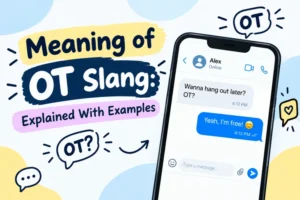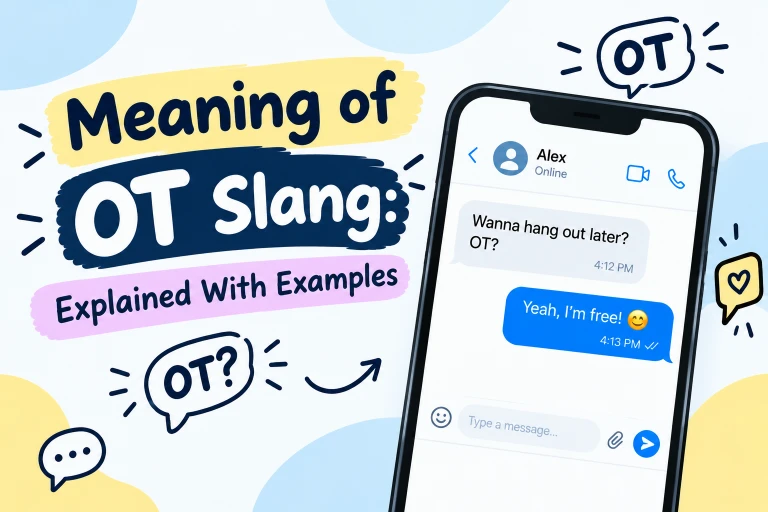
Meaning of ot slang can be confusing because the two letters OT have more than one meaning. In online chats, forums, and texting, OT often means “off topic.” It tells someone that the next comment or question is not directly related to the current discussion. In work or sports conversations, OT commonly means “overtime.”
For example, someone might write, “OT, but did you watch the new movie?” Here, OT means “off topic.” In a work chat, “I have to work OT tonight” means the person has to work overtime.
So, the surrounding words matter. OT does not have one fixed meaning in every conversation. This guide explains the main meanings, examples, tone, origin, and common ways people use OT.
Quick Answer:
OT slang usually means “off topic” in online conversations, but it can also mean “overtime” in work or sports. The context tells you which meaning is intended.
What Does OT Mean in Text?
In text and online conversations, OT most commonly means “off topic.” People use it when they want to move away from the main subject for a moment.
For example:
“OT, have you seen Sarah lately?”
The person is saying:
“Off topic, have you seen Sarah lately?”
It can be a simple way to tell the other person that a new question is unrelated to the discussion.
OT is especially useful in group chats, forums, discussion boards, and online communities where staying on the main subject matters.
Quick Meaning
| OT Meaning | Where It Is Used | Example |
| Off Topic | Chats, forums, social media | “OT, did you see that movie?” |
| Overtime | Work and jobs | “I’m working OT tonight.” |
| Overtime | Sports | “The game went into OT.” |
| On Topic | Some online communities | “OT: back to the main question.” |
| Out of Town | Some casual conversations | “I’m OT this weekend.” |
The first two meanings are the most useful ones to recognize in everyday online and work-related communication. Other meanings can appear in specific communities, so context should always come first.
OT Full Form and Definition
The most common slang-style full form of OT is:
OT = Off Topic
When used this way, it means something is outside the subject currently being discussed.
Another very common full form is:
OT = Overtime
This meaning is different. It usually refers to extra working hours or extra time in a sports game.
For example:
- “OT, but I love your new profile picture.” → Off topic
- “I worked six hours of OT.” → Overtime
- “The basketball game went into OT.” → Overtime
This is why searching only for the letters OT may not be enough. You need to look at the words around it.
Is OT Slang or an Abbreviation?
OT is better described as an abbreviation or initialism than as a traditional slang word.
In online communication, however, people often call it slang because it is used as informal shorthand.
The “off topic” meaning has a long history in online forums and discussion groups. “OT” has been used to mark posts or comments that move away from the main subject.
So if someone asks, “What does OT stand for?”, the safest answer is:
It depends on the context, but “off topic” and “overtime” are two major meanings.
OT Meaning in Texting
When you see OT in a casual text, check what the person says immediately before or after it.
If someone writes:
“OT for a second, what are you doing this weekend?”
OT means off topic.
The person is letting you know that they are changing the subject.
Another example:
“Sorry, this is OT, but I need to ask you something.”
Again, it means off topic.
The abbreviation can make the message shorter without needing to write the full phrase.
OT Meaning in Work Chats
Work conversations often use OT to mean overtime.
For example:
“Can you work OT tomorrow?”
This means:
“Can you work overtime tomorrow?”
You may also see:
- OT hours
- OT pay
- working OT
- paid OT
- overtime OT
In this setting, interpreting OT as “off topic” would make no sense.
For example:
“I made 8 hours of OT this week.”
The person is clearly talking about extra work hours.
OT Meaning in Sports
OT is also common in sports.
Here, OT means overtime, which refers to extra playing time after a game is tied at the end of regulation, depending on the sport’s rules.
For example:
“The game went into OT.”
This means the game needed extra time to determine the winner.
You might see OT in conversations about football, basketball, hockey, and other sports where overtime is part of the rules.
This is another clear example of why context matters.
Is OT Rude, Offensive, or Neutral?
OT is normally neutral.
The abbreviation itself is not an insult and is not generally offensive.
When it means off topic, it can even help make a conversation clearer.
For example:
“OT, but can I ask you something?”
This is usually casual and harmless.
Still, tone depends on the complete message. If someone writes:
“You’re OT again. Stop.”
that could sound annoyed.
The problem is not the abbreviation itself. The attitude comes from the surrounding words.
Where Is OT Commonly Used?
OT can appear in many types of communication, but its meaning changes by setting.
| Place | Likely Meaning | Example |
| Texting | Off topic / context-dependent | “OT, quick question.” |
| Forums | Off topic | “This post is OT.” |
| Discord | Off topic / overtime | “OT, but check this out.” |
| Work chat | Overtime | “I’m doing OT tonight.” |
| Sports chat | Overtime | “They won in OT.” |
| Social media | Off topic or another context-specific meaning | “OT, but…” |
| Gaming | Usually context-dependent | “The match went to OT.” |
There is no need to assume that every person on a particular platform uses OT in exactly the same way.
The conversation gives you the best clue.
OT Meaning on Social Media
On social media, OT can mean “off topic” when someone wants to introduce a subject that does not match the current post or discussion. It has also appeared in online communities and message boards for many years.
For example:
“OT, but where did you get that jacket?”
The person is asking something unrelated to the main discussion.
You may also see:
“This might be OT, but…”
That is another natural way to signal a subject change.
On a platform where the conversation is about sports, however, OT may instead mean overtime.
OT Meaning on Discord
Discord is especially dependent on context because servers can have very different communities.
In a discussion channel, someone might write:
“OT for a moment, does anyone play Minecraft?”
Here, OT means off topic.
In a gaming conversation, someone might say:
“We won in OT!”
Here, OT means overtime.
The same two letters can therefore have completely different meanings in the same app.
OT Meaning in Gaming
Gaming is another setting where context is important.
If players are talking about a match that requires extra time, OT usually means overtime.
Example:
“We barely won in OT.”
But if someone is chatting about something unrelated to the game, they might use OT to mean off topic.
Example:
“OT, what headset are you using?”
The first example is about the game. The second changes the conversation.
Real-Life Examples of OT Slang
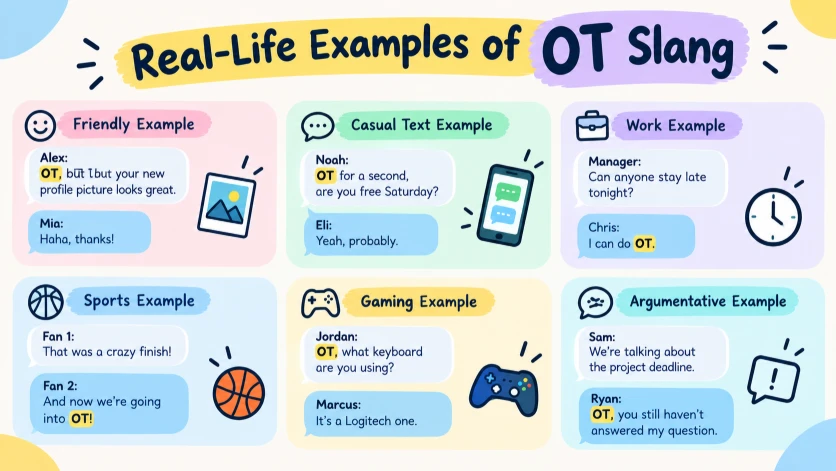
Friendly Example
Alex: “OT, but your new profile picture looks great.”
Mia: “Haha, thanks!”
Here, OT means off topic. The speaker briefly changes the subject in a friendly way.
Casual Text Example
Noah: “OT for a second, are you free Saturday?”
Eli: “Yeah, probably.”
The phrase shows that the person is moving away from the original topic.
Work Example
Manager: “Can anyone stay late tonight?”
Chris: “I can do OT.”
Here, OT means overtime.
Sports Example
Fan 1: “That was a crazy finish!”
Fan 2: “And now we’re going into OT!”
In this case, OT clearly means overtime.
Gaming Example
Jordan: “OT, what keyboard are you using?”
Marcus: “It’s a Logitech one.”
Here, OT means the question is unrelated to the current gaming discussion.
Argumentative Example
Sam: “We’re talking about the project deadline.”
Ryan: “OT, you still haven’t answered my question.”
This use can sound more direct because the speaker is trying to point out that the conversation has moved away from the main subject.
How to Know Which OT Meaning Someone Means
When you see OT, look for clues.
OT probably means “off topic” when:
- It appears at the beginning of a message.
- Someone writes “OT, but…”
- The person suddenly changes the subject.
- The discussion is happening in a forum or group.
- The message is unrelated to the previous topic.
OT probably means “overtime” when:
- The conversation is about work.
- Someone mentions hours or pay.
- A manager discusses shifts.
- People are talking about a sports game.
- The message mentions extra playing time.
A simple rule works well:
Look at the topic before deciding what OT means.
Comparison: OT vs OOT vs OOO
These abbreviations can sometimes confuse people.
| Abbreviation | Meaning | Common Context |
| OT | Off Topic / Overtime | Chats, work, sports |
| OOT | Out of Topic / other context-specific uses | Less common |
| OOO | Out of Office | Work and email |
| OTW | On the Way | Texting |
| OTT | Over the Top | Casual speech and social media |
Do not automatically replace one with another. Each abbreviation has its own meaning.
Why Do People Use OT?
The main reason is speed and convenience.
Typing two letters is faster than writing “off topic” or “overtime” every time.
In online discussions, OT can also warn readers that the conversation is about to move away from the main subject.
For example:
“OT: Has anyone tried the new restaurant?”
The reader immediately knows that the question is separate from the main discussion.
At work, OT is useful because “overtime” appears often in schedules, payroll discussions, and shift planning.
When Should You Avoid Using OT?
OT is fine in casual communication, but it may not be the clearest choice in formal writing.
Avoid unexplained OT in:
- Formal reports
- Academic assignments
- Official letters
- Important business documents
- Professional communication with people unfamiliar with the abbreviation
Instead of:
“I completed 10 hours of OT.”
a formal document could say:
“I completed 10 hours of overtime.”
Clear language is better when there is any chance of confusion.
Polite Alternatives to OT
If you mean off topic, you can write:
- “This is a little unrelated, but…”
- “On a separate note…”
- “Changing the subject for a moment…”
- “This is not directly related, but…”
If you mean overtime, simply write:
- “overtime”
- “extra hours”
- “additional work hours”
These alternatives are especially useful in formal or professional settings.
Common Mistakes With OT
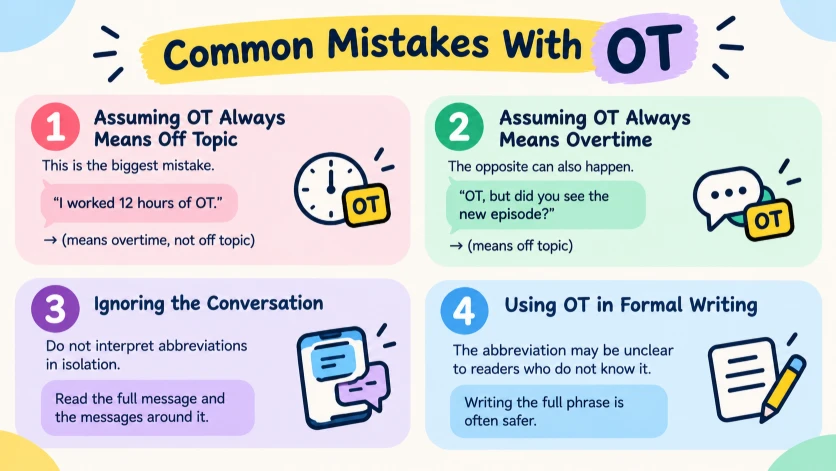
Mistake 1: Assuming OT Always Means Off Topic
This is the biggest mistake.
If someone says:
“I worked 12 hours of OT.”
they mean overtime, not off topic.
Mistake 2: Assuming OT Always Means Overtime
The opposite can also happen.
If someone says:
“OT, but did you see the new episode?”
they mean off topic.
Mistake 3: Ignoring the Conversation
Do not interpret abbreviations in isolation.
Read the full message and the messages around it.
Mistake 4: Using OT in Formal Writing
The abbreviation may be unclear to readers who do not know it.
Writing the full phrase is often safer.
Is OT Safe for Social Media?
Yes. OT is generally safe and neutral for social media.
It does not normally contain offensive or harmful language.
You can use it in a casual post or comment when you want to signal that you are changing the subject.
For example:
“OT, but does anyone know a good coffee shop nearby?”
There is no offensive meaning in this sentence.
Still, always check the community context because abbreviations can develop special meanings in particular groups.
Is OT Still Common?
The off-topic meaning has been used online for a long time, especially in forums and discussion communities. It is not a brand-new slang term.
The overtime meaning is also well established in work and sports.
What has changed is where people encounter the abbreviation. Today, you may see OT in group chats, workplace messaging, gaming discussions, social platforms, and sports conversations.
It is best viewed as common shorthand with different context-based meanings, rather than as one trendy Gen Z slang word.
Key Takeaways
- OT often means “off topic” in online conversations.
- OT also commonly means “overtime” at work and in sports.
- The surrounding conversation tells you which meaning is intended.
- OT is generally neutral and not offensive.
- It works best in casual communication.
- In formal writing, spelling out the meaning can prevent confusion.
FAQs
What Does OT Mean in Text?
In text, OT most commonly means “off topic.” It is used when someone talks about something unrelated to the main conversation. Depending on context, OT can also mean “overtime” or “on topic.”
What Is OT in UK Slang?
In UK slang, OT does not have one universal meaning. Its meaning depends on the conversation and the person using it. In some contexts, it may refer to “off topic,” “overtime,” or a local slang expression.
What Is OT in Street Slang?
In street slang, OT can have different meanings depending on the community and location. It may mean “out there,” “off topic,” or refer to a specific place, person, or phrase. Context is important when interpreting it.
What Does OT Mean in Gen Z Slang?
In Gen Z texting, OT is often used as an abbreviation for “off topic.” For example, someone might say, “OT, did you watch that new show?” to introduce a different subject.
What Does “OT” Mean in Rap Slang?
In rap slang, OT can have several meanings depending on the artist, lyrics, and regional slang. It may stand for “overtime” or be an abbreviation connected to a particular person, place, or crew.
What Does “OT” Mean in a Relationship?
In a relationship or romantic text, OT usually depends on the couple’s conversation. It can mean “off topic” when changing the subject, but it may also be a personal abbreviation or inside term between partners.
What Can OT Stand For?
OT can stand for several things, including:
- Off Topic
- On Topic
- Overtime
- Occupational Therapy
- Occupational Therapist
- Original Text
- Out of Town, depending on context
What Does “OT” Mean on Instagram?
On Instagram, OT can mean “off topic” in comments or DMs. It can also mean “overtime,” “on topic,” or another phrase depending on the caption, comment, or conversation.
Conclusion
The meaning of OT slang depends on where and how you see it. In online conversations, OT most often means “off topic.” It tells someone that the next comment or question is separate from the main discussion. In work and sports, OT commonly means “overtime.”
The easiest way to understand OT is to look at the words around it. “OT, but…” usually signals a subject change, while “working OT” clearly refers to extra work hours. Similarly, “the game went into OT” refers to extra playing time.
OT is generally neutral and safe for casual communication. It can make texting and online conversations quicker, but it is better to spell out the full phrase in formal writing. When in doubt, use context before guessing the meaning.
READ MORE!
- PS Mean in Text: Meaning & Examples
- PPL Mean in Text: Meaning, Examples & Social Media Use
- What Does TM Mean Slang? Meaning and Examples

Hi, I’m Zunaira Shafiq, a slang writer and language enthusiast. I enjoy exploring modern slang, internet expressions, texting abbreviations, and social media terms, then explaining them in simple, easy-to-understand English. My goal is to help readers understand the meaning, origin, and correct usage of popular slang words through clear definitions and real-life examples. I love making online language easier for students, language learners, and anyone who wants to stay updated with modern communication.