PS usually means “postscript” in text, a short extra note added after the main message. You may see it in texting, Instagram captions, WhatsApp messages, emails, TikTok posts, and everyday online conversations. People often search for “PS meaning in text” because the abbreviation can have different meanings depending on the conversation.
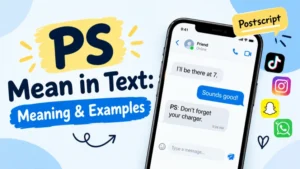
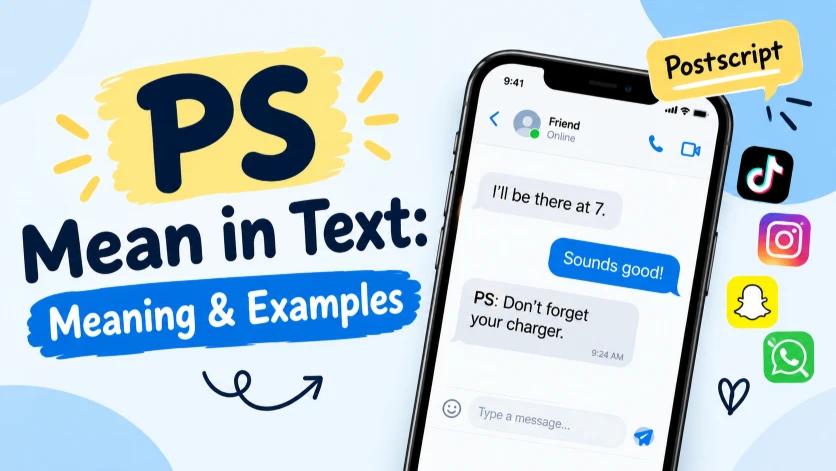
If someone writes, “I’ll call you tonight. PS: Don’t forget your charger,” the PS introduces an additional thought after the main message.
Unlike many internet slang terms, PS is not usually Gen Z-only slang. It is a long-established abbreviation that people still use online because it is quick, familiar, and useful when they remember something after finishing their main message.
PS Meaning in Text
In most everyday messages, PS means “postscript.” A postscript is an extra comment added after the main part of a message.
The word comes from Latin and literally relates to something written afterward. In traditional letters, people used “P.S.” when they had already finished writing but wanted to add one more thought.
Today, the same idea works in digital communication.
For example:
“Thanks for helping me with the project. PS: Send me the photos when you get a chance.”
The main message is about thanking someone. The PS adds another request.
Is PS slang, an acronym, or an abbreviation?
PS is best described as an abbreviation, rather than modern internet slang.
It is short for postscript. You may also see it written as P.S., especially in more traditional writing.
In casual texting, punctuation is often dropped, so someone might simply type:
“PS I bought your favorite snacks.”
Both “PS” and “P.S.” generally communicate the same idea.
What does PS mean in everyday chat?
In everyday chat, PS usually means:
“Here is one more thing I wanted to mention.”
It can be useful when someone remembers something after writing the main message.
For example:
“I’ll meet you at 7. PS: Bring a jacket.”
It can also make a message feel more personal or playful:
“Good luck on your exam! PS: You’ve got this.”
Sometimes people use PS to add a joke or an afterthought:
“I finally cleaned my room. PS: It took me three hours.”
So, while the basic meaning stays the same, the tone depends on what comes after it.
Where People Use PS
PS can appear almost anywhere people communicate online. It is especially common in messages, captions, comments, and informal written communication.
PS on TikTok
On TikTok, PS may appear in captions, comments, or direct messages.
Someone might write:
“PS: The recipe is in the comments.”
Or:
“PS this song has been stuck in my head all day.”
TikTok users may also use PS casually to add information that does not fit naturally into the main sentence.
It is not a special TikTok-only slang term. Its meaning is generally the same as in other forms of writing.
PS on Snapchat
On Snapchat, conversations tend to be short and informal, but PS can still appear when someone wants to add an extra thought.
For example:
“See you after class. PS: Don’t forget your hoodie.”
Because Snapchat messages are usually conversational, PS may be used without formal punctuation.
PS on Instagram
Instagram users may use PS in captions, comments, Stories, or direct messages.
A caption could say:
“Weekend well spent. PS: I need another vacation already.”
In an Instagram DM, someone might say:
“I sent you the address. PS: Parking is behind the building.”
The abbreviation works as a simple way to introduce an additional detail.
PS on WhatsApp
WhatsApp conversations often contain PS because people sometimes remember something after sending or writing their main message.
For example:
“I’ll be there around 6. PS: Can you save me a seat?”
It can also be used humorously:
“I’m definitely going to sleep early tonight. PS: It’s already midnight.”
PS in SMS
Traditional text messages can also use PS.
Someone might send:
“Happy birthday! Hope you have an amazing day. PS: Your gift is arriving tomorrow.”
SMS conversations are usually straightforward, so PS can be a convenient way to attach a small extra note.
Real Chat Examples
The easiest way to understand PS is to see how it works in normal conversations. Here are some realistic examples.
Example 1: Making plans
A: Are we still meeting at 8?
B: Yep, outside the cinema.
A: Perfect. PS: Bring a jacket, it’s getting cold.
Example 2: School
A: Did you finish the science assignment?
B: Almost. I’ll send it tonight.
A: Thanks! PS: The teacher moved the deadline to Friday.
Example 3: Birthday message
A: Happy birthday!! Hope you have the best day ever.
B: Thank you so much!
A: Of course! PS: I have a surprise for you later.
Example 4: Making a joke
A: I cleaned my entire room today.
B: Wow, finally 😂
A: I know, I’m proud of myself. PS: You can barely see the floor.
Example 5: Work conversation
A: I’ve attached the updated document. Let me know if anything needs changing.
B: Got it, thanks.
A: PS: I also added the figures from yesterday’s meeting.
Example 6: WhatsApp chat
A: Can you pick me up at 6?
B: Sure.
A: Thanks! PS: I’ll be waiting near the main entrance.
Example 7: Instagram DM
A: Your vacation photos look amazing!
B: Thanks! It was such a good trip.
A: PS: Where did you get that jacket?
Example 8: Friendly reminder
A: Don’t forget our movie tonight.
B: I won’t!
A: Great. PS: I already bought the tickets.
Example 9: Casual conversation
A: I’m going to bed early tonight.
B: Famous last words 😂
A: Seriously this time. PS: Unless you send me another funny video.
Example 10: Giving extra information
A: The meeting starts at 10 tomorrow.
B: Okay, I’ll be there.
A: PS: It’s in Room 204, not Room 201.
These examples show that PS does not usually change the meaning of the main message. It simply introduces something added afterward.
How to Reply When Someone Says “PS”
There is no special response you need to use when someone writes PS. Treat the information after it as an additional part of the message.
Your reply can depend on the tone of the conversation.
Funny replies
If the PS contains a joke, you can respond playfully.
Them: PS: Don’t judge my terrible cooking.
You: No promises 😂
Or:
Them: PS: I definitely didn’t eat the last cookie.
You: That sounds suspicious.
Casual replies
For an ordinary conversation, keep it simple.
Them: PS: Bring your charger.
You: Got it.
Or:
Them: PS: I’ll be there around 7.
You: Sounds good.
Friendly replies
If someone adds a personal note, a warm response works well.
Them: PS: Good luck tomorrow!
You: Thanks! I really appreciate it.
Or:
Them: PS: Don’t forget I’m always here if you need anything.
You: Thank you, that means a lot.
Neutral replies
For school, work, or less personal conversations, a straightforward answer is usually appropriate.
Them: PS: I attached the updated file.
You: Thanks, I’ll take a look.
The important thing is that PS itself does not require a particular reply.
Is PS Rude or Offensive?
PS is generally not rude or offensive. It is a normal abbreviation used to introduce an extra thought.
You can safely use it in many casual conversations.
For example:
“Thanks for your help. PS: Have a great weekend!”
There is nothing offensive about that wording.
However, the message following PS can obviously be rude, sarcastic, or inappropriate. The abbreviation itself is neutral.
Is PS safe to use?
Yes. PS is generally safe to use in ordinary communication.
It can work particularly well when you want to add a small detail without rewriting your entire message.
For example:
“I sent the document. PS: I corrected the spelling mistakes too.”
Can you use PS at school?
Usually, yes.
In a casual message to a classmate, PS is perfectly natural.
For formal school assignments, however, it is usually better to follow your teacher’s required format rather than adding a conversational postscript.
Can you use PS at work?
That depends on the situation.
In a casual workplace message, PS may be fine:
“Thanks for sending that over. PS: I’ll bring the printed copy tomorrow.”
In a formal business letter or professional document, spelling out the extra information clearly may be more appropriate.
The key difference is context and tone, not if PS is offensive.
Who Uses This Term?
PS is used by a very broad range of people.
Unlike newer internet abbreviations, it is not strongly associated with one particular generation.
Age groups
Teenagers, young adults, parents, teachers, office workers, and older adults may all understand or use PS.
Someone does not need to be familiar with internet slang to recognize it.
Gen Z usage
Gen Z may use PS in texts, captions, comments, and DMs, but PS is not specifically a Gen Z invention.
It existed long before social media and smartphones.
That is one reason the abbreviation is relatively easy to understand compared with newer slang expressions.
Common platforms
You may encounter PS on:
- TikTok
- Snapchat
- Messenger
- SMS
- Online forums
- Personal messages
Its meaning generally stays consistent across these platforms.
How often does PS appear online?
There is no single reliable frequency number for all platforms because usage varies by age, community, platform, and type of conversation.
It is better understood as a common general-purpose abbreviation rather than a trending piece of slang.
Origin of the Term
PS has a much older history than modern social media slang.
The abbreviation comes from postscript, a word associated with writing something after the main text has been completed. Historically, a person writing a letter could finish the letter, sign it, and then realize they had forgotten an important detail.
Instead of rewriting the entire letter, they could add a postscript.
That same basic idea carried into modern communication.
From letters to digital messages
Before texting existed, people used P.S. in handwritten and typed letters.
As communication moved online, the abbreviation remained useful.
Emails, forums, blogs, social media captions, and instant messages all provided new places where people could add a quick extra thought.
So the modern use of PS is largely a continuation of an older writing tradition rather than a slang term created by TikTok or another social network.
Internet culture and PS
Internet culture helped keep PS relevant because online conversations are often quick and informal.
Someone may finish typing a message and then remember one more detail. Writing “PS” is an easy way to signal that the following sentence is an addition.
The exact point at which people began using PS in digital conversations is difficult to identify, so claims about one specific website or group inventing the modern online use should be treated cautiously.
PS vs. IDK, IDC, IMO, and BRB
PS is different from many common chat abbreviations because it does not represent a phrase such as “I don’t know” or “be right back.” Instead, it identifies an extra note.
| Term | Meaning | Type | Usage | Popularity |
| PS | Postscript | Abbreviation | Adding an extra thought or detail | Common |
| IDK | I don’t know | Initialism | Showing uncertainty or lack of knowledge | Common |
| IDC | I don’t care | Initialism | Expressing indifference | Common |
| IMO | In my opinion | Initialism | Introducing a personal opinion | Common |
| BRB | Be right back | Initialism | Saying you will temporarily leave a chat | Common |
These abbreviations can appear in the same conversation, but they perform different jobs.
For example:
“IDK if I can come tonight. IMO the movie looks good, though. PS: I’ll let you know tomorrow.”
Here, IDK expresses uncertainty, IMO introduces an opinion, and PS adds a final thought.
Real-World Usage Example
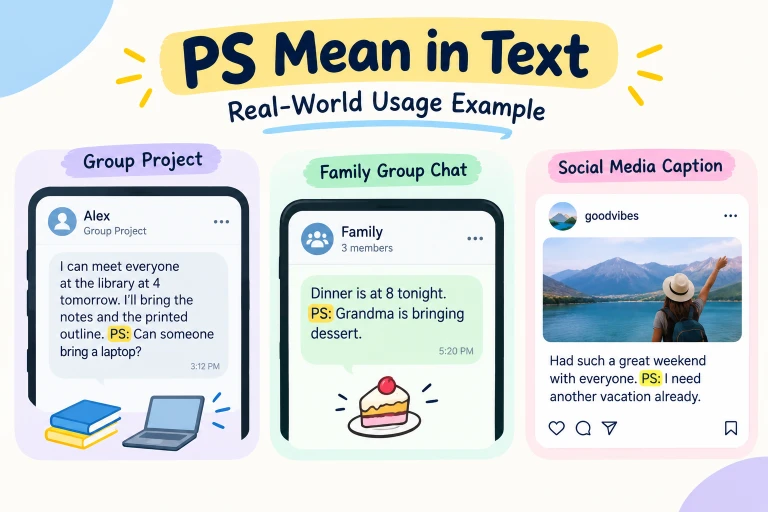
Imagine that two classmates are arranging a group project.
One person sends this message:
“I can meet everyone at the library at 4 tomorrow. I’ll bring the notes and the printed outline. PS: Can someone bring a laptop?”
The first two sentences contain the main information: where and when the meeting will happen and what the person will bring.
The PS adds a new request.
This is a practical reason people still use the abbreviation. Instead of rewriting the whole message, the sender can attach a small afterthought.
The same idea could appear in a family group chat:
“Dinner is at 8 tonight. PS: Grandma is bringing dessert.”
Or in a social media caption:
“Had such a great weekend with everyone. PS: I need another vacation already.”
In each case, PS signals that the writer has one more thing to say.
Frequently Asked Questions
What is PS in Gen Z slang?
PS usually means “postscript”, or an extra thought added after the main message. It is not specifically Gen Z slang, although younger people may use it in texts and social media.
What does my PS mean in slang?
If someone writes “PS” in a message, they usually mean they have one more thing to add. For example, “PS: Don’t forget your keys.”
How to use PS in text?
Use PS before an extra detail, reminder, joke, or afterthought. For example: “See you at 7. PS: Bring a jacket.”
Does PS mean “I love you”?
No. PS does not normally mean “I love you.” If someone writes “PS I love you,” the PS simply introduces the extra sentence “I love you.”
What does “PS” mean in chat?
In chat, PS usually means “postscript.” It signals that the sender is adding something after the main message.
What does “PS I love you” mean?
“PS I love you” means the person has added “I love you” as an extra thought at the end of their message. The phrase can sound affectionate, but PS itself does not mean “I love you.”
Conclusion
When you see PS in a text, it usually means “postscript” and introduces something the writer wants to add after the main message.
You can find it on TikTok, Snapchat, Instagram, WhatsApp, SMS, email, and other forms of online communication. It is not usually considered modern slang, and it is generally neutral and safe to use.
The best time to use PS is when you remember one more detail and want to attach it naturally to a message. For formal writing, though, it may be clearer to include the information directly in the main text.
So if someone sends you a message ending with “PS:”, there is no hidden meaning you need to decode. In most cases, they simply have one more thing to tell you.
READ MORE!
- PPL Mean in Text: Meaning, Examples & Social Media Use
- What Does TM Mean Slang? Meaning and Examples
- Malewife Slang: Meaning, Examples, Origin, and How to Use It

Hi, I’m Ryan Holden, a content writer with over 8 years of experience creating clear, engaging, and easy-to-understand content. I specialize in slang meanings, internet language, text abbreviations, and modern English expressions. My goal is to explain complex words in simple English with real-life examples so readers can quickly understand and use them correctly. I enjoy researching how language changes across social media, online communities, and everyday conversations, ensuring every article is accurate, helpful, and easy to read.