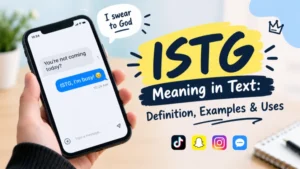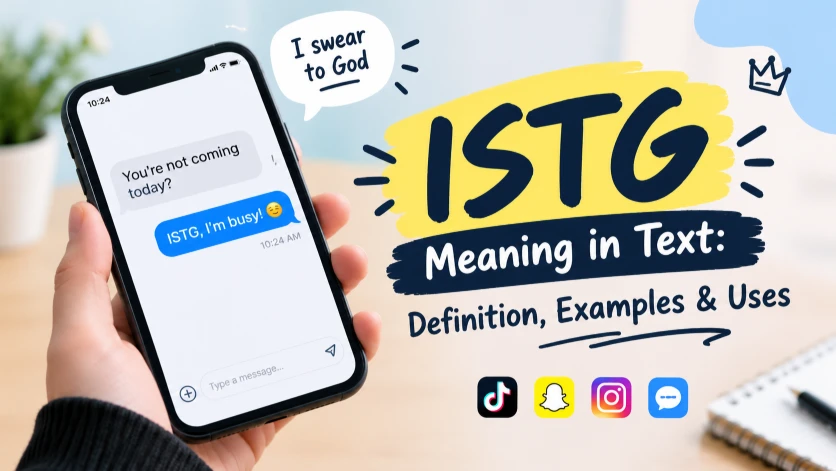
ISTG meaning slang is something people often search for when they see this abbreviation in a text message, social media comment, or online conversation. If someone sends you “ISTG, I told you already” or comments “ISTG this is so funny,” you might wonder what the letters mean and how to understand the message.
ISTG stands for “I swear to God.” People use it in everyday texting and on platforms such as TikTok, Snapchat, Instagram, Discord, and other online communities. Depending on the situation, it can express frustration, excitement, honesty, disbelief, or a strong reaction to something.
Although the phrase includes a reference to God, people do not always use it in a religious sense. Its meaning usually depends on the speaker’s tone and the conversation.
Quick Answer:
ISTG means “I swear to God.” It is an informal texting abbreviation used to emphasize a statement, express strong feelings, or show that someone is serious about what they are saying.
What Does ISTG Mean in Text?
ISTG means “I swear to God” in text messages and online conversations. It is a shortened expression that people use when they want to emphasize their words or make their feelings clear.
Instead of typing the complete phrase, someone can simply write ISTG to communicate quickly.
For example:
- “ISTG, I didn’t touch your phone.”
- “ISTG, that movie was amazing.”
- “ISTG, stop doing that.”
- “ISTG, you’re making me laugh.”
In each example, the abbreviation adds emphasis. However, it does not always communicate the same emotion.
A person might use ISTG to sound serious, express annoyance, emphasize a funny situation, or show excitement. The surrounding words and the relationship between the people involved help determine the intended meaning.
What Is the ISTG Full Form?
The full form of ISTG is “I swear to God.”
It is an initialism because each letter represents a word in the original phrase:
- I = I
- S = Swear
- T = To
- G = God
The abbreviation is especially common in informal digital communication, where people frequently shorten phrases to make messages quicker and more expressive.
What Does ISTG Stand For in Different Contexts?
Although ISTG generally has one main meaning, it can communicate different emotions depending on how someone uses it.
| Context | Meaning or feeling | Example |
| Honesty | Emphasizing that a statement is true | “ISTG, I’m telling the truth.” |
| Frustration | Showing annoyance or impatience | “ISTG, not this again.” |
| Excitement | Expressing a strong positive reaction | “ISTG, this song is perfect.” |
| Humor | Making a funny reaction more dramatic | “ISTG, my cat is ridiculous.” |
| Surprise | Emphasizing disbelief | “ISTG, that actually happened?” |
These are different uses of the same abbreviation rather than separate official definitions.
Is ISTG Rude, Offensive, or Neutral?
ISTG is generally considered informal slang, but if it sounds rude depends on the situation.
The expression “I swear to God” can sound intense because it emphasizes a statement. In a friendly conversation, it may simply express excitement or honesty. During an argument, it can sound irritated, impatient, or confrontational.
Some people may also find the religious reference inappropriate, depending on their beliefs and personal preferences.
When ISTG Is Friendly
Friends often use ISTG to emphasize a joke, compliment something, or share an enthusiastic reaction.
Example:
“ISTG, you’re the funniest person I know.”
This sounds positive and friendly because the speaker is expressing affection or appreciation.
When ISTG Sounds Angry
The abbreviation can sound more aggressive when someone uses it to complain, warn another person, or respond during a disagreement.
Example:
“ISTG, if you do that again, I’m leaving.”
This message communicates frustration and may sound like a warning.
Is ISTG a Bad Word?
ISTG is not generally classified as a profanity in itself. However, it contains the phrase “swear to God,” which some people consider inappropriate in certain settings.
It is best to consider the audience, tone, and situation before using it. A casual message to a friend is different from a professional email or a conversation with someone who dislikes religious expressions.
Where Is ISTG Commonly Used?
ISTG appears in many forms of online communication. Its main purpose remains the same, but the tone may vary depending on the platform and the type of conversation.
1. ISTG on TikTok
On TikTok, people may use ISTG in comments, captions, and replies to emphasize their reactions to videos.
Examples:
- “ISTG, this trend is everywhere.”
- “ISTG, I watched this 20 times.”
- “ISTG, this creator never disappoints.”
The abbreviation can make a reaction sound more dramatic, humorous, or enthusiastic.
2. ISTG on Snapchat
On Snapchat, ISTG is often used in private chats between friends. People may use it when explaining something, defending themselves, or reacting to a message.
Example:
“ISTG, I sent you that snap yesterday.”
Here, the speaker emphasizes that they believe their statement is true.
3. ISTG on Instagram
Instagram users may write ISTG in comments, direct messages, Stories, or captions.
Example:
“ISTG, these pictures turned out so good.”
The abbreviation adds emphasis to the compliment without changing the basic meaning of the sentence.
4. ISTG on Discord
On Discord, people may use ISTG in group chats, private messages, and community discussions.
Example:
“ISTG, we’ve been waiting for this update all week.”
It can communicate excitement, impatience, or frustration depending on the conversation.
5. ISTG in Gaming
Gamers sometimes use ISTG when reacting to unexpected events, teammates’ mistakes, or difficult gameplay moments.
Examples:
- “ISTG, that boss is impossible.”
- “ISTG, my teammate did that again.”
- “ISTG, I almost won that match.”
In gaming conversations, the abbreviation often adds emotion to a quick reaction.
6. ISTG in Regular Text Messages
ISTG is also common in everyday texting. Friends, classmates, and family members may use it when making a point or emphasizing a personal reaction.
Example:
“ISTG, I thought the meeting was tomorrow.”
This usage makes the message sound conversational rather than formal.
Real-Life Examples of ISTG in Different Situations
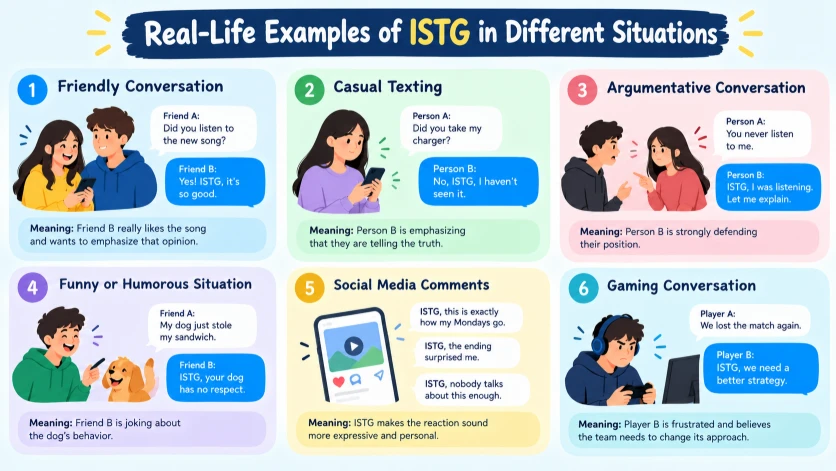
The easiest way to understand ISTG is to see how it works in different conversations. The same abbreviation can sound friendly, funny, serious, or irritated depending on the words around it.
1. Friendly Conversation
When friends talk casually, ISTG can emphasize a compliment or an enthusiastic reaction.
Example:
Friend A: Did you listen to the new song?
Friend B: Yes! ISTG, it’s so good.
Meaning: Friend B really likes the song and wants to emphasize that opinion.
Another example:
Friend A: I finally passed my driving test.
Friend B: ISTG, I’m so happy for you!
Here, the abbreviation communicates excitement and support.
2. Casual Texting
In everyday messages, ISTG can emphasize a statement or explain a misunderstanding.
Example:
Person A: Did you take my charger?
Person B: No, ISTG, I haven’t seen it.
Meaning: Person B is emphasizing that they are telling the truth.
Another example:
“ISTG, I forgot my headphones at home again.”
This expresses mild frustration with a situation.
3. Argumentative Conversation
During disagreements, ISTG can sound impatient or defensive. It may emphasize that someone has reached their limit or wants the other person to take them seriously.
Example:
Person A: You never listen to me.
Person B: ISTG, I was listening. Let me explain.
Meaning: Person B is strongly defending their position.
Another example:
“ISTG, stop interrupting me.”
This expresses annoyance and may sound confrontational.
4. Funny or Humorous Situation
People sometimes use ISTG to make an ordinary situation sound more dramatic for comedic effect.
Example:
Friend A: My dog just stole my sandwich.
Friend B: ISTG, your dog has no respect.
Meaning: Friend B is joking about the dog’s behavior.
Another example:
“ISTG, my alarm clock is my biggest enemy.”
The abbreviation adds emphasis to a humorous complaint.
5. Social Media Comments
ISTG can also help users emphasize a reaction to a relatable video, meme, or post.
Examples:
- “ISTG, this is exactly how my Mondays go.”
- “ISTG, the ending surprised me.”
- “ISTG, nobody talks about this enough.”
In these examples, the abbreviation makes the reaction sound more expressive and personal.
6. Gaming Conversation
In multiplayer games, ISTG may express frustration about repeated mistakes or difficult challenges.
Example:
Player A: We lost the match again.
Player B: ISTG, we need a better strategy.
Meaning: Player B is frustrated and believes the team needs to change its approach.
The phrase does not automatically mean the speaker is genuinely angry. Some players use it casually or jokingly.
Origin and Background of ISTG Slang
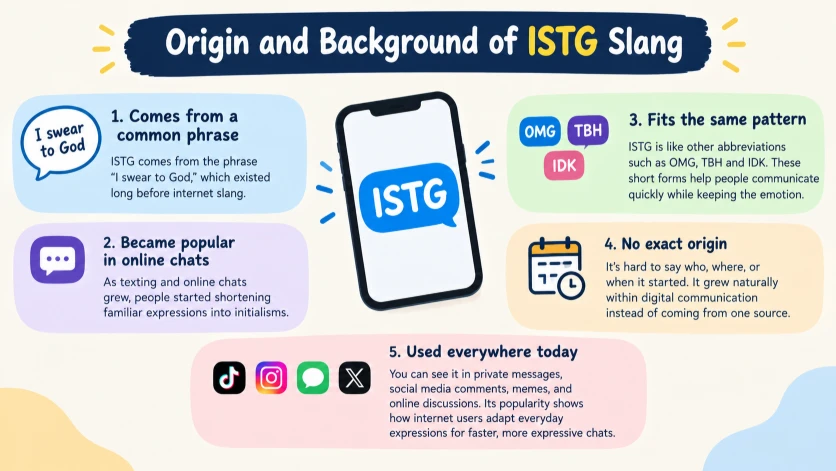
ISTG comes from the phrase “I swear to God,” which existed long before internet slang became popular.
The phrase is used in ordinary speech to emphasize sincerity, frustration, or a strong reaction. As text messaging and online chats became more common, people began shortening familiar expressions into initialisms.
ISTG fits the same general pattern as abbreviations such as OMG, TBH, and IDK. These shortened forms allow people to communicate quickly while keeping the emotional meaning of a sentence.
It is difficult to identify one exact person, platform, or date responsible for popularizing ISTG online. It developed within a broader culture of informal digital communication rather than having one clearly established origin.
Today, people may encounter it in private messages, social media comments, memes, and online discussions. Its popularity reflects the way internet users adapt everyday expressions for shorter, more expressive communication.
ISTG vs. Similar Slang Terms
Several texting abbreviations are similar to ISTG, but each has its own meaning and is used in different situations.
| Slang | Full form | Main purpose |
| ISTG | I swear to God | Emphasizes a statement or emotion |
| OMG | Oh my God | Expresses surprise, excitement, or disbelief |
| TBH | To be honest | Introduces an honest opinion |
| FR | For real | Shows agreement or emphasizes sincerity |
| NGL | Not gonna lie | Introduces a candid statement |
| IDK | I don’t know | Expresses uncertainty or lack of knowledge |
| IKR | I know, right? | Shows agreement or shared understanding |
ISTG vs. FR
ISTG and FR can both emphasize a statement, but they often serve slightly different purposes.
Example of ISTG:
“ISTG, that was the best concert ever.”
Example of FR:
“FR, that was the best concert ever.”
Both communicate a strong opinion. ISTG sounds more emphatic, while FR often expresses agreement or reinforces what someone has said.
ISTG vs. OMG
OMG commonly expresses surprise, excitement, or shock. ISTG more directly emphasizes a statement or reaction.
For example, “OMG, that’s amazing!” expresses excitement, while “ISTG, that’s amazing!” emphasizes how strongly the speaker feels about it.
ISTG vs. TBH
TBH usually introduces an honest opinion, while ISTG emphasizes a statement or feeling.
For example:
- “TBH, I didn’t enjoy the movie.” Introduces an opinion.
- “ISTG, I didn’t enjoy the movie.” Strongly emphasizes the statement.
Understanding these differences can help you interpret online messages more accurately.
Why Do People Use ISTG?
People use ISTG because it is short, recognizable, and emotionally expressive. It can make a message feel more natural in informal conversations.
Common reasons include:
- To emphasize honesty: A person wants to make clear that they believe what they are saying.
- To express frustration: Someone wants to communicate annoyance or impatience.
- To show excitement: The abbreviation makes a positive reaction sound stronger.
- To add humor: It can make a joke or complaint sound exaggerated.
- To communicate quickly: Typing four letters is faster than writing the entire phrase.
- To match online language: People often adopt familiar abbreviations to fit the style of a group chat or social media community.
However, ISTG does not prove that a statement is true. It simply shows that the speaker is emphasizing it. The meaning and credibility of the message still depend on the situation.
When Should You Avoid Using ISTG?
Although ISTG is common in casual conversations, it is not suitable for every situation.
Consider avoiding it in the following circumstances:
- Professional emails: Use clear, respectful language when communicating with teachers, employers, or colleagues.
- Formal assignments: Standard English is usually more appropriate for academic writing.
- Sensitive conversations: The expression may sound dismissive or overly intense when someone is upset.
- Religious discussions: Some people may be uncomfortable with casual references to God.
- Unfamiliar audiences: You may not know how another person interprets the phrase.
- Serious disagreements: Using emphatic slang can sometimes increase tension instead of helping resolve a problem.
The goal is not to avoid slang completely. It is to choose language that suits the audience and communicates your meaning clearly.
Polite Alternatives to ISTG
If you want to emphasize a statement without using a religious expression, several alternatives may work.
| Alternative | Best use | Example |
| Honestly | Sharing a sincere opinion | “Honestly, I didn’t know.” |
| I promise | Reassuring someone | “I promise, I’ll send it today.” |
| Seriously | Emphasizing a point | “Seriously, that was impressive.” |
| I’m telling the truth | Clarifying honesty | “I’m telling the truth; I wasn’t there.” |
| For real | Casual emphasis | “For real, that was amazing.” |
| I mean it | Showing seriousness | “I mean it; thank you for helping.” |
Choose the alternative that matches your intended tone. “I promise” may be appropriate when reassuring someone, while “seriously” may work better when expressing frustration or surprise.
What Is the Impact of ISTG on Communication?
Slang can make digital communication more expressive, but it can also create misunderstandings.
ISTG helps people communicate emotion without writing a long explanation. A short message such as “ISTG, that was hilarious” can quickly show enthusiasm or amusement.
However, written messages do not always communicate tone clearly. One person may interpret ISTG as playful exaggeration, while another may read it as anger or disrespect.
The abbreviation may also be unfamiliar to people who do not regularly use social media or internet slang.
To communicate effectively, consider these points:
- Look at the complete sentence rather than interpreting ISTG alone.
- Consider the relationship between the people messaging.
- Pay attention to if the conversation is playful, serious, or argumentative.
- Ask for clarification if the meaning is unclear.
Context is usually more helpful than the abbreviation itself when determining the speaker’s intention.
Is ISTG Safe to Use on Social Media?
ISTG is generally an ordinary slang abbreviation and is not inherently unsafe to use on social media. People commonly use it in captions, comments, private messages, and casual discussions.
However, its appropriateness depends on the context. The phrase may sound aggressive in an argument or inappropriate to someone who prefers not to use religious expressions casually.
Using ISTG does not automatically violate social media rules. Nevertheless, the surrounding content still matters. Threats, harassment, bullying, or other harmful behavior can be problematic regardless of which abbreviation is used.
For most casual conversations, ISTG is understandable and widely recognizable among people familiar with internet slang. When communicating with an unfamiliar audience, clearer wording may be a better choice.
Frequently Asked Questions
1. What does ISTG mean in slang?
ISTG means “I swear to God.” It is used in texting and online conversations to emphasize honesty, excitement, frustration, or another strong feeling.
2. What does ISTG stand for in texting?
ISTG stands for “I swear to God.” People use it in informal messages to make their statements sound more emphatic.
3. Does ISTG mean someone is angry?
Not necessarily. ISTG can express anger, but it can also communicate excitement, humor, surprise, or sincerity. The surrounding message determines the tone.
4. Is ISTG considered rude?
ISTG is not automatically rude or offensive. However, it may sound aggressive in an argument, and some people dislike casual religious references.
5. What does ISTG mean on TikTok?
On TikTok, ISTG has the same main meaning: “I swear to God.” Users often include it in comments and captions to emphasize reactions to videos, jokes, trends, or relatable situations.
6. What is the difference between ISTG and FR?
ISTG means “I swear to God,” while FR means “for real.” Both can emphasize a statement, but FR is often used to agree with someone or confirm that something is genuine.
Conclusion
ISTG meaning slang refers to the expression “I swear to God,” a common abbreviation used in texting and online communication. People use it to emphasize honesty, express excitement, show frustration, or make a reaction sound more dramatic.
You may see ISTG on TikTok, Snapchat, Instagram, Discord, gaming chats, and everyday text messages. Although its main meaning remains consistent, its tone can change depending on the conversation.
When using ISTG, consider your audience and the situation. It usually works well in casual chats, but clearer and more professional alternatives may be better in formal or sensitive conversations. Understanding the context will help you recognize what someone means and use the abbreviation appropriately.
READ MORE!
- RD Mean in Text: Simple Meaning Explained With Examples
- Rii Mean in Text: Simple Meaning Explained
- RQ Mean in Text: Complete Meaning Explained

Hi, I’m Ryan Holden, a content writer with over 8 years of experience creating clear, engaging, and easy-to-understand content. I specialize in slang meanings, internet language, text abbreviations, and modern English expressions. My goal is to explain complex words in simple English with real-life examples so readers can quickly understand and use them correctly. I enjoy researching how language changes across social media, online communities, and everyday conversations, ensuring every article is accurate, helpful, and easy to read.