What does FML mean in slang is a common question because the abbreviation appears frequently in text messages, memes, TikTok videos, Instagram captions, Reddit posts, and online conversations.
If you’ve ever seen someone write “FML” after something embarrassing or frustrating happened, you may have wondered what they meant.
FML is one of the oldest and most recognizable internet abbreviations. It is often used to express disappointment, bad luck, or frustration in a humorous or exaggerated way.
While the phrase contains strong language, many people use it casually when talking about everyday problems rather than serious situations.
Understanding its tone and context can help you know when it is appropriate to use and when it’s better to choose a more polite alternative.
Quick Answer
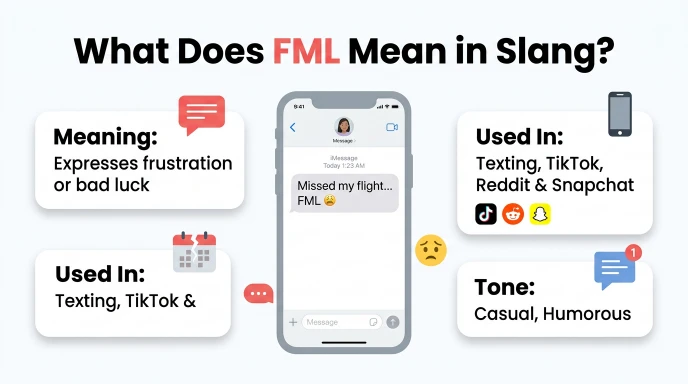
FML stands for “F* My Life.”** In slang, it is used to express frustration, disappointment, embarrassment, or bad luck after something annoying or unfortunate happens.
What Does FML Mean in Text?
In texting, FML is a quick way to react when something goes wrong. Instead of writing a long explanation, people simply type FML to show they are having a bad day or dealing with an annoying situation.
For example:
- “I missed my flight. FML.”
- “I forgot my homework at home. FML.”
- “My phone died during the interview. FML.”
In these examples, the abbreviation communicates frustration without requiring a lengthy message.
Although the phrase includes a swear word, it is often used humorously rather than literally.
FML Full Form / Definition
The full form of FML is:
FML = F* My Life**
In internet slang, it usually means:
- “I’m having terrible luck.”
- “This situation is really frustrating.”
- “Things couldn’t get much worse.”
- “Today is not going well.”
Most people use FML to describe small everyday inconveniences rather than serious personal crises.
Different Meanings of FML in Slang
Although the full form stays the same, the meaning can change slightly depending on the situation.
1. Frustration (Most Common)
People use FML when something annoying happens.
Example:
“I spilled coffee all over my laptop. FML.”
2. Embarrassment
It can express embarrassment after making a mistake.
Example:
“I waved back at someone who wasn’t waving at me. FML.”
3. Bad Luck
Sometimes it simply means someone is having an unlucky day.
Example:
“It started raining the second I left home. FML.”
4. Humorous Exaggeration
Many people use FML jokingly for minor problems.
Example:
“The pizza place forgot my fries. FML.”
Here, the speaker is not genuinely hopeless they’re exaggerating for humor.
Is FML Rude, Offensive, or Neutral?
The answer depends on the audience.
Casual Use
Among friends, FML is generally understood as a humorous expression of frustration.
Example:
“Forgot my charger again. FML.”
Mildly Offensive
Because FML contains a profanity in its full form, some people may find it inappropriate, especially in professional or family settings.
Formal Situations
Avoid using FML in:
- Business emails
- School assignments
- Job interviews
- Professional presentations
- Official documents
Instead, choose more neutral language.
Where Is FML Commonly Used?
FML appears across many digital platforms where people share daily experiences and reactions.
Text Messages
Friends often use it after something unfortunate happens.
Example:
“Locked my keys in the car. FML.”
TikTok
Creators frequently include FML in videos showing funny fails or embarrassing moments.
Example:
“POV: You studied the wrong chapter… FML.”
Users write it in captions or comments after posting relatable mishaps.
Example:
“Dropped my phone on vacation. FML.”
Snapchat
Friends use it in quick chats to complain about small problems.
Example:
“Missed the bus again. FML.”
Many users include FML in stories about unlucky situations or funny accidents.
Gaming
Players sometimes type FML after losing a match or making a costly mistake.
Example:
“Disconnected during the final round. FML.”
Why People Use FML
Despite its strong wording, FML remains popular because it quickly communicates emotion.
People use it to:
- Express frustration.
- Share embarrassing moments.
- React to bad luck.
- Add humor to a difficult situation.
- Make stories more relatable.
- Vent without writing a long explanation.
Instead of saying:
“I’m extremely frustrated because everything went wrong today.”
Someone may simply write:
“FML.”
The short abbreviation immediately communicates the feeling.
Origin and Background of FML
The phrase “F* My Life”** became widely recognized in internet culture during the late 2000s. Its popularity grew after the launch of the website FMyLife, where people shared short stories about embarrassing, unlucky, or frustrating experiences.
As smartphones, texting, and social media became more common, the abbreviation FML spread rapidly across online conversations. Users began typing it in messages, comments, memes, and gaming chats because it was faster than writing the full phrase.
Today, FML is recognized worldwide and is used mainly as a humorous reaction to everyday inconveniences rather than as a literal expression of despair.
Real-Life Examples of FML Usage
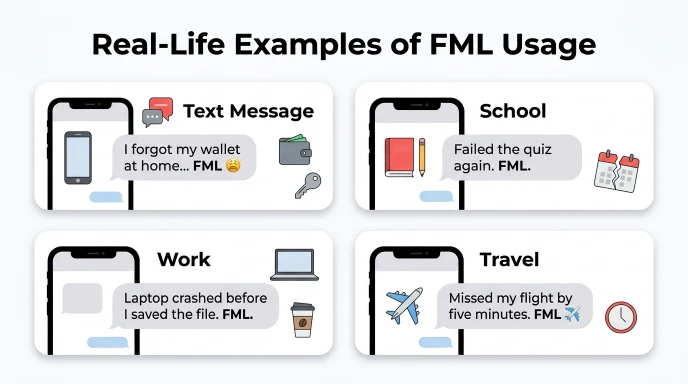
Friendly Conversation
Emma: I left my wallet at home.
Sophia: FML… I’d be so stressed too.
Casual Text
“Missed my train by ten seconds. FML.”
Social Media
“Finally finished my project… then my laptop crashed. FML.”
Gaming
“Lagged out during the championship match. FML.”
School
“Studied the wrong chapter for today’s test. FML.”
Work
“Sent the email before attaching the file. FML.”
Funny Situation
“Bought ice cream, dropped it before the first bite. FML.”
Everyday Life
“My alarm didn’t go off this morning. FML.”
Comparison with Similar Slang
Although FML is one of the most recognizable internet abbreviations, several similar slang terms express frustration, surprise, or disappointment. Knowing the differences helps you use each one naturally.
| Slang | Meaning | Tone | Common Usage |
| FML | Expressing frustration or bad luck | Mildly offensive | Texting, memes, social media |
| SMH | Shaking my head in disappointment | Neutral | Texting, Reddit, X |
| OMG | Expressing surprise or shock | Neutral | Everyday conversations |
| RIP | Used humorously after a mistake or loss | Casual | Gaming, memes, texting |
| Bruh | Showing disbelief or frustration | Casual | TikTok, Snapchat, texting |
| L | Refers to a loss or failure | Casual | Gaming and social media |
While these expressions may have similar purposes, FML is usually used when talking about your own frustrating or unlucky experiences.
When Should You Avoid Using FML?
Although FML is widely recognized online, it isn’t appropriate in every situation.
Professional Communication
Avoid using FML in:
- Business emails
- Job applications
- Workplace chats
- Client communication
- Professional presentations
The abbreviation contains profanity in its full form and may appear unprofessional.
Academic Writing
School assignments, reports, and research papers should use standard English.
Instead of writing:
“FML because I failed the experiment.”
Write:
“The experiment did not produce the expected results.”
Speaking with Children
Since FML expands to a phrase containing strong language, it’s better to avoid using it around younger audiences.
Serious Situations
FML is commonly used for everyday frustrations.
Avoid using it when discussing:
- Serious illness
- Loss of life
- Mental health emergencies
- Major personal tragedies
A more thoughtful and respectful response is appropriate in these situations.
Polite Alternatives
If you want to express frustration without using profanity, consider these alternatives.
| Instead of FML | Use This Instead |
| FML | What a bad day |
| FML | That’s unfortunate |
| FML | My luck today |
| FML | Seriously? |
| FML | Oh no |
| FML | That’s frustrating |
| FML | What a disaster |
| FML | I can’t believe this happened |
These alternatives work well in both personal and professional conversations.
Why People Use FML
FML has remained popular for years because it communicates strong emotions in just three letters.
People use it to:
- Express disappointment.
- Share embarrassing moments.
- React to bad luck.
- Add humor to frustrating situations.
- Connect through relatable experiences.
- Make stories shorter and more entertaining.
Many people also use FML ironically to exaggerate minor inconveniences.
For example:
“The coffee shop ran out of my favorite drink. FML.”
Although disappointing, the situation is clearly not life-changing.
Impact of Using Slang in Communication
Like many internet abbreviations, FML changes the tone of a conversation.
Makes Messages Shorter
Typing three letters is much faster than writing an entire sentence.
Adds Humor
People often use FML to laugh at everyday problems rather than complain seriously.
Creates Relatability
Readers often recognize similar experiences and respond with empathy or humor.
May Sound Unprofessional
Because it contains implied profanity, FML should be avoided in formal communication.
Depends on Context
The same abbreviation can sound funny among friends but inappropriate in a business meeting.
Is FML Safe for Social Media?
Yes, FML is generally safe to post on platforms such as:
- TikTok
- Snapchat
- Discord
- X (formerly Twitter)
However, remember these tips:
- Some audiences may dislike profanity.
- Younger users may not know the full meaning.
- Avoid overusing it in every post.
- Use it naturally rather than forcing it into conversations.
Being mindful of your audience helps keep your content respectful and relatable.
Common Mistakes People Make
Even though FML is simple to understand, people sometimes misuse it.
Using It for Serious Tragedies
FML is generally intended for everyday frustrations or humorous bad luck, not major life events.
Using It in Professional Settings
The implied profanity makes it unsuitable for formal communication.
Assuming Everyone Understands It
Not everyone is familiar with internet abbreviations, especially older audiences or people who are new to online slang.
Overusing It
Writing FML after every inconvenience can make messages seem repetitive or overly dramatic.
Frequently Asked Questions
What does FML mean in slang?
FML stands for “F* My Life.”** It is used to express frustration, embarrassment, or bad luck after something unfortunate happens.
What does FML mean in texting?
In texting, FML is a quick way to react when something annoying, embarrassing, or disappointing happens.
Is FML offensive?
It can be. While many people use it casually among friends, its full form contains profanity, so it may offend some audiences.
Is FML used on TikTok?
Yes. It frequently appears in TikTok captions, comments, memes, and videos that show funny or unlucky situations.
Can I use FML at work?
It’s generally not recommended. Professional communication should avoid slang that contains implied profanity.
Is FML always meant seriously?
No. Most people use FML humorously to exaggerate everyday inconveniences rather than express genuine hopelessness.
Conclusion
If you’ve been wondering what does FML mean in slang, the answer is simple: FML stands for “F* My Life” and is commonly used to express frustration, embarrassment, disappointment, or bad luck.** It has become one of the most recognizable internet abbreviations and is widely used in texting, memes, gaming, and social media platforms like TikTok, Instagram, Snapchat, Reddit, and Discord.
Although FML often describes minor everyday problems in a humorous way, its full form includes profanity, so it’s best reserved for casual conversations with people who understand the context. In professional or formal situations, choosing more polite alternatives is a better option. By understanding its meaning, tone, and appropriate usage, you can recognize FML in online conversations and use it naturally when the situation calls for it.
Read more about!
- What Does GNG Mean Slang? Simple Guide
- ATM Slang: Full Form, Usage & Examples
- NTM Slang: Meaning in Text, Full Form & Examples

Hi, I’m Ryan Holden, a content writer with over 8 years of experience creating clear, engaging, and easy-to-understand content. I specialize in slang meanings, internet language, text abbreviations, and modern English expressions. My goal is to explain complex words in simple English with real-life examples so readers can quickly understand and use them correctly. I enjoy researching how language changes across social media, online communities, and everyday conversations, ensuring every article is accurate, helpful, and easy to read.