ATM slang is one of the most common abbreviations you’ll see in text messages, social media posts, and online chats.
If someone sends you a message saying, “I’m busy ATM,” you might wonder if they’re talking about a cash machine or something completely different. In online conversations, ATM usually has a different meaning than the banking term.
People use ATM because it’s short, easy to type, and instantly understood by most internet users.If you’re chatting on Snapchat, Discord, TikTok, Instagram, WhatsApp, or texting a friend, you’ll likely come across this abbreviation.
Understanding its meaning helps you avoid confusion and reply appropriately.
Quick Answer:
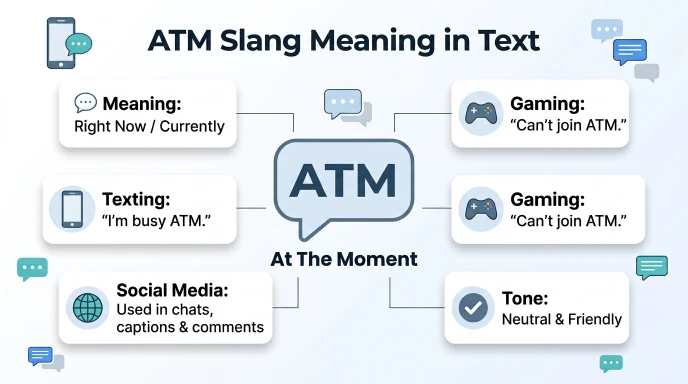
In texting and internet slang, ATM stands for “At The Moment.” It means right now or currently and is commonly used to describe what someone is doing or feeling.
What Does ATM Mean in Text?
When used as slang, ATM means “At The Moment.”
People use it to describe something happening right now or currently. It’s a quick alternative to typing “at the moment,” making conversations faster and more casual.
For example:
- “I’m studying ATM.”
- “Can’t talk ATM.”
- “I’m watching a movie ATM.”
In each example, ATM simply means currently or right now.
ATM Full Form / Definition
ATM Full Form
In texting and online slang:
ATM = At The Moment
Although many people know ATM as Automated Teller Machine, context makes the meaning clear.
For example:
Text Message:
“I’m driving ATM.”
Here, the sender obviously means At The Moment, not a cash machine.
ATM Meaning Slang
As slang, ATM means:
- Right now
- Currently
- At present
- At this time
It’s one of the simplest abbreviations used in digital communication.
What Does ATM Stand For?
Many users search:
- What does ATM stand for?
- ATM meaning slang
- ATM full form in text
The answer depends on the situation.
| Context | Meaning |
| Texting | At The Moment |
| Social Media | At The Moment |
| Banking | Automated Teller Machine |
| Finance | Automated Teller Machine |
Reading the surrounding conversation helps determine which meaning is intended.
Is ATM Rude, Offensive, or Neutral?
ATM is completely neutral.
It doesn’t contain rude language, insults, or offensive meanings.
| Situation | Appropriate? |
| Friends | ✅ Yes |
| Family | ✅ Yes |
| Social Media | ✅ Yes |
| Gaming | ✅ Yes |
| School Chat | ✅ Yes |
| Professional Email | ⚠ Usually avoid |
Although it’s acceptable in casual conversations, writing “at the moment” instead of ATM is generally better in formal emails or business communication.
Where Is ATM Commonly Used?
ATM appears almost everywhere people communicate online.
Common platforms include:
- SMS texting
- Snapchat
- Instagram DMs
- TikTok comments
- Discord servers
- Reddit discussions
- Facebook Messenger
- X (formerly Twitter)
People also use it in gaming chats because it’s short and easy to type during fast conversations.
Why People Use ATM
Internet users prefer abbreviations because they save time.
Instead of typing:
“I can’t play at the moment.”
They simply write:
“I can’t play ATM.”
Using ATM helps make conversations:
- Faster
- Shorter
- More casual
- Easier to read
- More natural during live chats
This is why it remains one of the most widely recognized texting abbreviations.
Real-Life Examples of ATM Usage
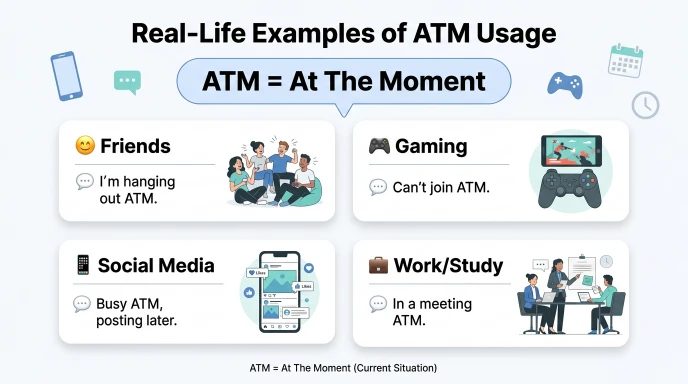
Friendly
“I’m visiting my grandparents ATM.”
Casual
“I’m watching Netflix ATM.”
Social Media
“Not posting much ATM because I’m traveling.”
Gaming
“I can’t join the match ATM.”
Work Chat
“I’m in a meeting ATM. I’ll reply later.”
These examples all use ATM to mean currently.
Tone and Context
ATM is usually calm and conversational.
It doesn’t express emotion by itself.
Instead, it simply provides information about the present situation.
For example:
“I’m tired ATM.”
This tells someone how you feel right now.
“Can’t answer ATM.”
This politely explains why you’re unavailable.
The abbreviation works best when describing temporary situations.
Origin and Background of ATM Slang
ATM became popular during the rise of SMS messaging in the late 1990s and early 2000s.
At that time:
- Text messages had character limits.
- Mobile keyboards were slower.
- Users looked for shorter ways to communicate.
Abbreviations like:
- LOL
- BRB
- IDK
- IMO
- ATM
became common because they saved both time and space.
As smartphones and social media grew, ATM continued to be widely used across messaging apps and online communities.
Today, it remains one of the easiest abbreviations to recognize in casual digital communication.
Why ATM Became So Popular
Several reasons explain why ATM is still widely used.
It’s Short
Typing three letters is much faster than writing “at the moment.”
Everyone Understands It
Most internet users recognize the abbreviation immediately.
It Fits Any Conversation
ATM works for:
- School
- Friends
- Gaming
- Family
- Social media
- Everyday texting
Because it’s flexible, people continue using it every day.
Comparison with Similar Slang
ATM isn’t the only abbreviation people use to describe time or current activities. Here are a few similar terms and how they compare.
| Slang | Meaning | Best Used For | Tone |
| ATM | At The Moment | Current situation | Neutral |
| RN | Right Now | Immediate actions | Casual |
| TBH | To Be Honest | Giving opinions | Friendly |
| BRB | Be Right Back | Temporary absence | Casual |
| IDK | I Don’t Know | Expressing uncertainty | Neutral |
Among these, ATM focuses on what is happening currently, while RN often emphasizes something happening immediately.
ATM vs RN
People often confuse ATM and RN because both refer to the present.
Here’s the difference:
- ATM (At The Moment): Refers to your current situation or activity.
- RN (Right Now): Emphasizes the exact present moment and often sounds more immediate.
Example
ATM: “I’m working ATM.”
RN: “I need your help RN!”
Both are correct, but RN usually creates a greater sense of urgency.
When to Avoid Using ATM
Although ATM is widely accepted in casual conversations, there are situations where it’s better to avoid it.
Avoid using ATM in:
- Business emails
- Job applications
- Academic papers
- Legal documents
- Formal reports
- Professional presentations
Instead, write the complete phrase:
- At the moment
- Currently
- At present
This makes your writing more professional and easier for everyone to understand.
Polite Alternatives to ATM
If you’re writing formally, consider these alternatives instead of using ATM:
- At the moment
- Currently
- Right now
- At present
- For now
- At this time
These phrases communicate the same idea while matching a more professional tone.
Why People Use ATM Slang
ATM has remained popular for years because it’s practical and easy to understand.
People use it because it:
- Saves typing time
- Makes conversations quicker
- Feels natural in texting
- Is recognized by most internet users
- Fits almost any casual conversation
If you’re chatting with friends or responding in a group chat, ATM helps keep messages short without losing meaning.
Impact of Using Slang in Communication
Slang like ATM has changed the way people communicate online.
Benefits
- Faster conversations
- Less typing
- More natural texting
- Easier communication on mobile devices
- Familiar to younger internet users
Possible Drawbacks
- Some people may confuse it with Automated Teller Machine.
- Older readers may not recognize the texting meaning.
- It may look too informal in professional settings.
Using ATM in the right context helps your message stay clear and appropriate.
Is ATM Safe for Social Media?
Yes.
ATM is considered completely safe across major social media platforms.
You can comfortably use it on:
- TikTok
- Snapchat
- Discord
- X (formerly Twitter)
The abbreviation contains no offensive language, profanity, or inappropriate meaning. It’s one of the safest and most common internet abbreviations.
Common Mistakes People Make
Here are a few mistakes users often make with ATM.
Confusing It with the Banking Term
Remember that context matters.
- “I stopped at the ATM.” → Cash machine
- “I’m eating ATM.” → At the moment
Using It in Formal Writing
Although ATM is common in texting, it’s usually better to write “at the moment” in formal communication.
Assuming Everyone Knows the Meaning
If you’re communicating with someone unfamiliar with internet slang, writing the full phrase may avoid confusion.
Frequently Asked Questions
What does ATM mean in slang?
In internet slang, ATM means “At The Moment.” It refers to something happening right now or currently.
What is the ATM full form in texting?
The texting full form of ATM is “At The Moment.”
Does ATM always mean a cash machine?
No. In online conversations, ATM usually means At The Moment. In banking or finance, it means Automated Teller Machine.
Is ATM rude?
No. ATM is a neutral abbreviation and is appropriate for everyday texting and social media.
Can I use ATM in professional emails?
It’s better not to. In formal writing, use “at the moment” or “currently” instead.
Is ATM popular on social media?
Yes. ATM is commonly used on Snapchat, Instagram, TikTok, Discord, WhatsApp, Reddit, and other messaging platforms.
Conclusion
ATM slang is one of the most common abbreviations used in digital communication. In texting, it stands for “At The Moment,” meaning currently or right now. Its popularity comes from being short, easy to understand, and useful in everyday conversations across messaging apps and social media.
While ATM is perfectly acceptable in casual chats, it’s usually best to avoid it in formal or professional writing, where the complete phrase “at the moment” sounds more polished. By understanding the context, you’ll know if ATM refers to a current situation or an Automated Teller Machine. Used correctly, ATM slang helps make online conversations quicker, clearer, and more natural.
Read more about!
- Banger Slang: Meaning, Text Usage & Examples
- NTM Slang: Meaning in Text, Full Form & Examples
- What Does PTSO Mean in Slang? Complete Guide to Its Meaning

Hi, I’m Ryan Holden, a content writer with over 8 years of experience creating clear, engaging, and easy-to-understand content. I specialize in slang meanings, internet language, text abbreviations, and modern English expressions. My goal is to explain complex words in simple English with real-life examples so readers can quickly understand and use them correctly. I enjoy researching how language changes across social media, online communities, and everyday conversations, ensuring every article is accurate, helpful, and easy to read.