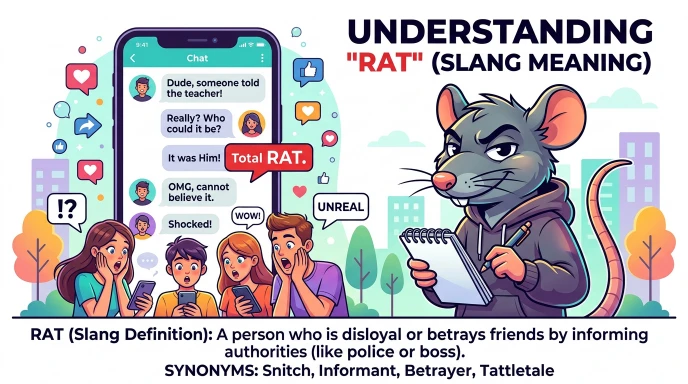
Rat meaning slang can be confusing because the word rat has both a literal meaning and several informal meanings.
In slang, calling someone a rat is usually negative. It can describe a person who betrays others, gives away secrets, or tells an authority figure about someone’s actions. In simple terms, it can mean “snitch,” “informer,” or “traitor.”
You may see rat in texts, social media comments, gaming chats, movies, or casual conversations. For example, someone might say, “He told the teacher what we did. What a rat!” Here, the speaker is calling the person disloyal for giving information away.
However, rat does not always mean exactly the same thing. It can also describe someone viewed as dishonest, sneaky, or unpleasant. The meaning depends on the sentence and the relationship between the speakers.
Quick Answer:
In slang, rat usually means a person who betrays someone, tells secrets, or “snitches.” It is normally an insulting or negative term.
What Does Rat Mean in Text?
In texting, rat is commonly used as an insult for someone who is seen as disloyal or untrustworthy.
For example:
“You told Mom? You’re such a rat.”
The speaker means that the person revealed something they were expected to keep secret.
Another example is:
“Don’t rat me out.”
This means “Don’t tell anyone what I did.”
The phrase rat on someone has a similar meaning. It refers to telling someone, especially an authority figure, about another person’s actions or secrets. Cambridge defines rat on as slang for betraying someone or sharing their secrets.
Rat Slang Meaning
The main slang meanings of rat include:
- Snitch someone who tells on another person
- Informer someone who gives information to authorities or others
- Traitor someone who betrays friends or a group
- Disloyal person someone who breaks another person’s trust
- Despicable person someone viewed as dishonest or unpleasant
Dictionaries also recognize rat as a slang term for an informer and someone who betrays or deserts friends or associates.
What Does “Rat Out” Mean?
Rat out is a common slang phrase meaning to tell someone about another person’s wrongdoing or secrets, often to a person in authority.
For example:
“He ratted me out to the teacher.”
This means he told the teacher what the speaker had done.
Another example:
“Please don’t rat us out.”
Here, the speaker is asking someone not to reveal information about them.
It can be used casually, but it usually has a negative meaning because it suggests broken trust.
Is Rat Rude or Offensive?
Yes, rat is usually rude or insulting when it describes a person.
Calling someone a rat suggests that they are:
- Disloyal
- Sneaky
- Untrustworthy
- A snitch
- A betrayer
The strength of the insult depends on the situation. Friends may sometimes use it jokingly, but in a serious argument, rat can be quite harsh.
For example:
“You ate the last cookie? You little rat!”
This could be playful between friends.
But:
“He is a rat. He betrayed everyone.”
This sounds much more serious and insulting.
So, always consider the speaker’s tone and relationship with the other person.
Where Is Rat Slang Commonly Used?
The slang meaning of rat can appear in many informal settings, including:
- Text messages
- Social media
- Instagram comments
- TikTok conversations
- Snapchat
- Discord
- Gaming chats
- Movies and TV shows
- Casual conversations
It can also describe someone accused of giving information to the authorities.
However, the word is not limited to those settings. People can use rat more generally for anyone they believe has betrayed them.
Real-Life Examples of Rat Usage
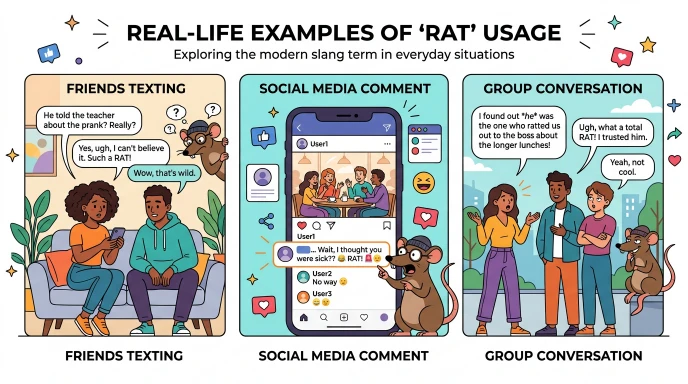
The meaning becomes clearer when you see how people use it in different situations.
Friendly or Playful Usage
“You told everyone my secret? You’re such a rat 😂”
This may be playful if the friends are joking.
Casual Usage
“Don’t rat me out to Dad.”
The speaker is asking the other person not to tell Dad about something.
Argumentative Usage
“I trusted you, and you went behind my back. You’re a rat.”
Here, rat is a strong insult showing anger and disappointment.
School Context
“He ratted me out for using my phone in class.”
This means he told the teacher about the speaker’s behavior.
Workplace Context
“Someone ratted him out to the manager.”
This means someone reported his actions to the manager.
Gaming Context
“Bro, you ratted out our hiding spot!”
Here, the word can be used casually to accuse another player of revealing information.
Social Media Context
“She posted the screenshots. What a rat.”
The speaker believes the person betrayed someone’s trust by sharing private messages.
Rat Meaning in Gaming
In gaming communities, rat can have a few related uses.
Players may call someone a rat if they:
- Betray teammates
- Reveal a player’s location
- Share private strategies
- Hide and wait for an easy attack
- Give information to the opposing side
For example:
“That guy is a rat. He gave our position away.”
Here, the meaning is close to traitor or snitch.
Gaming slang can change between communities, so the exact meaning may depend on the game and the players involved.
Rat Meaning on Social Media
On social media, rat is often used as an insult when someone shares information that another person wanted to keep private.
For example:
“Why did you post our private chat? Rat behavior.”
Rat behavior means acting sneaky, disloyal, or untrustworthy.
Sometimes people also use the word jokingly in memes or comments. A person might call their friend a rat simply because the friend revealed a harmless secret.
The surrounding conversation helps show if the word is serious or playful.
Origin and Background of Rat as Slang
The word rat itself is very old. The English word can be traced back to Old English and related Germanic forms. The slang meanings developed separately from the animal’s literal meaning.
The negative meaning comes from the idea of rats as sneaky, unwanted, or untrustworthy animals. This association helped rat become a word for a person considered dishonest or disloyal.
Modern dictionaries recognize meanings connected with betrayal, informing, and deserting associates.
Over time, phrases such as rat on and rat out became common informal expressions for revealing someone’s secrets or wrongdoing.
Rat vs. Snitch vs. Traitor
These words are similar, but they are not always identical.
| Word | Common Meaning | Tone |
| Rat | A person who betrays or tells on someone | Negative |
| Snitch | Someone who reports another person’s actions or secrets | Negative |
| Traitor | Someone who betrays a person, group, or cause | Strongly negative |
| Informer | A person who provides information, often to authorities | More neutral/formal |
| Tattletale | Someone who tells an authority about another person’s behavior | Often childish or informal |
Rat can cover both betrayal and informing. Snitch focuses more specifically on telling someone about another person’s actions.
Why Do People Call Someone a Rat?
People usually use rat when they feel someone has broken trust.
For example, imagine three friends agree to keep something private. One friend tells another person. The other two might call that person a rat because they believe the promise was broken.
The word can communicate more than simply “you told someone.” It can suggest:
“You were supposed to be loyal to us.”
That is why rat often carries a stronger emotional meaning than simply saying “you told.”
When Should You Avoid Using Rat?
Because rat is usually an insult, it is best to avoid it in formal or professional communication.
You should generally avoid using it in:
- Business emails
- Academic writing
- Professional reports
- Formal complaints
- Job applications
- Serious workplace discussions
Instead of saying:
“He is a rat.”
you could say:
“He broke our trust.”
Or:
“He shared information that was supposed to remain private.”
These alternatives explain the problem without using an insulting slang term.
Polite Alternatives to Rat
If you want to describe the same behavior without sounding rude, you can say:
- Untrustworthy
- Disloyal
- Dishonest
- Someone who revealed the information
- Someone who broke a confidence
- Someone who reported the situation
For a casual setting, snitch or tattletale may work, but these can also sound negative.
Why People Use Rat Slang
People use rat because it quickly expresses a strong feeling about someone’s behavior.
Instead of saying:
“I am upset because you told someone something I asked you to keep private.”
a person might simply say:
“You’re a rat!”
The slang is shorter and more emotional.
It is especially useful in casual conversations where speakers want to sound direct, dramatic, humorous, or angry.
Impact of Using Rat in Communication
Calling someone a rat can change the tone of a conversation very quickly.
It can make a message sound:
- Angry
- Accusing
- Playful
- Sarcastic
- Hostile
For example:
“You’re a rat 😂”
could be a joke between close friends.
But:
“You’re a rat. I never want to talk to you again.”
is clearly hostile.
The same word can feel different depending on the punctuation, emojis, relationship, and context.
Is Rat Safe for Social Media?
The word rat itself is generally not a dangerous or prohibited word. It is a common informal insult.
However, using it to attack or harass another person can create problems in online conversations. Social media platforms have their own rules about harassment and abusive behavior.
It is better to use the word carefully, especially when talking about real people publicly.
A harmless joke between friends is different from repeatedly targeting someone with insults.
Common Mistakes With Rat Slang
One common mistake is thinking that rat always refers to the animal. In casual conversations, the word can describe a person who is considered disloyal or a snitch.
Another mistake is assuming that rat and snitch always have exactly the same meaning. They overlap, but rat can also suggest betrayal or disloyalty more broadly.
A third mistake is ignoring the tone.
“You rat 😂”
may be playful.
“You are a rat.”
may be a serious insult.
Looking at the complete conversation is the best way to understand what the speaker means.
FAQs
What does rat mean in slang?
In slang, rat usually means someone who betrays others, tells secrets, or informs on someone. It is normally a negative term.
What does “rat me out” mean?
Rat me out means tell someone about me or reveal what I did, especially to an authority figure.
Is rat the same as snitch?
They are very similar. Both can mean someone who tells on others, but rat can also mean a disloyal person.
Is calling someone a rat rude?
Usually, yes. It is generally used as an insult, although close friends may sometimes use it jokingly.
What does “rat on someone” mean?
Rat on someone means to reveal their secrets or report their actions, especially when doing so breaks their trust.
Can rat be used jokingly?
Yes. Friends may call each other rat after revealing a harmless secret or teasing someone. The tone and relationship are important.
Conclusion
The rat meaning slang usually refers to someone who is seen as a snitch, informer, traitor, or disloyal person. Calling someone a rat is usually negative because it means they broke someone’s trust or shared private information.
You may see rat in texting, social media, gaming chats, and casual conversations. Expressions such as “rat on” and “rat out” are also commonly used when someone reports another person’s actions or reveals secrets.
Still, context matters. A friend saying “You’re a rat 😂” may be joking, while the same words during a serious argument can be a strong insult. In formal communication, use polite words like untrustworthy, disloyal, or someone who told the secret.
Read more about!
- Chach Slang: Meaning, Definition & How It’s Used
- Mink Slang: Full Guide to Its Casual Use
- Tool Slang Meaning: What Does Tool Mean in Slang?

Hi, I’m Zunaira Shafiq, a slang writer and language enthusiast. I enjoy exploring modern slang, internet expressions, texting abbreviations, and social media terms, then explaining them in simple, easy-to-understand English. My goal is to help readers understand the meaning, origin, and correct usage of popular slang words through clear definitions and real-life examples. I love making online language easier for students, language learners, and anyone who wants to stay updated with modern communication.