Sopranos slang insults are colorful expressions made famous by HBO’s The Sopranos. Fans often search for these phrases after hearing them in memorable scenes, social media clips, memes, or quotes shared on TikTok, Reddit, and YouTube.
Many of these insults come from Italian-American slang, New Jersey street language, and Mafia culture rather than being invented specifically for the show.
Some insults are humorous among friends, while others are genuinely offensive if used in real-life conversations. Their meaning often depends on tone, context, and the relationship between the speakers.
Understanding these expressions helps fans appreciate the show’s dialogue while knowing when certain phrases are better left as TV quotes rather than everyday language.
Quick Answer:
Sopranos slang insults are informal Italian-American and mob-inspired expressions popularized by The Sopranos. Some are playful among fans, while others are offensive and should be used carefully.
What Do Sopranos Slang Insults Mean in Text?
When people use Sopranos slang insults in text messages or online conversations, they are usually:
- Quoting the TV series.
- Joking with fellow fans.
- Referring to Mafia-style speech.
- Sharing memes or reaction posts.
Most uses are humorous rather than literal.
For example:
“Don’t be such a stunad.”
Meaning:
“Don’t be so foolish.”
Without knowledge of the show, these expressions can sound confusing.
Sopranos Slang Insults Full Form / Definition
If you’re searching for Sopranos slang insults full form, there isn’t one.
These are not abbreviations.
Instead, they are nicknames, insults, and slang terms influenced by:
- Italian-American English
- Southern Italian dialects
- New Jersey street slang
- Organized crime vocabulary
- Everyday neighborhood expressions
Many existed before The Sopranos, but the series made them widely recognized.
Are Sopranos Slang Insults Rude, Offensive, or Neutral?
Most Sopranos slang insults are informal and range from mildly rude to strongly offensive.
| Type | Tone |
| Friendly teasing | Mild |
| Fan quotes | Humorous |
| Casual insults | Rude |
| Strong profanity | Offensive |
Always consider your audience before using them.
Where Are Sopranos Slang Insults Commonly Used?
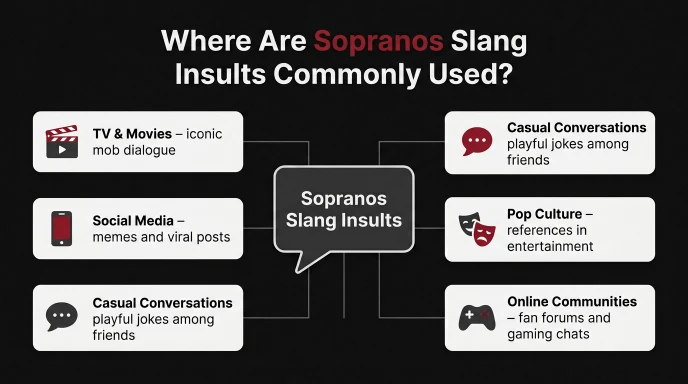
Today these expressions appear on:
- TikTok
- YouTube
- Discord
- X (formerly Twitter)
- Fan forums
- Group chats
- Meme pages
They’re especially popular among fans discussing classic TV moments.
Popular Sopranos Slang Insults and Their Meanings
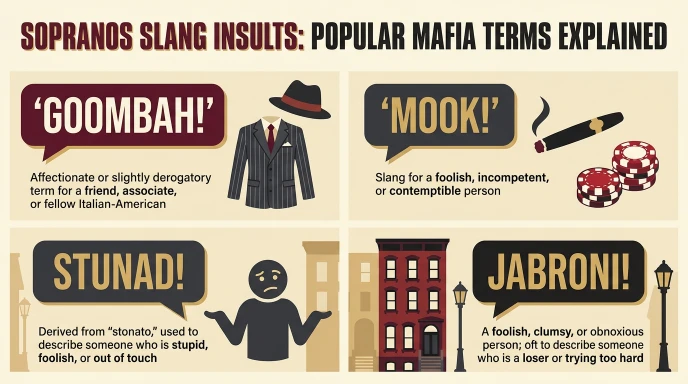
Stunad
Meaning:
A foolish or unintelligent person.
Tone:
Usually insulting, though friends sometimes use it jokingly.
Example:
“You forgot your wallet again? What a stunad.”
Goombah (or Goomba)
Meaning:
Originally referred to a close friend or associate from the Italian word compare. In pop culture, it can also refer to an Italian-American man.
Tone:
Depends on context. It is not automatically an insult but can sound stereotypical if used carelessly.
Example:
“He’s one of the neighborhood goombahs.”
Gavone
Meaning:
A rude, uncultured, or greedy person.
Example:
“Don’t act like a gavone at dinner.”
Mook
Meaning:
Someone considered foolish, annoying, or insignificant.
Example:
“Ignore that mook.”
Jamoke
Meaning:
A fool or someone acting clueless.
Example:
“Only a jamoke would do that.”
Fanook
Meaning:
A derogatory slur historically used against gay men.
Important: This term is widely considered offensive today and should generally be avoided in real-life conversation.
Schmuck
Meaning:
An annoying or foolish person.
Although commonly associated with Yiddish, it also appears in the show’s dialogue.
Example:
“Don’t be a schmuck.”
Real-Life Examples of Usage
Friendly
“Quit being a stunad and come help.”
Casual
“That guy’s acting like a gavone.”
Fan Discussion
“Tony called him a mook again.”
Meme
“Me forgetting my password for the tenth time… stunad.”
Origin and Background of Sopranos Slang
Many expressions heard in The Sopranos existed long before the television series.
Their roots include:
- Southern Italian dialects
- Sicilian speech
- Italian-American communities
- New York and New Jersey neighborhoods
- Organized crime culture
The show’s writers used authentic regional language to make the dialogue feel realistic.
After the series became popular, fans began quoting these expressions online, turning many into internet memes.
Comparison with Similar Slang
| Slang | Meaning | Strength | Common Usage |
| Stunad | Fool | Mild | Fan conversations |
| Gavone | Rude person | Medium | Casual insult |
| Mook | Fool | Mild | Everyday slang |
| Jamoke | Idiot | Mild | Informal |
| Schmuck | Fool | Medium | Casual speech |
| Fanook | Offensive slur | Strong | Best avoided |
When to Avoid Using Sopranos Slang Insults
Avoid using these expressions:
- At work.
- In professional emails.
- At school.
- With strangers.
- During formal events.
- Around people unfamiliar with the show’s context.
Some expressions carry cultural stereotypes or are offensive outside fan communities.
Polite Alternatives
Instead of using insults, consider saying:
- Silly
- Careless
- Forgetful
- Goofy
- Clumsy
- Unwise
These alternatives express frustration without offending others.
Why People Use Sopranos Slang Insults
Fans enjoy these expressions because they:
- Reference a classic television series.
- Add humor to conversations.
- Reflect Italian-American culture portrayed in the show.
- Create shared jokes among fans.
- Make memes more entertaining.
For many people, using these phrases is more about celebrating the show’s dialogue than insulting someone.
Impact of Using Slang in Communication
Benefits
- Creates humor among fans.
- Shows familiarity with The Sopranos.
- Makes conversations entertaining.
- Builds community among viewers.
Possible Drawbacks
- Some insults are offensive.
- Meanings may not be understood.
- Cultural stereotypes can be reinforced.
- Certain expressions are inappropriate in professional settings.
Choosing the right audience is important.
Is It Safe for Social Media?
Generally, yes if used responsibly.
Fans regularly quote Sopranos slang insults on:
- TikTok
- Discord
- X
However, avoid posting offensive slurs or using insults to harass individuals, as this may violate platform rules or offend readers.
Real-Life Examples by Tone
Friendly
“You’re such a stunad sometimes.”
Casual
“Don’t be a jamoke.”
Fan Conversation
“That’s the most Sopranos insult I’ve heard all day.”
Gaming
“Our teammate played like a stunad.”
Social Media
“Watching The Sopranos taught me words I never knew existed.”
Frequently Asked Questions
What are Sopranos slang insults?
They are Italian-American and mob-inspired slang expressions popularized by The Sopranos, often used humorously among fans.
Are these insults real Italian words?
Some are based on Southern Italian dialects or Italian-American speech, while others evolved within local communities and differ from standard Italian.
Is “stunad” offensive?
It is generally considered a mild insult meaning someone is foolish or acting unintelligently.
What does “gavone” mean?
It describes someone who is rude, uncultured, or lacking good manners.
Are Sopranos slang insults suitable for work?
No. Most are informal, and some are offensive or culturally sensitive, making them inappropriate for professional settings.
Why are these insults still popular?
The show’s memorable dialogue, internet memes, and fan communities have kept these expressions popular years after the series ended.
Conclusion
Sopranos slang insults are a memorable part of the show’s unique dialogue and reflect the influence of Italian-American culture, regional speech, and mob-inspired language. Expressions such as stunad, gavone, and mook are often quoted by fans for humor and nostalgia, while others are stronger and should be avoided in everyday conversation. Understanding Sopranos slang insults, their meanings, and their cultural background allows you to appreciate the series without misusing offensive language. If you choose to use these expressions, keep the context, audience, and tone in mind so they remain entertaining rather than disrespectful.
Read more about!
- Fish Gay Slang: Meaning, Origin & Examples
- Fin Slang: Complete Meaning, Origin & Everyday Examples
- Innit Slang: Meaning, Origin & How to Use It Correctly

Hi, I’m Ryan Holden, a content writer with over 8 years of experience creating clear, engaging, and easy-to-understand content. I specialize in slang meanings, internet language, text abbreviations, and modern English expressions. My goal is to explain complex words in simple English with real-life examples so readers can quickly understand and use them correctly. I enjoy researching how language changes across social media, online communities, and everyday conversations, ensuring every article is accurate, helpful, and easy to read.