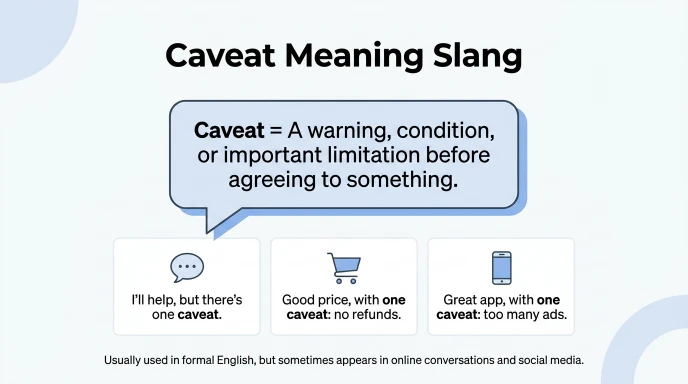
Caveat meaning slang is a phrase many people search after seeing the word in text messages, online discussions, TikTok comments, Reddit threads, or casual conversations.
Although caveat is not a traditional internet slang term, it is often used informally online to introduce a warning, condition, or exception before making a statement. Knowing how people use the word can help you understand conversations more clearly and avoid misunderstanding someone’s point.
Unlike abbreviations such as LOL or AF, caveat is a regular English word that has become popular in casual digital communication because it is short, precise, and easy to understand. You’ll often see it when someone agrees with an idea but wants to mention one important limitation.
Quick Answer:
In modern online conversations, caveat means “one important warning, condition, or exception.” It is not true slang, but it is commonly used informally in texting, social media, and online discussions.
What Does Caveat Mean in Text?
When someone writes “caveat” in a text, they usually want to add a warning or important condition before or after making a statement.
For example:
“I love that restaurant. Caveat: it gets really crowded on weekends.”
This simply means:
“There’s one important thing you should know.”
Unlike many slang words, caveat doesn’t replace another phrase or have a hidden meaning. It helps clarify that an opinion comes with an exception.
Caveat Full Form / Definition of the Slang
Many people search for “caveat full form”, but caveat is not an acronym.
It does not stand for separate words.
Instead, it is a complete English word that originally comes from Latin, meaning:
“Let a person beware.”
Today, its modern meaning is much simpler:
- Warning
- Condition
- Limitation
- Exception
- Something important to remember
So if you’re asking what does caveat stand for, the answer is that it doesn’t stand for anything it is a standalone word.
Is Caveat Rude, Offensive, or Neutral?
Caveat is completely neutral.
It is commonly used in:
- Friendly conversations
- Online discussions
- Business communication
- Academic writing
- Professional emails
- Social media posts
Unlike many slang expressions, caveat contains no profanity or insulting language.
| Situation | Appropriate? |
| Text messages | ✅ Yes |
| Reddit discussions | ✅ Yes |
| TikTok captions | ✅ Yes |
| Workplace emails | ✅ Yes |
| School assignments | ✅ Yes |
| Professional presentations | ✅ Yes |
It is one of the few words that works well in both casual and formal settings.
Where Is Caveat Commonly Used?
Although caveat isn’t internet slang, you’ll frequently see it on:
- X (Twitter)
- Discord
- TikTok comments
- YouTube discussions
- Blogs
- Forums
- Text messages
People use it whenever they want to add an important exception.
Example:
“The phone is amazing. Caveat: the battery could last longer.”
Different Ways Caveat Is Used
1. Adding a Warning
Example:
“Caveat: this tutorial assumes you know the basics.”
Meaning:
There is an important condition before you continue.
2. Adding an Exception
Example:
“I’d recommend it with one caveat.”
Meaning:
There is one limitation to the recommendation.
3. Introducing Extra Information
Example:
“Everything worked perfectly. My only caveat is the delivery time.”
Meaning:
Everything was good except for one issue.
Real-Life Examples of Caveat Usage
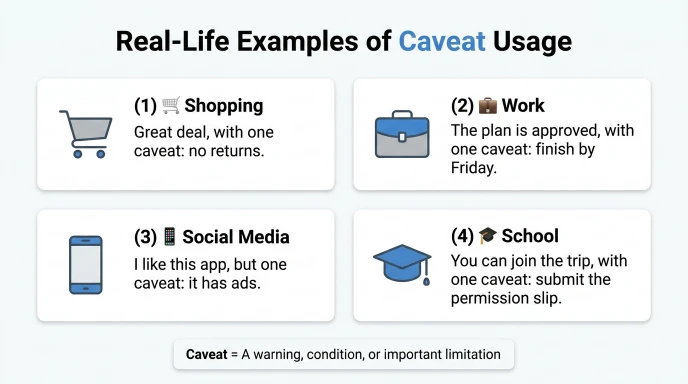
Friendly Conversation
“I’ll lend you my laptop. Caveat: I need it back tonight.”
Casual Text
“That movie is worth watching. Caveat it starts a little slow.”
Social Media
“This recipe is delicious. Caveat: it takes two hours to prepare.”
Online Gaming
“This game is fun. Caveat: you’ll need a powerful PC.”
Discussion or Debate
“I agree with your opinion, but here’s one caveat.”
Origin and Background of Caveat
The word caveat comes from Latin.
Originally, it meant:
“Let him or her beware.”
For centuries, lawyers and scholars used the word in legal and formal writing.
Over time, its meaning expanded into everyday English.
Today, people use caveat much more casually to introduce:
- Warnings
- Conditions
- Limitations
- Small exceptions
Because online communication values concise language, caveat has become increasingly common in digital conversations.
Comparison with Similar Words
| Word | Meaning | Tone | Common Use |
| Caveat | Warning or exception | Neutral | Everyday English |
| Disclaimer | Formal warning | Professional | Legal and business |
| FYI | For your information | Casual | Texting |
| Note | Extra information | Neutral | Writing |
| Heads-up | Friendly warning | Informal | Texting and speech |
Among these, heads-up is the closest informal alternative.
When to Avoid Using Caveat
Although caveat is appropriate almost everywhere, there are times when a simpler word works better.
Avoid using caveat:
- When speaking with very young children.
- If your audience may not know the word.
- When a simple word like “warning” is clearer.
- In situations requiring very plain language.
Instead, you can simply say:
- Just so you know…
- One thing to remember…
- Keep in mind…
- One warning…
- One exception…
Polite Alternatives
Since caveat is already polite, alternatives are mainly for simplicity.
Good alternatives include:
- Keep in mind
- One thing to note
- One exception
- One limitation
- Just a warning
- Heads-up
- One important detail
Each conveys a similar meaning while matching different audiences.
Why People Use Caveat
People like using caveat because it:
- Saves time.
- Sounds clear and precise.
- Introduces exceptions politely.
- Avoids lengthy explanations.
- Makes reviews more balanced.
- Adds credibility to opinions.
Instead of saying:
“There’s one important thing you need to know before making a decision…”
people simply write:
“One caveat…”
Impact of Using Caveat in Communication
Using caveat can improve communication by making expectations clear.
Benefits
- Prevents misunderstandings.
- Makes advice more honest.
- Builds trust.
- Shows balanced thinking.
- Adds important context.
Possible Drawbacks
- Some readers may not know the word.
- It can sound formal to younger audiences.
- Simpler language may sometimes be easier.
Overall, caveat is widely understood and respected in both casual and professional conversations.
Is Caveat Safe for Social Media?
Yes.
Caveat is completely safe for:
- TikTok
- Discord
- Snapchat
- X (Twitter)
It contains:
- No offensive language
- No profanity
- No inappropriate meaning
Because of its neutral tone, it is suitable for almost every audience.
Real-Life Examples by Tone
Friendly
“You can borrow my bike. Caveat: please return it today.”
Casual
“That restaurant is great. Caveat it closes early.”
Discussion
“I mostly agree, but I have one caveat.”
Gaming
“This game is amazing. Caveat: it requires a fast internet connection.”
Social Media
“The camera quality is excellent. Caveat: low-light photos aren’t as sharp.”
FAQs
What does caveat mean in slang?
Caveat is not actually slang. In casual conversations, it simply means an important warning, condition, or exception.
What does caveat stand for?
Nothing. Caveat is a complete English word and not an acronym.
Is caveat rude?
No. It is polite, neutral, and suitable for both formal and informal conversations.
Can I use caveat in texting?
Yes. Many people use caveat in text messages, Reddit posts, and social media when introducing an important condition.
Is caveat professional?
Yes. Unlike many internet slang terms, caveat works well in business, academic, and professional writing.
Is caveat popular online?
Yes. While it is not internet slang, it is commonly used in online reviews, discussions, forums, and social media to explain exceptions or limitations.
Conclusion
Caveat meaning slang can be slightly misleading because caveat is not true slang. Instead, it is a standard English word that has become common in casual online conversations. People use it to introduce an important warning, condition, or exception before or after making a statement. If you’re reading Reddit discussions, TikTok comments, text messages, or professional emails, understanding caveat meaning slang, caveat full form, and what does caveat stand for helps you recognize that the speaker is simply adding useful context. Since the word is polite, neutral, and easy to understand, it remains an excellent choice for both informal chats and formal communication.
Read more about!
- Flexing Meaning Slang: Complete Guide
- DA Meaning Slang: Definition, Origin & Everyday Examples
- Blue Meaning Slang: Definition, Examples & Everyday Usage

Hi, I’m Zunaira Shafiq, a slang writer and language enthusiast. I enjoy exploring modern slang, internet expressions, texting abbreviations, and social media terms, then explaining them in simple, easy-to-understand English. My goal is to help readers understand the meaning, origin, and correct usage of popular slang words through clear definitions and real-life examples. I love making online language easier for students, language learners, and anyone who wants to stay updated with modern communication.