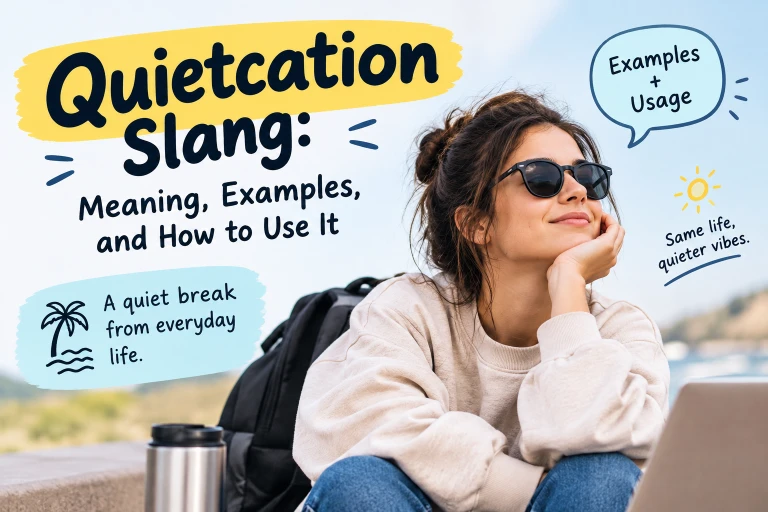
You may see quietcation slang when people talk about travel, self-care, or taking a break from busy daily life. A quietcation is a type of vacation where the main goal is peace and rest, not packed schedules, loud nightlife, or seeing as many places as possible.
The word is a blend of quiet + vacation. It can describe staying in a quiet hotel, visiting a remote place, spending time in nature, reading, taking slow walks, or simply putting your phone away for a while.
The term became much more visible in 2025 and 2026 as travel discussions started focusing more on silence, slow travel, and escaping digital noise. Cambridge Dictionary also lists quietcation as a newer word for a holiday where the focus is on spending time in silence.
Quick Answer
| Question | Answer |
| Meaning | A peaceful vacation focused on quiet, rest, and slowing down |
| Word Type | Modern slang / informal neologism |
| Made From | Quiet + vacation |
| Tone | Positive, calm, and casual |
| Used By | Travelers, social media users, wellness communities |
| Common Places | Travel posts, TikTok, Instagram, blogs, conversations |
| Offensive? | No |
| Popular? | A newer travel term gaining attention |
The important point is that a quietcation does not always mean complete silence. One person may want a remote cabin with no Wi-Fi, while another may simply want a peaceful hotel, fewer activities, and a slower schedule.
What Does Quietcation Mean?
A quietcation is a vacation planned around quiet, calm, rest, and less stimulation.
Instead of filling every hour with tours and activities, the traveler leaves room to slow down. They may read a book, walk through nature, enjoy a quiet meal, sleep longer, or spend time away from their phone.
For example:
“I don’t want a busy trip this year. I need a quietcation.”
Here, the person is saying they want a peaceful break rather than an exciting or crowded holiday.
Quietcation is therefore more about the feeling and purpose of the trip than a specific destination. A cabin in the woods could work. So could a quiet beach hotel or even a peaceful stay close to home.
Pronunciation
Quietcation is commonly pronounced approximately like:
KWY-uht-KAY-shun
Cambridge Dictionary gives the pronunciation as /ˈkwaɪ.ətˌkeɪ.ʃᵊn/.
The word sounds like a combination of quiet and vacation, which also makes its meaning fairly easy to guess.
Where Did Quietcation Come From?
The word is a blend of quiet and vacation. Dictionary.com reports an early use in 2010 by blogger Jenifer Hanen, who used “quiet-cation” for time spent enjoying peace while her family was away. That early use was closer to a staycation, while today’s common meaning focuses more broadly on peaceful travel and quiet experiences.
The modern travel meaning became much more visible around 2025. Media coverage and social posts helped bring the term into wider conversation. Wiktionary also records the word as a newer English neologism and notes its connection with the 2025 travel trend.
So, it is better to call quietcation a newer informal word than an old traditional slang term.
Why Did Quietcation Become Popular?
Many people now use travel as a way to escape busy routines. A trip does not always need to be packed with sightseeing, parties, and activities.
A quietcation offers a different idea: do less and enjoy the space around you.
The term also fits naturally with ideas such as:
- Slow travel
- Digital breaks
- Nature trips
- Wellness travel
- Solo travel
- Quiet hotels
- Reading retreats
- Peaceful getaways
- Mindful travel
Recent travel coverage has connected quietcations with a wider interest in silence, slower experiences, and places that reduce noise and stimulation.
Quietcation vs Staycation vs Silent Retreat
These terms are related, but they are not exactly the same.
| Term | Meaning | Main Focus |
| Quietcation | A peaceful vacation with less noise and pressure | Rest and calm |
| Staycation | A holiday spent at or near home | Staying local |
| Silent Retreat | A structured retreat centered around silence | Silence and reflection |
| Digital Detox | A break from phones, apps, or screens | Less technology |
| Slow Travel | Traveling at a relaxed pace | Fewer plans and deeper experiences |
A quietcation can overlap with all of these ideas, but it does not have to include them.
For example, you can take a quietcation without completely turning off your phone.
Quietcation vs Quiet Vacationing
There is an important difference between quietcation and quiet vacationing.
A quietcation is about taking a peaceful holiday.
Quiet vacationing, on the other hand, can refer to an employment trend where someone takes a vacation while trying to avoid formally using paid time off. These two phrases should not be treated as the same thing. Dictionary.com specifically points out this distinction.
So:
Quietcation = peaceful travel.
Quiet vacationing = a different workplace-related idea.
Where Quietcation Is Used
The word is mainly connected with travel and lifestyle conversations rather than traditional texting slang.
| Platform | How It May Be Used | Example |
| Travel captions | “My quietcation starts today.” | |
| TikTok | Travel and lifestyle videos | “Come with me on a quietcation.” |
| Travel discussions | “Where is the best place for a quietcation?” | |
| YouTube | Travel or relaxation content | “My peaceful quietcation in the mountains.” |
| X | Short travel comments | “I need a quietcation after this week.” |
| Texting | Casual plans | “I’m planning a quietcation next month.” |
Its meaning stays mostly the same across these platforms. The setting changes, but the basic idea remains a peaceful break from noise and busy routines.
Is Quietcation Positive or Negative?
Quietcation is positive.
People normally use the word to describe something they want or enjoy. It suggests:
- Peace
- Rest
- Privacy
- Calm
- Nature
- Relaxation
- A slower pace
For example:
“After months of work, I really need a quietcation.”
The speaker is not complaining about the quiet. They are saying that quiet is exactly what they want.
Is Quietcation Formal or Informal?
Quietcation is informal.
It works well in:
- Social media posts
- Travel blogs
- Text messages
- Casual conversations
- Travel articles
- Lifestyle discussions
You would not normally need the word in a formal business email.
For example:
Casual:
“We’re going on a quietcation next weekend.”
More formal:
“We’re planning a peaceful holiday focused on rest.”
The second version is clearer in formal writing.
What Does Quietcation Look Like in Real Life?
A quietcation does not have one fixed format.
Someone might rent a small cabin, turn off notifications, and spend three days reading. Another person might book a quiet hotel near the ocean and take long morning walks.
Someone else might travel alone to a small town and leave most of the schedule empty.
The common idea is less pressure and more quiet time.
Real-Life Examples of Quietcation Slang
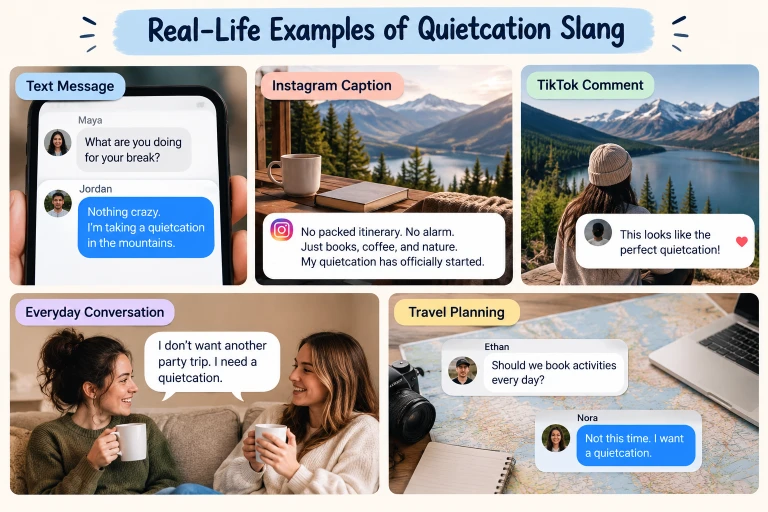
Text Message
Maya: “What are you doing for your break?”
Jordan: “Nothing crazy. I’m taking a quietcation in the mountains.”
Here, Jordan wants a calm trip instead of a busy holiday.
Instagram Caption
“No packed itinerary. No alarm. Just books, coffee, and nature. My quietcation has officially started.”
The word works well as a short label for a peaceful travel experience.
TikTok Comment
“This looks like the perfect quietcation!”
The commenter is describing the peaceful trip shown in the video.
Everyday Conversation
“I don’t want another party trip. I need a quietcation.”
This shows the contrast between an energetic vacation and a relaxing one.
Travel Planning
Ethan: “Should we book activities every day?”
Nora: “Not this time. I want a quietcation.”
Nora is saying she wants free time rather than a packed travel plan.
Common Mistakes When Using Quietcation
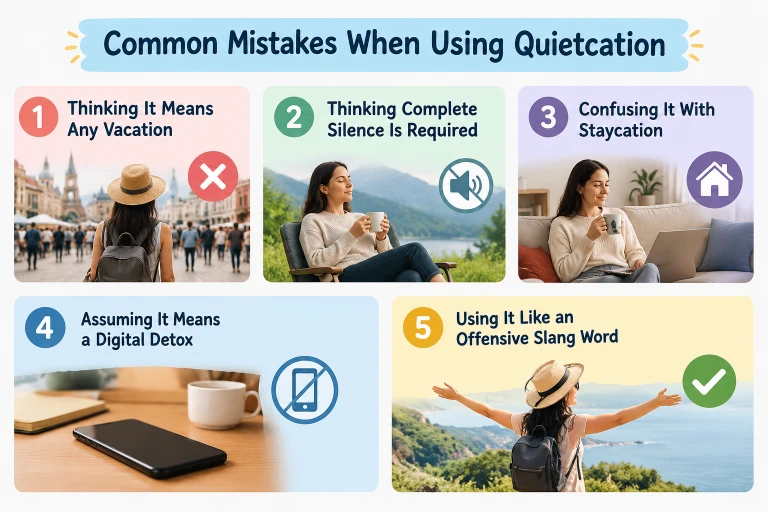
1. Thinking It Means Any Vacation
Not every vacation is a quietcation.
A crowded city trip with a full schedule may be a normal vacation, but it does not strongly fit the quietcation idea.
2. Thinking Complete Silence Is Required
A quietcation does not always mean sitting in total silence.
The level of quiet depends on the person. Some people simply want fewer crowds and less noise.
3. Confusing It With Staycation
A staycation usually focuses on staying home or close to home.
A quietcation focuses on peace and a slower experience. It can happen at home or while traveling.
4. Assuming It Means a Digital Detox
A quietcation may include turning off your phone, but a digital detox is not required.
Someone can enjoy a quiet hotel and still check their messages once or twice.
5. Using It Like an Offensive Slang Word
Quietcation is not an insult or rude expression. It is a positive lifestyle and travel term.
Is Quietcation Still Popular?
Quietcation is a newer and growing travel term rather than an old, established slang word.
It received noticeable attention in 2025 and continued appearing in travel discussions during 2026. Cambridge Dictionary included it among newer words, while recent travel coverage has discussed quietcations as part of the broader interest in quieter travel.
That does not mean everyone uses the word in everyday speech. Many people may understand the idea of a peaceful vacation without calling it a “quietcation.”
So the best description is new and increasingly recognized, rather than universally common.
Similar Words to Quietcation
If you like the idea behind quietcation, you may also see these terms:
- Staycation : a vacation at or near home.
- Slow travel : traveling at a more relaxed pace.
- Digital detox : taking a planned break from digital devices.
- Silent retreat : a structured experience centered on silence.
- Wellness retreat : travel focused on rest, health, or well-being.
- Getaway : a short trip taken for a break.
The closest match depends on what the traveler is trying to achieve.
What Is the Opposite of a Quietcation?
There is no single official opposite slang word.
A busy vacation, party trip, or packed itinerary would describe almost the opposite experience.
For example:
“Last year was a party trip. This year I’m choosing a quietcation.”
This contrast makes the meaning easy to understand.
When Should You Use Quietcation?
Use quietcation when talking about a trip or break designed around:
- Peace and quiet
- Nature
- Rest
- Slow mornings
- Less sightseeing
- Fewer crowds
- Time away from screens
- Personal space
It is especially useful when you want to describe the style of a vacation in one word.
When Should You Avoid Quietcation?
Avoid the term when the audience may not know newer travel slang or when the writing needs very formal language.
For a formal report, you could say:
“a peaceful vacation focused on rest and reduced activity”
For a casual post, quietcation is shorter and more natural.
Key Takeaways
- Quietcation combines quiet + vacation.
- It means a peaceful holiday focused on rest and calm.
- It does not always require complete silence.
- It is different from a staycation and a digital detox.
- The term became much more visible around 2025 and continues to appear in 2026 travel discussions.
FAQs About Quietcation Slang
What does quietcation mean in slang?
Quietcation means a vacation focused on peace, quiet, relaxation, and slowing down. It may involve nature, a quiet hotel, fewer activities, or time away from digital distractions. The term is informal and combines the words quiet and vacation. It is mainly used in travel, lifestyle, and social media conversations.
Is quietcation a real word?
Yes. Quietcation is a newer English word used to describe a peaceful type of vacation. Cambridge Dictionary has included it in its coverage of newer words, and Dictionary.com has a slang entry for the term. It is still newer than common words such as “vacation” or “holiday.”
What is the difference between a quietcation and a staycation?
A staycation is mainly about staying at home or close to home during a break. A quietcation is about creating a peaceful, low-pressure vacation. You can have a quietcation while traveling to another place, but you can also use the idea during a peaceful stay at home.
Does a quietcation mean no phones?
Not necessarily. Some people use a quietcation as a chance to reduce screen time or disconnect from social media, but there is no rule that says phones must be completely off. The main idea is creating more space for rest, quiet, and a slower pace.
Is quietcation the same as a silent retreat?
No. A silent retreat usually has a structured focus on silence and may follow specific rules or practices. A quietcation is more flexible. It can include talking, sightseeing, reading, walking, or using a phone in moderation. The main goal is simply to enjoy a calmer experience.
Who uses the word quietcation?
Travelers, lifestyle writers, social media users, and people interested in wellness or slow travel may use the term. Dictionary.com notes that the word can appeal to younger professionals, city dwellers, parents, independent travelers, and people interested in mindfulness.
Is quietcation positive or negative?
Quietcation has a positive meaning. It describes a peaceful and relaxing break. People usually use it when they want to escape noise, crowds, busy schedules, or constant notifications. It is not normally used as an insult, criticism, or offensive expression.
How do you use quietcation in a sentence?
You can say, “I need a quietcation after such a busy month.” Another natural example is, “We’re planning a quietcation by the lake with no packed schedule.” In both sentences, the word describes a peaceful break rather than an activity-filled vacation.
Conclusion
Quietcation slang is a simple new word for a peaceful type of vacation. It combines quiet and vacation and describes travel or time away that focuses on rest, calm, privacy, and a slower pace.
A quietcation might mean staying in a remote cabin, visiting a quiet beach, reading in a peaceful hotel, taking long walks, or simply leaving your schedule open. It does not require complete silence or a total digital detox.
The term became more widely discussed around 2025 and has continued appearing in travel conversations in 2026.
If you see someone say, “I need a quietcation,” they usually mean they want a break from noise, crowds, pressure, and busy plans. It is an informal but useful word for a growing style of peaceful travel.
READ MORE!
- Salvadoran Slang: Common Words, Meanings, and Examples
- Chorizo Slang: What Does It Mean and How Is It Used?
- Slang Names for Coffee: Fun, Cool & Popular Coffee Nicknames

Hi, I’m Ryan Holden, a content writer with over 8 years of experience creating clear, engaging, and easy-to-understand content. I specialize in slang meanings, internet language, text abbreviations, and modern English expressions. My goal is to explain complex words in simple English with real-life examples so readers can quickly understand and use them correctly. I enjoy researching how language changes across social media, online communities, and everyday conversations, ensuring every article is accurate, helpful, and easy to read.