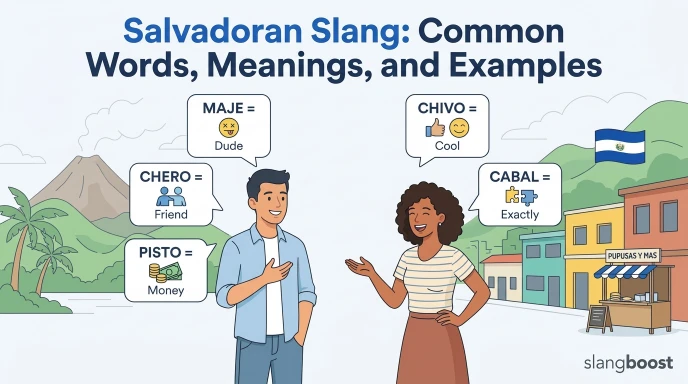
Salvadoran slang is a collection of informal words and phrases commonly used in everyday Spanish in El Salvador.
Salvadorean slang usually refers to informal words, expressions, and phrases used in El Salvador. You may see these terms in texting, social media, conversations with friends, travel content, or Spanish-language online communities. Some words can sound completely different from textbook Spanish, which is why people often search for their meanings before using them.
Salvadoran Spanish has its own recognizable vocabulary, often called caliche, along with everyday expressions shared with other parts of Central America. Words such as maje, chero, cipote, bicho, pisto, chivo, cabal, and púchica can have meanings that are strongly connected to local usage.
The important thing is context. A word that sounds rude in one situation can be friendly among close friends in another.
Quick Answer:
Salvadorean slang means informal vocabulary and expressions commonly used in El Salvador. Its meaning and tone can change depending on the speaker, situation, and relationship between people.
What Does Salvadorean Slang Mean in Text?
When people write Salvadorean slang in texts, they generally mean casual Salvadoran Spanish rather than formal or academic Spanish.
For example:
- maje : dude, guy, or sometimes an insulting term depending on tone
- cabal : exactly, right, or that’s right
- chero : friend or buddy
- cipote : kid or young person
- bicho/bicha : kid, boy, or girl
- pisto : money
- chivo : cool, great, or nice
- púchica : an expression of surprise or frustration
- chucho : dog
- chuco : dirty or messy
These meanings are documented in several references to Salvadoran vocabulary, although individual words can have different meanings in other Spanish-speaking countries.
In texting, Salvadoran slang can make a conversation feel more relaxed and local.
Example
“¿Qué ondas, maje?”
Depending on the relationship and tone, this can be understood roughly as:
“What’s up, dude?”
It is much more casual than something you would normally expect in formal writing.
Common Salvadorean Slang Words and Their Meanings
Here are some useful examples of Salvadoran slang:
| Slang | Common meaning | Tone |
| Maje | Dude, guy, sometimes fool | Casual |
| Chero | Friend, buddy | Friendly |
| Cipote | Kid, young person | Casual/neutral |
| Bicho/Bicha | Kid, boy, girl | Casual |
| Pisto | Money | Casual |
| Chivo | Cool, great, nice | Positive |
| Cabal | Exactly, right | Casual |
| Chucho | Dog | Informal |
| Chuco | Dirty, messy | Casual |
| Púchica | Shoot, wow, darn | Informal |
| Bayunco | Silly, goofy, foolish | Teasing/negative |
| Bolo/Bola | Drunk | Informal |
| Bolado | Thing, object | Casual |
Different sources sometimes give slightly different translations because slang does not always have a perfect one-word English equivalent.
Is Salvadorean Slang Rude, Offensive, or Neutral?
Salvadorean slang is not automatically rude. The tone depends heavily on the individual word and how it is used.
For example, chero is generally friendly because it refers to a friend or buddy. Chivo is also commonly positive and can describe something cool or enjoyable.
Other expressions need more care.
Maje
Maje can mean “dude” or “guy,” especially in casual conversation. However, depending on tone and context, it can also be insulting or imply that someone is foolish.
So:
“Ese maje es mi chero.”
can have a friendly meaning.
But using the same word angrily toward a stranger may sound disrespectful.
Bayunco
Bayunco can describe someone as silly, goofy, or foolish. It can be playful between friends, but it may also offend someone when said seriously.
Púchica
Púchica is generally an exclamation rather than an insult. It can express surprise, frustration, or annoyance, similar to “shoot,” “wow,” or “darn,” depending on the situation.
Where Is Salvadorean Slang Commonly Used?
Salvadoran slang is primarily used in El Salvador, especially in informal everyday communication.
You may encounter it in:
- Text messages
- WhatsApp conversations
- Facebook posts
- Instagram captions and comments
- TikTok videos
- YouTube videos
- Casual conversations
- Music and entertainment
- Travel discussions
- Spanish-language online communities
Not every Salvadoran uses every slang word in exactly the same way. Age, region, social group, and situation can influence vocabulary.
Formal documents, academic writing, business communication, and official announcements generally use more standard Spanish.
Real-Life Examples of Salvadorean Slang
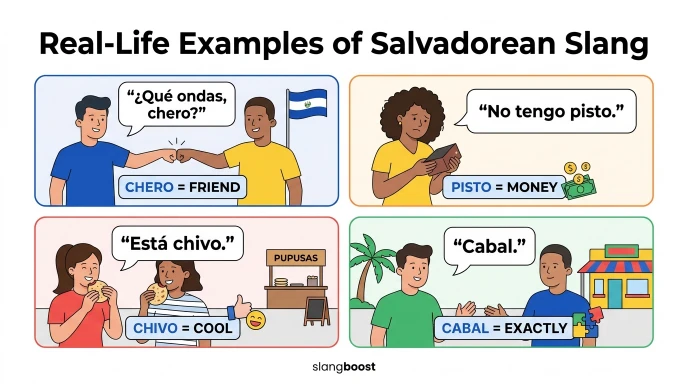
The easiest way to understand slang is to see it in context.
Friendly Example
“¿Qué ondas, chero?”
Meaning:
“What’s up, buddy?”
Here, chero is being used in a friendly way.
Money Example
“No tengo pisto para salir hoy.”
Meaning:
“I don’t have money to go out today.”
Here, pisto is a casual Salvadoran term for money.
Positive Example
“La película estuvo chiva.”
Meaning:
“The movie was great.”
Chivo/chiva can be used positively for something cool, good, or enjoyable.
Kid Example
“Los cipotes ya salieron de la escuela.”
Meaning:
“The kids already left school.”
Cipote/cipota is commonly associated with children or young people in Salvadoran usage.
Surprise Example
“¡Púchica! Se me olvidaron las llaves.”
Meaning:
“Shoot! I forgot my keys.”
The expression communicates surprise or frustration rather than naming a specific person.
Agreement Example
“Cabal, eso mismo pensé.”
Meaning:
“Exactly, that’s what I thought.”
Cabal can be used to agree with someone or confirm that something is correct.
Salvadoran Slang in Social Media and Texting
Online communication makes regional slang easier to encounter outside El Salvador.
Someone might use maje, cabal, chivo, or qué ondas in a casual post or message. However, seeing a Salvadoran slang term online does not necessarily mean the word is exclusive to El Salvador.
Spanish-speaking countries share many expressions, and some words have different meanings across borders.
For example, maje is also associated with other Central American varieties of Spanish. That means context and location matter when interpreting it.
This is especially important when translating slang into English. A literal translation may miss the actual social meaning.
Full Form of Salvadorean Slang
There is no single full form for “Salvadorean slang.”
The phrase itself is a broad label for informal vocabulary associated with Salvadoran Spanish.
Unlike acronyms such as “LOL” or “BRB,” Salvadoran slang normally consists of ordinary words, shortened expressions, regional vocabulary, and colloquial phrases.
So if someone searches for “Salvadorean slang full form,” there is no single expansion to provide.
Instead, the correct approach is to identify the specific slang word and explain its meaning and usage.
Origin and Background of Salvadorean Slang
Salvadoran Spanish developed through a mixture of Spanish and local linguistic and cultural influences.
One important influence comes from Nawat, the Indigenous language historically associated with the Pipil people. Some Salvadoran vocabulary has Indigenous roots, while other expressions developed through contact with neighboring Central American varieties of Spanish.
The term caliche is often used for informal Salvadoran speech and slang. It is not simply a collection of random internet words. Much of this vocabulary is part of everyday spoken communication.
Words such as cipote, bicho, chero, and pisto have become recognizable parts of Salvadoran informal speech.
Another noticeable feature of Salvadoran Spanish is the use of vos in informal speech. This is known as and is also found in several other parts of Latin America.
Salvadoran Slang vs. Standard Spanish
One reason Salvadoran slang can be confusing is that a person may know standard Spanish but still struggle with local expressions.
For example:
| Standard Spanish | Salvadoran usage | English |
| dinero | pisto | money |
| amigo | chero | friend |
| niño | cipote/bicho | kid |
| perro | chucho | dog |
| exactamente | cabal | exactly |
| genial | chivo | cool/great |
| cosa | bolado | thing |
These are useful examples, but they should not be treated as strict replacements in every sentence. Regional speech changes naturally, and some terms are shared with neighboring countries.
Common Mistakes When Using Salvadorean Slang
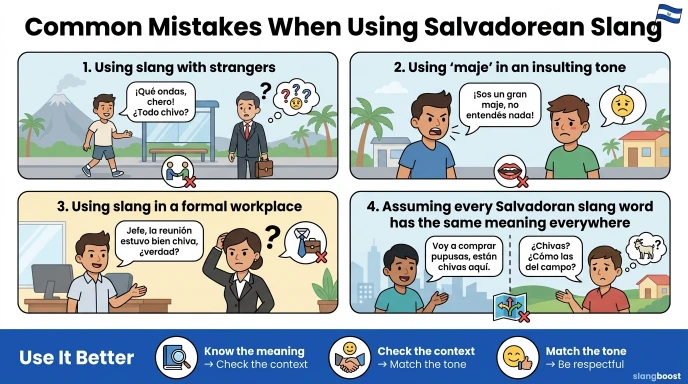
1. Assuming every word is exclusive to El Salvador
Some slang terms are also used elsewhere in Central America.
It is better to call them Salvadoran usage rather than assuming nobody outside El Salvador understands them.
2. Translating everything literally
A slang expression may not make sense when translated word for word.
The intended meaning comes from context, tone, and local usage.
3. Using rude terms with strangers
Some words can sound friendly among close friends but insulting when directed at someone you do not know.
Listen to how locals use a term before copying it.
4. Using slang in formal writing
Salvadoran slang is generally most natural in informal communication.
For professional emails, academic assignments, official documents, and formal presentations, standard Spanish is usually a better choice.
5. Treating all Salvadorans as using identical vocabulary
Language varies between generations, communities, and situations.
A word that is common among young people may not be equally common among older speakers.
When Should You Avoid Salvadorean Slang?
Avoid regional slang when the situation requires clear, formal communication.
This includes:
- Job applications
- Business emails
- Academic papers
- Legal documents
- Official applications
- Formal presentations
- Communication with someone you do not know well
This does not mean Salvadoran slang is “bad Spanish.” It simply means different situations call for different registers.
Why Do People Use Salvadorean Slang?
People use regional slang for several reasons.
Identity
Local vocabulary can show where someone is from and connect them with their culture.
Friendship
Informal words can make conversations feel warmer and more relaxed.
Convenience
Slang often makes everyday communication shorter and more natural.
Humor
Many expressions carry playful or humorous meanings that would be lost in a literal translation.
Cultural Connection
Using local expressions can help someone feel connected to Salvadoran Spanish and everyday life.
Impact of Slang on Communication
Slang can make communication feel more natural when both speakers understand it.
For Salvadoran speakers, a local expression may communicate more than its dictionary translation. It can signal familiarity, humor, emotion, or cultural identity.
However, slang can also create confusion.
A person unfamiliar with Salvadoran Spanish may misunderstand a word or assume that it has the same meaning as standard Spanish.
That is why context is more important than memorizing a list of translations.
Is Salvadorean Slang Safe for Social Media?
Generally, ordinary Salvadoran slang is fine for social media.
Words such as chero, chivo, cabal, pisto, and cipote are not automatically inappropriate. However, some slang terms can be insulting, vulgar, or offensive depending on the word and context.
Social platforms also have their own rules about harassment, threats, hate speech, and other prohibited content. Using regional slang does not automatically make content unsafe, but the meaning of the complete sentence still matters.
When posting publicly, choose words based on your audience.
Polite Alternatives to Potentially Offensive Slang
When you are unsure about a slang word, standard Spanish is the safer option.
Instead of a potentially insulting term, you can use:
- amigo/amiga: friend
- persona: person
- niño/niña: child
- joven: young person
- dinero: money
- exactamente: exactly
- excelente: excellent
These choices are easier for Spanish speakers from different countries to understand.
A Quick Comparison of Common Salvadoran Terms
| Word | Meaning | Typical feeling |
| Chero | Friend/buddy | Friendly |
| Maje | Dude/guy; sometimes fool | Context-dependent |
| Chivo | Cool/great | Positive |
| Cabal | Exactly/right | Neutral-positive |
| Pisto | Money | Casual |
| Cipote | Kid/young person | Casual/neutral |
| Bicho | Kid/young person | Casual |
| Púchica | Shoot/wow/darn | Emotional |
| Bayunco | Silly/goofy | Teasing or negative |
| Chuco | Dirty/messy | Negative |
Because slang is regional, these meanings should be understood as common Salvadoran uses rather than universal Spanish definitions.
Frequently Asked Questions About Salvadoran Slang
What do they call Salvadorans in slang?
Salvadorans are sometimes casually called Salvis. However, Salvadoran is the standard and respectful term.
What does “bicho” mean in Salvadoran slang?
In Salvadoran slang, bicho can mean a kid, boy, or young person. It is usually used in casual conversation.
What is the Salvadoran slang word for “dude”?
Maje is a common Salvadoran slang word for “dude” or “guy.” Depending on the tone, it can sound friendly or insulting.
What does “Salvadoran” mean?
Salvadoran means a person from El Salvador or something related to El Salvador.
Conclusion
Salvadorean slang is a broad collection of informal words and expressions connected with everyday Spanish in El Salvador. Terms such as cabal, chero, chivo, pisto, cipote, bicho, maje, and púchica show how regional vocabulary can add personality and cultural meaning to ordinary conversations.
The key is context. Not every slang word is rude, and not every word has one fixed translation. Some expressions are friendly, while others can become offensive depending on tone and relationship.
If you are learning Salvadoran Spanish, start by understanding how people actually use these words rather than memorizing direct translations. That approach will help you recognize the difference between casual, friendly, humorous, and inappropriate usage.
Read more about!
- Slang Names for Coffee: Fun, Cool & Popular Coffee Nicknames
- Chorizo Slang: What Does It Mean and How Is It Used?
- Barney Slang: What Does Barney Mean?

Hi, I’m Ryan Holden, a content writer with over 8 years of experience creating clear, engaging, and easy-to-understand content. I specialize in slang meanings, internet language, text abbreviations, and modern English expressions. My goal is to explain complex words in simple English with real-life examples so readers can quickly understand and use them correctly. I enjoy researching how language changes across social media, online communities, and everyday conversations, ensuring every article is accurate, helpful, and easy to read.