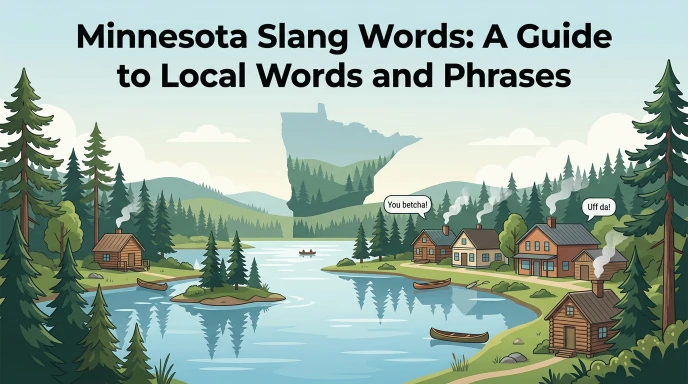
Minnesota slang words are regional expressions, phrases, and local terms that you may hear in Minnesota conversations, texts, social media posts, and everyday life. Some are linked to the state’s Upper Midwest culture, while others come from Scandinavian influence or local traditions.
Words such as “ope,” “uff da,” “you betcha,” “hotdish,” “spendy,” and “pop” can sound unusual to someone who has never spent time in Minnesota. Some are not exclusive to Minnesota, either. They may also be heard in other parts of the Upper Midwest.
The meaning also depends on context. For example, “ope” can be a quick reaction after bumping into someone, while “you betcha” usually shows agreement.
Quick Answer
Minnesota slang words are informal regional expressions connected with Minnesota and Upper Midwest speech. They often sound friendly, humorous, polite, or understated.
What Do Minnesota Slang Words Mean in Text?
In texts and online messages, Minnesota slang usually keeps the same basic meaning it has in spoken conversation.
For example:
- Ope = a quick reaction to a small mistake or surprise.
- Uff da = a reaction to something difficult, surprising, tiring, or overwhelming.
- You betcha = yes, definitely, or of course.
- Pop = soda or a soft drink.
- Spendy = expensive.
- Hotdish = a casserole-style meal.
- Up north = a common way Minnesotans refer to heading toward northern parts of the state.
- Don’t ya know = a phrase often added to the end of a sentence.
Some of these expressions are strongly associated with Minnesota, while others are broader Upper Midwest terms.
Popular Minnesota Slang Words and Phrases
Here are some of the most recognizable Minnesota expressions.
| Minnesota Slang | Meaning | Example |
| Ope | Quick reaction to a small mistake or surprise | “Ope, sorry!” |
| Uff da | Surprise, exhaustion, frustration, or relief | “Uff da, that was a long day.” |
| You betcha | Definitely, yes, or of course | “You betcha, I’ll come.” |
| Hotdish | Casserole-style meal | “We’re having hotdish tonight.” |
| Pop | Soda | “Want a pop?” |
| Spendy | Expensive | “That restaurant is pretty spendy.” |
| Don’t ya know | A regional sentence-ending phrase | “It’s cold today, don’t ya know.” |
| Minnesota nice | Stereotype of polite, friendly, reserved behavior | “That’s Minnesota nice.” |
| Up north | Northern Minnesota or a trip there | “We’re going up north this weekend.” |
| Skyway | Enclosed pedestrian walkway connecting buildings | “Let’s take the skyway.” |
| Parking ramp | Parking garage | “The car is in the parking ramp.” |
| Rummage sale | Yard or garage sale | “We found it at a rummage sale.” |
Minnesota’s regional vocabulary includes terms such as hotdish, skyway, pop, parking ramp, spendy, and uff da.
1. Ope
Ope is one of the most recognizable Upper Midwest expressions.
People often say it when they make a small mistake, bump into someone, notice something unexpectedly, or need to move around another person.
For example:
“Ope, sorry! Didn’t see you there.”
It can also work like a quick “excuse me” when someone needs to squeeze past another person.
The word is not normally rude. Its soft, quick delivery can actually make a minor awkward moment feel more polite.
2. Uff Da
Uff da is a flexible expression with Scandinavian roots. It can show surprise, exhaustion, frustration, relief, or simply a reaction to something that feels like a lot.
For example:
“Uff da, shoveling all that snow took forever.”
It can also appear after good news:
“Uff da, I’m glad that’s finally over.”
The exact emotion comes from the situation and the speaker’s tone. Minnesota sources commonly describe it as a versatile expression rather than a word with only one fixed meaning.
3. You Betcha
You betcha is a friendly way to say “yes,” “definitely,” “of course,” or “absolutely.”
Example:
“Are you coming to the lake this weekend?”
“You betcha!”
It is strongly associated with Minnesota and the Upper Midwest, although it is not used only in Minnesota.
You may also see playful spellings such as “ubetcha” in casual online messages.
4. Hotdish
Hotdish is one of the best-known Minnesota food terms.
For many people outside the region, the closest familiar word is casserole. In Minnesota, however, “hotdish” is a deeply familiar regional food term and is commonly associated with family meals, community gatherings, and potlucks.
Example:
“Grandma is bringing her tater tot hotdish.”
The term can describe many casserole-style meals, so the exact ingredients can vary.
5. Pop
In Minnesota, you may hear pop where someone from another part of the United States might say soda.
Example:
“Do you want a pop with your burger?”
This is not unique to Minnesota. “Pop” is also common in other parts of the Midwest and northern United States. Still, it is useful to know when visiting Minnesota because you may hear it often.
6. Spendy
Spendy means expensive or costly.
It is a casual way to describe something that costs more than expected.
Example:
“That new coffee shop is a little spendy.”
It does not necessarily mean something is outrageously expensive. It can simply mean the price feels high.
Minnesota vocabulary references list spendy as a regional term meaning expensive or high-priced.
7. Don’t Ya Know
Don’t ya know is often heard as a phrase at the end of a sentence in Minnesota-style speech.
It does not always mean the speaker is actually asking if you know something.
Example:
“It’s getting pretty cold, don’t ya know.”
It can act more like a conversational tag.
The phrase is strongly associated with Minnesota and nearby Upper Midwest speech, although people may use it jokingly when imitating a stereotypical Minnesota accent.
8. Minnesota Nice
Minnesota nice is a cultural phrase rather than a single slang word.
It describes a stereotype of Minnesotans as polite, friendly, reserved, mild-mannered, and sometimes reluctant to have direct confrontations.
For example:
“Everyone kept offering to help. That’s Minnesota nice.”
The phrase can be sincere, but it can also be humorous or slightly critical depending on context. Some people use it to describe indirect communication or avoiding open disagreement.
9. Up North
Up north is a familiar Minnesota phrase for traveling toward northern parts of the state.
It is often connected with cabins, lakes, fishing, camping, hiking, and outdoor trips.
Example:
“We’re heading up north for the weekend.”
The phrase does not point to one exact town. Its meaning depends on where the speaker lives and where they are going.
10. Skyway
A skyway is an enclosed pedestrian walkway that connects buildings, especially in downtown areas.
The term is especially useful in Minneapolis because the city’s downtown has an extensive skyway system that allows people to move between buildings without walking outside.
Example:
“Let’s take the skyway to the next building.”
This is more accurately described as regional vocabulary than slang, but it is a useful Minnesota term for visitors.
Is Minnesota Slang Rude or Offensive?
Most common Minnesota expressions are neutral, friendly, or humorous.
Words such as ope, uff da, you betcha, pop, hotdish, and spendy are not normally offensive.
However, tone still matters.
For example, someone can use “Minnesota nice” positively:
“She helped everyone at the event. That’s Minnesota nice.”
But another speaker might use it critically to describe someone who avoids saying what they really think.
So, context matters more than the word itself.
Where Is Minnesota Slang Commonly Used?
Minnesota expressions are most natural in everyday conversations, but they can also appear online.
| Place | How Minnesota Slang Appears |
| Texting | Casual conversations with friends |
| Captions about Minnesota life | |
| TikTok | Regional humor and accent videos |
| Discussions about Minnesota and Midwest culture | |
| Local community conversations | |
| Discord | Casual chats among friends |
| YouTube | Minnesota travel and culture content |
| Everyday Speech | The most natural setting for regional expressions |
Not every phrase is equally common on every platform. Many Minnesota expressions are primarily spoken and then used online for humor, identity, or regional pride.
Real-Life Examples of Minnesota Slang Words
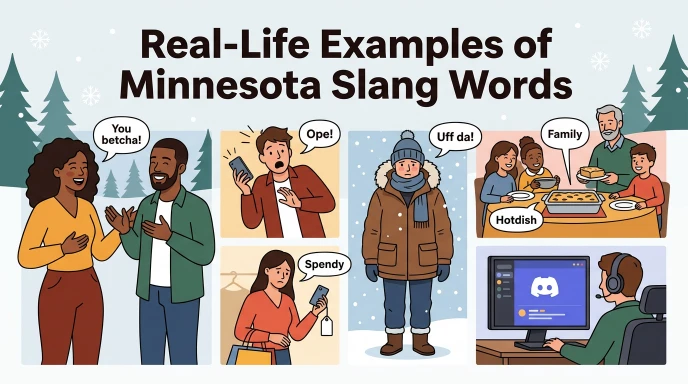
Friendly Conversation
Avery: “Want to come over for dinner?”
Caleb: “You betcha!”
Here, you betcha simply means “yes” or “of course.”
Small Accident
Nora: “Ope! I almost dropped my phone.”
The speaker uses ope as a quick reaction to a small mistake.
Talking About Weather
Miles: “Uff da, it’s cold today.”
The phrase expresses a strong reaction to unpleasant weather.
Talking About Food
Grace: “What are you bringing to the potluck?”
Eli: “My family’s famous hotdish.”
Here, hotdish refers to a casserole-style meal.
Talking About Prices
Sophie: “How much was that jacket?”
Lucas: “A little spendy, but I really liked it.”
Spendy means expensive or costly.
Social Media Caption
“Ope, looks like winter is back. ❄️”
Here, ope adds a playful Minnesota-style reaction to the weather.
Gaming or Discord Chat
“Uff da, that boss fight was brutal.”
In this case, uff da is being used casually to show that the game was difficult or exhausting.
Minnesota Slang vs Midwest Slang
Minnesota slang overlaps with broader Midwestern slang, so not every term belongs only to Minnesota.
| Minnesota Expression | Broader Meaning | Minnesota Connection |
| Ope | Quick reaction or apology | Strong Upper Midwest association |
| Uff da | Surprise, exhaustion, relief | Strong Scandinavian/Minnesota association |
| You betcha | Yes or definitely | Strong Minnesota stereotype |
| Pop | Soda | Common across parts of the Midwest |
| Spendy | Expensive | Regional Upper Midwest vocabulary |
| Hotdish | Casserole | Strong Minnesota food identity |
| Minnesota nice | Polite/reserved behavior | Specifically tied to Minnesota culture |
This distinction matters because calling every regional word “Minnesota-only slang” would be inaccurate.
Where Did Minnesota Slang Come From?
Minnesota speech developed through a mix of Upper Midwest regional English, local culture, and immigrant influences.
Scandinavian influence is especially noticeable in expressions such as uff da. Minnesota also developed its own vocabulary around weather, food, outdoor life, transportation, and community traditions.
The state also shares many speech patterns with nearby Midwestern regions. That is why some expressions heard in Minnesota can also be heard in Wisconsin, North Dakota, South Dakota, and other parts of the Upper Midwest.
Not every phrase has a simple “first use” date. Regional speech usually develops gradually through everyday conversation, so it is safer to describe many Minnesota expressions as regional vocabulary or cultural expressions rather than claim one exact inventor or starting year.
Why Do People Use Minnesota Slang?
People use regional expressions for several simple reasons.
To Show Local Identity
Using words such as hotdish or you betcha can signal a connection with Minnesota or the Upper Midwest.
To Sound Friendly
Expressions such as ope often soften small awkward moments.
To Express Emotion
Uff da can communicate a reaction without needing a long explanation.
To Add Humor
Minnesota expressions are often used playfully online, especially when people joke about local accents, winter, food, or regional culture.
To Communicate Naturally
People rarely stop to think about regional vocabulary during normal conversation. They simply use the words that feel natural to them.
When Should You Avoid Minnesota Slang?
There is usually no safety issue with common Minnesota expressions, but formal situations call for clearer standard English.
Avoid heavy use of regional expressions in:
- Formal business reports
- Academic papers
- Official documents
- Job applications
- Professional presentations
- Legal writing
For example, saying “That place is pretty spendy” is fine in a conversation.
In a formal report, “The restaurant is relatively expensive” would be clearer.
Polite Alternatives to Minnesota Slang
Most Minnesota slang does not need a polite replacement because it is not offensive.
Still, you can switch to standard English when needed:
| Minnesota Expression | More Formal Alternative |
| Ope | Excuse me / Sorry |
| Uff da | Wow / That was difficult |
| You betcha | Certainly / Absolutely |
| Spendy | Expensive |
| Pop | Soft drink / Soda |
| Hotdish | Casserole |
Why Minnesota Slang Matters in Communication
Regional language can tell you more than the basic meaning of a word.
It can show where a speaker comes from, what communities they identify with, and how they approach conversation.
Minnesota expressions are also useful for visitors. Understanding “up north,” “hotdish,” “pop,” or “skyway” can make everyday conversations easier.
At the same time, outsiders do not need to force these expressions into every sentence. Using them naturally is better than trying to imitate a Minnesota accent or stereotype.
Is Minnesota Slang Safe for Social Media?
Yes. Common Minnesota expressions such as ope, uff da, you betcha, hotdish, and spendy are generally safe for social media.
They are not inherently offensive or harmful.
They can work especially well in:
- Travel posts
- Minnesota memes
- Regional humor
- TikTok videos
- Instagram captions
- Reddit discussions
- Local community posts
The main thing to remember is context. A phrase that sounds funny in a Minnesota meme may not fit a formal professional post.
Common Mistakes With Minnesota Slang
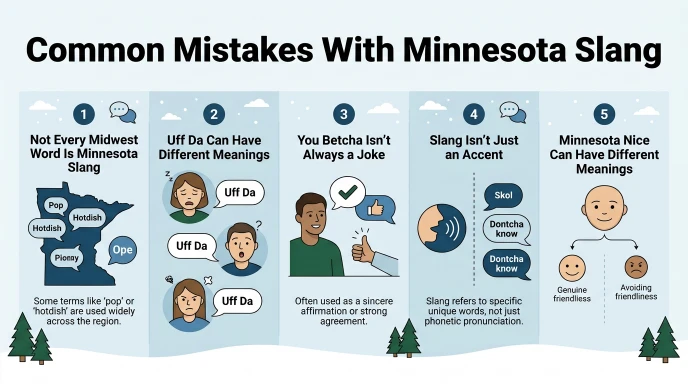
Calling Every Midwest Word “Minnesota Slang”
Minnesota shares vocabulary with nearby states. Some expressions are regional rather than Minnesota-exclusive.
Assuming “Uff Da” Has One Meaning
Its meaning changes with context. It can express surprise, exhaustion, frustration, relief, or sympathy.
Thinking “You Betcha” Is Always a Joke
It can be used seriously as a friendly way to say yes or definitely.
Using an Accent Instead of Learning the Words
Minnesota slang is about vocabulary and communication, not simply copying a stereotypical accent.
Assuming “Minnesota Nice” Always Means Friendly
The phrase can be positive, neutral, or critical depending on how it is used.
FAQs
What is Minnesota’s catchphrase?
Minnesota is often associated with “You betcha!”, a friendly phrase commonly linked with Minnesota speech and culture.
How to talk like you’re from Minnesota?
Use a friendly, relaxed tone and phrases such as “you betcha,” “uff da,” and “dontcha know.” The Minnesota accent is also known for its distinctive vowel sounds.
What are people from Minnesota called in slang?
People from Minnesota are commonly called “Minnesotans.” A playful nickname you may hear is “Minnesotans” or “Minnesotans from the Land of 10,000 Lakes.”
What are words that Minnesotans say differently?
Some Minnesotans pronounce certain vowels differently, giving the accent its recognizable sound. Words such as “bag,” “boat,” “about,” and “roof” may sound different from other American accents.
What is a Minnesota thing to say?
“Uff da!” is one of the expressions strongly associated with Minnesota. “You betcha!” and “Dontcha know?” are also commonly connected with the state’s speech.
What is Minnesota’s main nickname?
Minnesota’s official and most famous nickname is “The North Star State.” It is also widely known as “The Land of 10,000 Lakes.”
Conclusion
Minnesota slang words give you a useful look at the language and culture of Minnesota and the wider Upper Midwest. Expressions such as ope, uff da, you betcha, hotdish, pop, spendy, and Minnesota nice can make conversations sound more local and natural.
The key is to understand the context. Ope often marks a small surprise or mistake, uff da expresses a strong reaction, and you betcha shows agreement. Meanwhile, words such as hotdish, pop, and spendy describe familiar things in a regional way.
Not every expression is unique to Minnesota, and some are shared across neighboring states. That is why it is better to think of Minnesota slang as a mix of local vocabulary, Upper Midwest speech, cultural phrases, and everyday expressions.
If you are visiting Minnesota, talking with someone from the state, or simply exploring regional American English, these words can help you understand the conversation without guessing what the speaker means.
READ MORE!
- Quietcation Slang: Meaning, Examples, and How to Use It
- Neegy Slang: Meaning, Origin, and How People Use It
- Slang Names for Coffee: Fun, Cool & Popular Coffee Nicknames

Hi, I’m Ryan Holden, a content writer with over 8 years of experience creating clear, engaging, and easy-to-understand content. I specialize in slang meanings, internet language, text abbreviations, and modern English expressions. My goal is to explain complex words in simple English with real-life examples so readers can quickly understand and use them correctly. I enjoy researching how language changes across social media, online communities, and everyday conversations, ensuring every article is accurate, helpful, and easy to read.