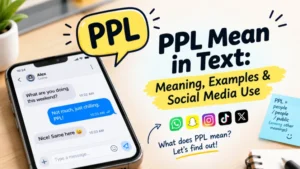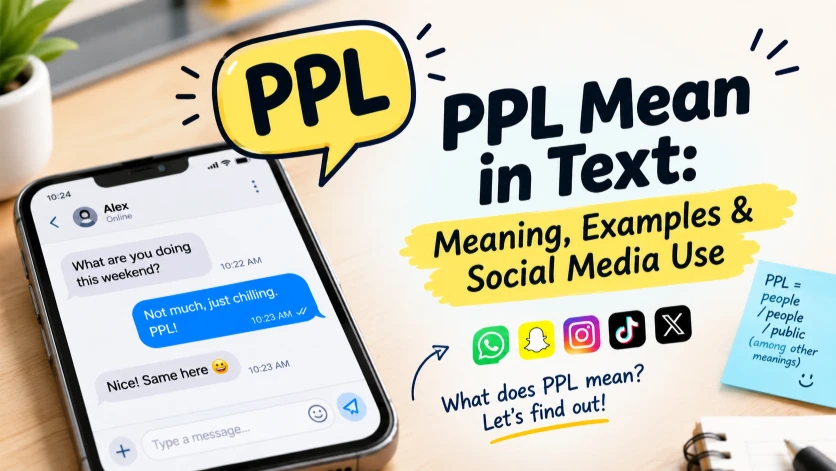
PPL usually means “people” in text messages and online conversations. It is a shortened form of the word “people” that saves time when typing. You may see PPL in texting, TikTok comments, Snapchat messages, Instagram posts, WhatsApp chats, and other casual online conversations.
For example, someone might text, “Why do ppl do this?” They simply mean, “Why do people do this?”
Many people search for PPL meaning in text because abbreviations can look confusing when you see them for the first time. Unlike some slang terms, PPL is usually straightforward once you know that it is simply a shortened version of “people.”
This guide explains what PPL means, how people use it online, where you are most likely to see it, how to reply, and when you should avoid using it.
PPL Meaning in Text
PPL means “people” in text and online chat. It is an informal abbreviation used to make messages shorter and quicker to type.
For example:
“Some ppl never listen.”
This means:
“Some people never listen.”
PPL is usually an abbreviation or texting shorthand, rather than a separate slang word with a completely different meaning. The letters come from the main sounds or letters of people, while the less useful letters are left out.
You might see PPL used in sentences such as:
- “Why do ppl care so much?”
- “Ppl are talking about it everywhere.”
- “Some ppl just don’t understand.”
- “Are there any ppl here?”
- “I met a lot of new ppl today.”
The meaning is normally easy to identify from the sentence.
Is PPL Slang or an Abbreviation?
PPL is better described as an informal abbreviation or texting shorthand.
People sometimes call it slang because it is common in casual internet communication. However, PPL does not usually create a new meaning for “people.” It simply makes the original word shorter.
That distinction matters.
Words such as “sus,” “rizz,” or “cap” can have meanings that are different from their traditional definitions. PPL generally does not work that way. It simply replaces people with a shorter form.
What Does PPL Stand For?
In casual texting, PPL stands for “people.”
For example:
“PPL keep asking me the same question.”
Means:
“People keep asking me the same question.”
The surrounding sentence normally makes the meaning obvious.
Where Do People Use PPL?
PPL is mostly used in informal digital communication. You can find it across several social platforms and messaging services.
It is especially useful when someone wants to type quickly or make a post look casual.
PPL on TikTok
On TikTok, PPL may appear in captions, comments, replies, and direct messages.
A TikTok comment might say:
“Why do ppl keep doing this 😭”
The commenter means:
“Why do people keep doing this?”
TikTok users often shorten common words because comments and captions are usually casual. PPL fits naturally into that style.
You may also see it in comments such as:
- “Ppl in the comments are wild.”
- “Why do ppl know this already?”
- “Some ppl need to hear this.”
- “Ppl are taking this way too seriously.”
The abbreviation does not automatically indicate a particular age group. Anyone familiar with texting shorthand may use it.
PPL on Snapchat
Snapchat conversations are usually informal, so PPL can fit naturally into a Snap or chat.
For example:
“Do ppl still use this?”
Someone might use PPL simply because typing “people” feels unnecessary in a quick message.
Snapchat messages can also contain several abbreviations at once:
“Ppl r coming later lol.”
Here, PPL means people, while r is a shortened form of “are” and lol means “laughing out loud.”
PPL on Instagram
Instagram users may use PPL in comments, captions, Stories, and direct messages.
For example:
“Ppl are asking where I got this.”
Here, PPL has exactly the same meaning as “people.”
An Instagram caption could also say:
“Things ppl don’t tell you before traveling.”
The abbreviation makes the caption feel informal and conversational.
PPL on WhatsApp
PPL is also possible in WhatsApp conversations, especially when friends or family members are chatting casually.
For example:
“How many ppl are coming tonight?”
The message simply asks how many people will attend.
WhatsApp users often develop their own texting habits. Some people use abbreviations frequently, while others prefer writing full words.
PPL in SMS and Text Messages
PPL was especially useful in older SMS-style communication, when people often wanted to type quickly or keep messages short.
A simple text could say:
“A lot of ppl are going to the party.”
Today, smartphones make typing easier, but texting abbreviations remain common because they have become part of casual online communication.
Real Chat Examples of PPL
The easiest way to understand PPL is to see it in realistic conversations.
Example 1: Making Plans
A: Are ppl coming over tonight?
B: Yeah, I think five or six ppl are coming.
A: Nice, I’ll be there too.
Here, PPL means people.
Example 2: Talking About School
A: Did ppl like the new teacher?
B: Most ppl seemed to like her.
A: That’s good.
PPL simply shortens “people” in casual conversation.
Example 3: Social Media
A: Why are ppl arguing in the comments?
B: I don’t even know 😂
A: Internet drama again.
The abbreviation helps make the message quick and casual.
Example 4: Making a Group Plan
A: How many ppl are going?
B: Around ten.
A: Okay, I’ll book a bigger table.
Again, PPL means people.
Example 5: Asking About an Event
A: Were there many ppl at the concert?
B: Yeah, it was packed.
A: Wish I could’ve gone.
The meaning is clear from context.
Example 6: Giving an Opinion
A: Some ppl take everything too seriously.
B: Honestly, true 😂
A: Especially online.
PPL works naturally in an informal opinion.
Example 7: Talking About Friends
A: Are your ppl still coming?
B: Yeah, they’ll be here soon.
A: Cool.
Here, “ppl” can refer informally to a group of people, such as friends or acquaintances.
Example 8: Asking for Help
A: Do ppl know how to fix this?
B: Someone posted a tutorial.
A: Send it to me.
The abbreviation keeps the question short.
Example 9: Comment Section
A: Ppl are missing the point of the video.
B: Exactly. They’re focusing on the wrong thing.
A: That’s what I thought too.
PPL can appear at the beginning of a sentence just like the full word “people.”
Example 10: Casual Conversation
A: Why do ppl always leave things until the last minute?
B: Because we’re all terrible at planning 😂
A: Fair enough.
This is a typical casual use of PPL.
How to Reply When Someone Says PPL
Because PPL usually means people, you do not need a special response to the abbreviation itself.
Simply respond to the message normally.
Funny Replies
If the conversation is playful, you could reply:
- “Ppl are mysterious creatures 😂”
- “Which ppl are we talking about? 👀”
- “Not the ppl again 😂”
- “Ppl gonna ppl.”
These responses work because the conversation itself is casual.
Casual Replies
You can answer naturally:
- “Yeah, I know what you mean.”
- “A lot of ppl think that.”
- “True, I noticed that too.”
- “Yeah, there were so many.”
Friendly Replies
If a friend uses PPL, there is no need to match their exact texting style.
You could say:
“Yeah, I think a lot of people feel the same way.”
Or simply:
“I agree!”
Neutral Replies
In a more neutral conversation, you can use the complete word:
“Yes, many people have mentioned that.”
This can be useful if you are talking to someone who prefers standard writing.
Is PPL Rude or Offensive?
PPL is not normally rude or offensive. It is simply an informal abbreviation for “people.”
Using PPL does not usually insult anyone or carry an offensive meaning.
However, the sentence around PPL can still be rude.
For example:
“Ppl like you are annoying.”
The problem is not the abbreviation PPL. The entire sentence is insulting.
On the other hand:
“Ppl are waiting outside.”
is completely neutral.
Is PPL Safe to Use?
In casual communication, PPL is generally safe to use.
It can work well in:
- Text messages
- Group chats
- Social media comments
- DMs
- Casual captions
- Online communities
Is PPL Appropriate at School?
That depends on the type of writing.
When texting a classmate casually, PPL is usually fine.
For essays, assignments, exams, and other formal school writing, use “people” instead.
For example:
Casual:
“Why do ppl think that?”
Formal:
“Why do people think that?”
The second version is better for academic writing.
Is PPL Appropriate at Work?
In a casual workplace chat, PPL may be understandable, but it is still informal.
For professional emails, reports, proposals, presentations, and official documents, use people instead.
A simple rule is:
Casual conversation = PPL can work.
Formal communication = write people.
Who Uses the Term PPL?
PPL is used by people who communicate online, especially in casual texting and social media conversations.
It is not limited to one specific age group.
Gen Z Usage
Gen Z users may encounter PPL regularly in texting, comments, and social media conversations. However, PPL is not exclusively a Gen Z expression.
It existed as texting shorthand before many current social platforms became popular.
Millennials and Older Users
Millennials and other internet users may also recognize or use PPL, particularly if they have experience with older online chatrooms, SMS, forums, or instant messaging.
That is one reason it can be misleading to label PPL as purely “Gen Z slang.”
Common Online Platforms
You may see PPL on:
- TikTok
- Snapchat
- Discord
- X
- Text messages
- Online forums
Its use depends more on the person’s communication style than on the platform itself.
How Often Does PPL Appear Online?
PPL is a recognizable abbreviation, but people do not always use it.
Some people write:
“people”
Others write:
“ppl”
Both are understood.
Texting style changes from person to person. Someone who likes abbreviations may use PPL frequently, while another person may never use it.
Origin of the Term PPL
The exact moment when PPL was first created is difficult to identify.
It likely developed from the broader tradition of shortening words in digital communication. Early SMS messaging, internet chatrooms, forums, and instant messaging encouraged users to type quickly and efficiently.
People began shortening common words such as:
- people → ppl
- please → pls
- tomorrow → tmrw
- because → bc
- before → b4
These shortcuts helped users communicate with fewer characters and less typing.
Internet Culture and PPL
As texting and online messaging became everyday habits, many abbreviations moved between different platforms.
A person might use PPL in an SMS conversation, then carry the same habit into a Facebook comment, Instagram DM, or group chat.
Unlike newer internet slang, PPL does not have one famous meme, creator, or viral moment that clearly explains its origin.
Its history is better understood as part of the wider development of texting shorthand.
Is the Origin of PPL Certain?
Not completely.
There is no universally accepted single person or event that can be identified as the creator of PPL. It is more reasonable to describe it as an informal abbreviation that developed naturally through digital communication.
That makes PPL different from slang terms whose origins can be traced to a specific community, song, meme, or cultural movement.
PPL Compared With Other Text Abbreviations
PPL often appears alongside other common texting abbreviations.
| Term | Meaning | Type | Usage | Popularity |
| PPL | People | Abbreviation | Casual texting and social media | Common |
| IDK | I don’t know | Acronym | Texting, chats, comments | Very common |
| IDC | I don’t care | Acronym | Casual messages and social media | Very common |
| IMO | In my opinion | Acronym | Texting, forums, comments | Common |
| BRB | Be right back | Acronym | Chats and messaging | Well known |
These terms are not interchangeable.
For example:
“PPL are waiting.”
means:
“People are waiting.”
But:
“IDK what they want.”
means:
“I don’t know what they want.”
And:
“IMO it’s better this way.”
means:
“In my opinion, it’s better this way.”
Understanding the individual abbreviation is important because each one serves a different purpose in a sentence.
Real-World Usage Example
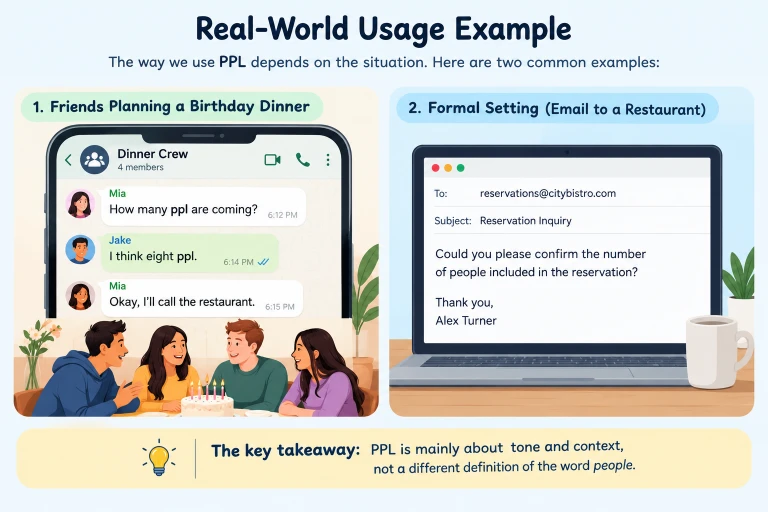
Imagine that a group of friends is planning a birthday dinner.
One friend sends a WhatsApp message:
“How many ppl are coming?”
Another friend replies:
“I think eight ppl.”
The first friend might then say:
“Okay, I’ll call the restaurant.”
There is nothing unusual or complicated about PPL in this situation. It simply makes the word “people” shorter.
Now imagine the same conversation in a formal setting. An employee might write an email to a restaurant:
“Could you please confirm the number of people included in the reservation?”
Writing people is more appropriate because the communication is professional.
This shows an important point: PPL is mainly about tone and context, not a different definition of the word people.
Why Do People Write PPL Instead of People?
There are several simple reasons.
It Is Faster to Type
PPL uses only three letters instead of six.
In a fast-moving conversation, people often shorten common words automatically.
It Looks Casual
Texting has its own informal style.
Using PPL can make a message feel more relaxed:
“What are ppl saying?”
Compared with:
“What are people saying?”
Both mean the same thing, but the first looks more like casual internet language.
It Fits Social Media
Short captions and comments often use abbreviations because users want to express an idea quickly.
For example:
“Things ppl do when they’re bored.”
is a natural social media-style caption.
It Has Become Familiar
People who have spent years texting or using online communities may recognize PPL immediately.
Once an abbreviation becomes familiar, users do not need to think about what each letter represents.
PPL vs. People: What Is the Difference?
The meaning is essentially the same, but the style is different.
| Writing | Style | Example |
| People | Standard | “People are waiting outside.” |
| PPL | Informal | “PPL are waiting outside.” |
Use people when you want standard English.
Use PPL when the conversation is casual and abbreviations are appropriate.
The choice is usually about context rather than meaning.
Common Mistakes When Understanding PPL
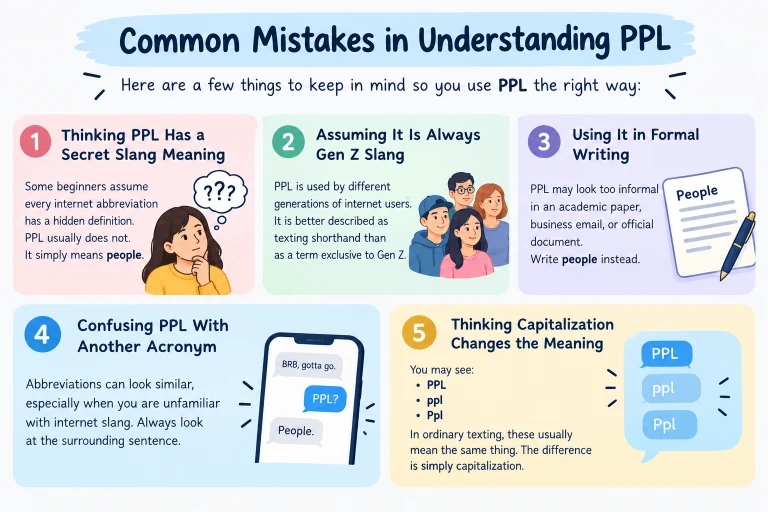
Mistake 1: Thinking PPL Has a Secret Slang Meaning
Some beginners assume every internet abbreviation has a hidden definition.
PPL usually does not.
It simply means people.
Mistake 2: Assuming It Is Always Gen Z Slang
PPL is used by different generations of internet users.
It is better described as texting shorthand than as a term exclusive to Gen Z.
Mistake 3: Using It in Formal Writing
PPL may look too informal in an academic paper, business email, or official document.
Write people instead.
Mistake 4: Confusing PPL With Another Acronym
Abbreviations can look similar, especially when you are unfamiliar with internet slang.
Always look at the surrounding sentence.
Mistake 5: Thinking Capitalization Changes the Meaning
You may see:
- PPL
- ppl
- Ppl
In ordinary texting, these usually mean the same thing.
The difference is simply capitalization.
Frequently Asked Questions
What Does “PPL” Stand for in Chat?
PPL stands for “people” in chat. It is a casual abbreviation often used in text messages, social media, and online conversations.
What Does “PPL” Mean?
PPL means “people.” It is a shortened form commonly used when someone wants to type quickly in casual communication.
What Is PPL in WhatsApp Chat?
In WhatsApp chat, PPL usually means “people.” For example, “Some ppl are coming” means “Some people are coming.”
What Does ): Mean in Text?
): is an emoticon that can show sadness, disappointment, or an unhappy feeling. Its exact meaning can depend on the conversation and the person using it.
What Is PPL in Text Slang?
In text slang, PPL is a casual abbreviation for “people.” You may see it in texts, comments, chats, and social media posts.
What Is a PPL?
A PPL can simply refer to “people” when used as a texting abbreviation. However, in other contexts, PPL can have different meanings, so the surrounding sentence matters.
Conclusion
So, what does PPL mean in text? In most casual online conversations, PPL means “people.” It is a short, informal abbreviation commonly found in text messages, social media comments, DMs, and online chats.
You may see it on TikTok, Snapchat, Instagram, WhatsApp, Reddit, Discord, and other platforms. The meaning usually stays the same even when the platform changes.
PPL is also not necessarily a modern Gen Z slang word. It is better understood as texting shorthand that developed alongside internet communication and the habit of shortening common words.
If a friend writes, “Are any ppl coming?” they are simply asking, “Are any people coming?” There is no hidden meaning that you need to decode.
For casual conversations, using PPL is generally fine. For school assignments, professional emails, reports, or other formal writing, people is the better choice.
The easiest rule to remember is simple: PPL = people. Look at the surrounding sentence to confirm the context, and you will usually understand the message immediately.
READ MORE!
- What Does TM Mean Slang? Meaning and Examples
- Malewife Slang: Meaning, Examples, Origin, and How to Use It
- Aurapilled Slang: Meaning, Origin, and How People Use It

Hi, I’m Ryan Holden, a content writer with over 8 years of experience creating clear, engaging, and easy-to-understand content. I specialize in slang meanings, internet language, text abbreviations, and modern English expressions. My goal is to explain complex words in simple English with real-life examples so readers can quickly understand and use them correctly. I enjoy researching how language changes across social media, online communities, and everyday conversations, ensuring every article is accurate, helpful, and easy to read.