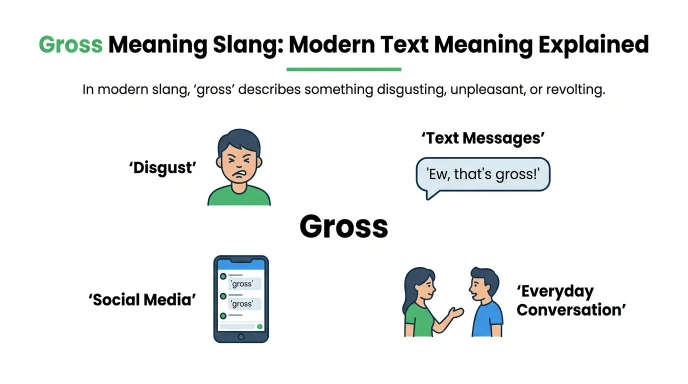
“Gross” is slang for something disgusting, unpleasant, or very unattractive.
Gross meaning slang is a common search because the word “gross” has a different meaning in casual conversations than it does in formal English.
While “gross” can refer to a total amount in math or business, in slang it usually expresses disgust, dislike, or something unpleasant.
You’ll often see it in text messages, TikTok videos, Instagram comments, memes, and everyday conversations.
People use gross to react to bad smells, strange behavior, spoiled food, or anything they find disgusting or uncomfortable.
Although it’s a simple word, its meaning depends on the situation and tone. This guide explains what gross means in slang, where it’s commonly used, and how to use it naturally.
What Does Gross Meaning Slang Mean in Text?
In texting and online conversations, gross is a quick way to express disgust or strong dislike.
People often use it as a reaction rather than a detailed explanation.
Examples
- Ew, that’s gross!
- That smell is gross.
- Gross! I can’t believe he did that.
- This food tastes gross.
The word usually shows a negative emotional reaction.
Gross Full Form / Definition of the Slang
Full Form
Gross does not have a full form.
It is a regular English adjective that has become a common slang expression.
Definition
In slang, gross means something that is disgusting, unpleasant, dirty, or disturbing.
What Does Gross Stand For?
It does not stand for anything. It is simply a word used informally to express disgust.
Is Gross Rude, Offensive, or Neutral?
Gross is generally mildly negative.
It is not considered offensive on its own, but it can hurt someone’s feelings if directed at them.
| Situation | Tone |
| Reacting to spoiled food | Neutral |
| Reacting to bad smells | Neutral |
| Describing a person’s behavior | Negative |
| Insulting someone’s appearance | Rude |
Use the word carefully when talking about people.
Where Is Gross Commonly Used?
Text Messages
Friends often react with “gross” when something sounds unpleasant.
Example:
You ate cold pizza from last week?
Gross!
Social Media
The word appears in comments, memes, and reaction videos.
Everyday Conversations
People use it to describe:
- Bad smells
- Dirty places
- Strange habits
- Unpleasant food
- Awkward situations
Online Videos
Reaction creators frequently say “gross” when responding to unusual content.
Real-Life Examples of Gross Usage
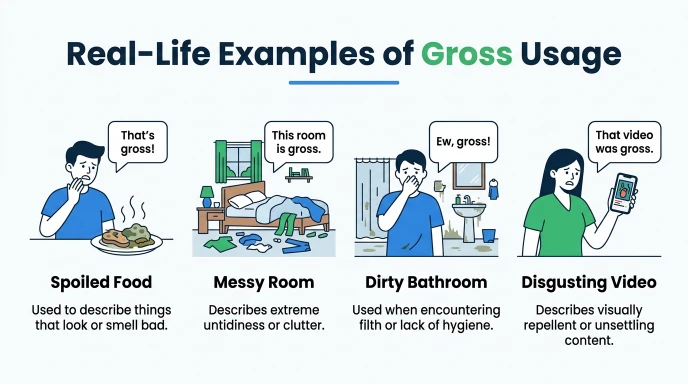
Friendly
That milk expired yesterday. Gross!
Casual
I stepped in mud without shoes. Gross.
Social Media
Gross! I can’t watch this video.
Argumentative
That’s a gross way to treat people.
Gaming
That camper strategy is gross!
(In gaming, “gross” can sometimes mean unfair, overpowered, or annoying rather than disgusting.)
Family Conversation
The trash needs to be taken out it smells gross.
Origin and Background of Gross Slang
The word gross has been part of the English language for centuries.
Originally, it meant:
- Large
- Total amount
- Whole quantity
Over time, another meaning developed:
Extremely unpleasant or disgusting.
By the late 20th century, teenagers frequently used gross! as a reaction to anything unpleasant.
Movies, television shows, and social media helped make it one of the most recognizable slang expressions in English.
Today, it remains common across all age groups.
Comparison with Similar Slang
| Slang | Meaning | Difference |
| Gross | Disgusting | Mild reaction |
| Ew | Expression of disgust | Short emotional response |
| Yuck | Disgust | Often playful |
| Nasty | Very unpleasant | Stronger than gross |
| Disgusting | Extremely unpleasant | More formal |
Although similar, gross sounds more conversational than “disgusting.”
When Should You Avoid Using Gross?
Avoid calling people or personal characteristics gross because it may sound insulting.
Also avoid using it:
- In professional emails
- Business meetings
- Academic writing
- Formal presentations
- Customer communication
Choose more respectful language in formal settings.
Polite Alternatives
If you want to sound more professional, try these alternatives.
| Gross | Polite Alternative |
| Gross | Unpleasant |
| Gross | Unsanitary |
| Gross | Dirty |
| Gross | Distasteful |
| Gross | Unappealing |
These expressions work better in formal communication.
Why Do People Use Gross?
People use gross because it quickly communicates emotion.
It expresses disgust
One word immediately explains how someone feels.
It’s easy to understand
Most English speakers recognize the meaning instantly.
It adds emotion
The word makes reactions stronger.
It’s widely accepted
People of different ages use it naturally.
It works online
Short reactions fit perfectly in comments and messages.
Impact of Using Gross in Communication
Like many emotional words, gross has advantages and disadvantages.
Benefits
- Easy to understand
- Expresses emotion quickly
- Common in everyday English
- Works well in casual conversations
- Fits social media reactions
Drawbacks
- May sound rude if directed at people.
- Can hurt someone’s feelings.
- Too informal for professional settings.
Choosing the right audience is important.
Is Gross Safe for Social Media?
Yes.
The word gross is safe to use on:
- TikTok
- X (Twitter)
- Snapchat
- Discord
- YouTube
It is commonly used to react to funny, strange, or unpleasant content.
However, avoid using it to bully or insult individuals.
Common Expressions with Gross
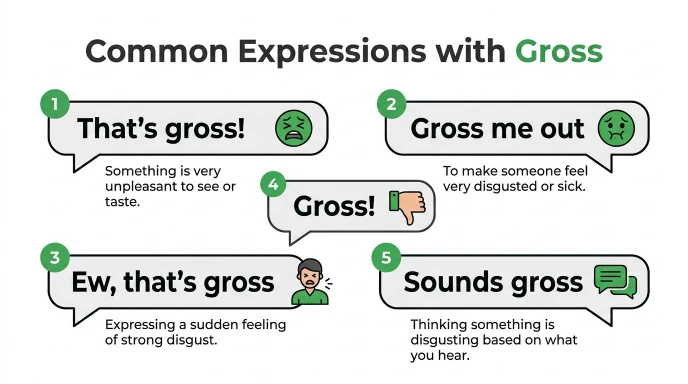
You’ll often hear these phrases.
- That’s gross.
- Ew, gross!
- So gross.
- Gross behavior.
- Gross food.
- Gross smell.
- Absolutely gross.
These expressions appear frequently in casual English.
Tips for Using Gross Naturally
Here are a few simple tips.
- Use it for unpleasant situations.
- Avoid calling people “gross.”
- Don’t overuse it in every conversation.
- Choose professional alternatives at work.
- Remember that tone changes how people interpret the word.
Comparison
| Expression | Meaning | Tone | Common Use |
| Gross | Disgusting | Casual | Everyday speech |
| Ew | Expression of disgust | Informal | Texting |
| Yuck | Disgust | Playful | Family conversations |
| Nasty | Very unpleasant | Strong | Casual |
| Unpleasant | Not enjoyable | Formal | Professional writing |
FAQs
What does gross mean in slang?
In slang, gross means disgusting, unpleasant, or revolting.
Does gross have a full form?
No. Gross is a regular English word and does not have a full form.
Is gross an offensive word?
Not usually. However, calling a person “gross” can sound rude or insulting.
Is gross still commonly used?
Yes. It remains one of the most popular words for expressing disgust in everyday English.
Can gross have different meanings?
Yes. In business, gross refers to the total amount before deductions. In slang, it means disgusting or unpleasant.
Can I use gross in professional communication?
It’s better to use words like unpleasant, unsanitary, or inappropriate in formal settings.
Conclusion
Understanding the gross meaning slang helps you recognize one of the most common expressions of disgust in modern English. In casual conversations, gross simply means disgusting, unpleasant, dirty, or revolting, and it’s often used as a quick emotional reaction to food, smells, behavior, or uncomfortable situations.
Although gross is perfectly acceptable in texting, social media, and everyday conversations, it should be used carefully when referring to people because it can sound insulting. By understanding the context and choosing the right tone, you can use this common slang naturally while avoiding misunderstandings.
Read more about!
Fax Slang: Complete Guide to Its Meaning and Usage
Funny UK Slang: A Complete Guide to British Words and Phrases
Dig 1960 Slang: Everything You Need to Know

Hi, I’m Zunaira Shafiq, a slang writer and language enthusiast. I enjoy exploring modern slang, internet expressions, texting abbreviations, and social media terms, then explaining them in simple, easy-to-understand English. My goal is to help readers understand the meaning, origin, and correct usage of popular slang words through clear definitions and real-life examples. I love making online language easier for students, language learners, and anyone who wants to stay updated with modern communication.