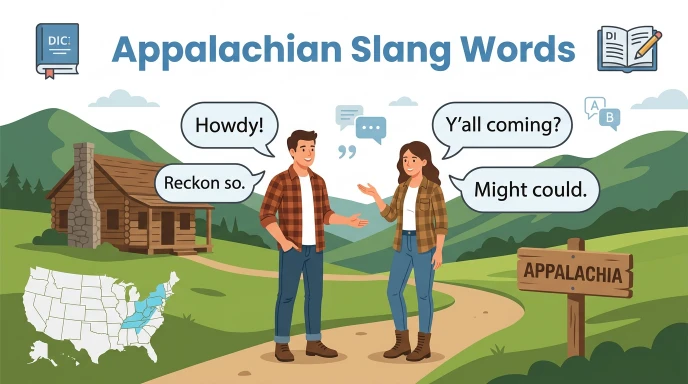
Appalachian slang words are informal words and expressions commonly used in the Appalachian region of the United States that reflect its unique culture, history, and everyday way of speaking.
Appalachian slang words are a unique part of American English that reflect the rich culture, history, and traditions of the Appalachian Mountains. People often search for these expressions after hearing them in conversations, movies, country music, TikTok videos, or television shows.
While many of these words are called “slang,” some are actually regional dialect terms that have been passed down through generations rather than modern internet slang.
These expressions are commonly heard in parts of Kentucky, Tennessee, West Virginia, Virginia, North Carolina, and neighboring Appalachian communities.
Understanding them can help you appreciate local culture and avoid confusion when speaking with people from the region.
Quick Answer:
Appalachian slang words are regional expressions and dialect terms commonly used throughout the Appalachian Mountains. Most are friendly, informal, and deeply connected to local culture and everyday life.
What Do Appalachian Slang Words Mean in Text?
When Appalachian expressions appear in text messages or social media, they usually keep the same meaning they have in everyday speech.
For example:
“Y’all fixin’ to head out?”
Meaning:
“Are you getting ready to leave?”
Unlike internet abbreviations such as LOL or BRB, Appalachian slang reflects regional speech rather than online culture.
Many younger users also share these phrases on:
- TikTok
- YouTube
- X (formerly Twitter)
to celebrate Appalachian heritage or explain local sayings.
Appalachian Slang Words Full Form
If you’re searching for Appalachian slang words full form, there isn’t one.
These are not abbreviations.
Instead, they are traditional regional words and expressions that developed naturally through generations of Appalachian English.
Many originated from influences including:
- Early English dialects
- Scottish English
- Irish English
- German immigrant speech
- Native American place names
As a result, Appalachian speech preserves words and pronunciations that have disappeared from many other parts of the United States.
Are Appalachian Slang Words Rude, Offensive, or Neutral?
Most Appalachian expressions are completely neutral.
| Expression Type | Tone |
| Family sayings | Friendly |
| Everyday conversation | Neutral |
| Humorous expressions | Casual |
| Traditional dialect | Respectful |
| Regional teasing | Depends on context |
Most words are intended to sound warm, familiar, and conversational rather than offensive.
Where Are Appalachian Slang Words Commonly Used?
These expressions are commonly heard in:
- Kentucky
- Tennessee
- West Virginia
- Virginia
- North Carolina
- South Carolina
- Georgia
- Eastern Ohio
- Parts of Pennsylvania
Today they also appear online through:
- TikTok creators
- Reddit communities
- YouTube channels
- Facebook groups
- Podcasts about Appalachian culture
Common Appalachian Slang Words and Their Meanings
Here are some of the best-known Appalachian expressions.
Y’all
Meaning:
“You all.”
Example:
“Y’all coming over tonight?”
Fixin’ To
Meaning:
Getting ready to do something.
Example:
“I’m fixin’ to cook dinner.”
Reckon
Meaning:
Think or suppose.
Example:
“I reckon it’ll rain later.”
Young’un
Meaning:
A young child or younger person.
Example:
“That young’un sure can run.”
Britches
Meaning:
Pants.
Example:
“Go change your britches.”
Holler
Meaning:
A small valley between mountains.
Example:
“She lives back in the holler.”
Catawampus
Meaning:
Crooked, uneven, or out of place.
Example:
“That picture is hanging catawampus.”
Tuckered Out
Meaning:
Very tired.
Example:
“I’ve been working all day. I’m tuckered out.”
Might Could
Meaning:
Possibly able to.
Example:
“I might could help tomorrow.”
Bless Your Heart
Meaning:
A phrase that can express kindness, sympathy, or gentle criticism depending on the tone.
Example:
“Bless your heart you tried.”
Real-Life Examples of Appalachian Slang
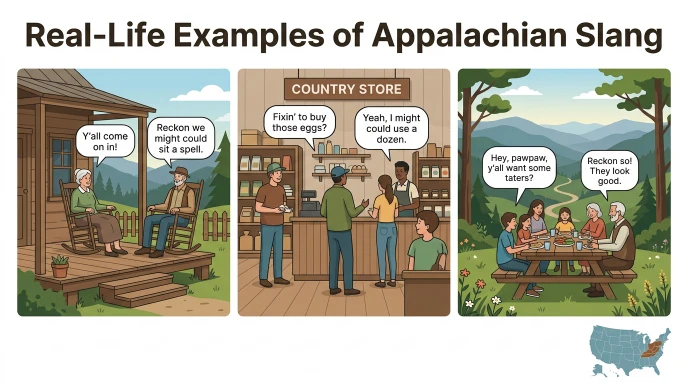
Friendly
“Y’all come back anytime.”
Casual
“I’m fixin’ to head home.”
Family
“That young’un has grown so much.”
Community
“We live down the holler.”
Humor
“That fence is catawampus.”
Origin and Background of Appalachian Slang Words
Appalachian English developed over hundreds of years.
The region’s mountainous geography helped preserve older forms of English brought by settlers from:
- England
- Scotland
- Ireland
Because many communities remained relatively isolated, traditional vocabulary survived long after it disappeared elsewhere.
Modern Appalachian speech also reflects local history, farming traditions, and strong family connections.
Many words considered “slang” today are actually part of a long-standing regional dialect.
Comparison with Other Regional American Slang
| Expression | Region | Meaning | Tone |
| Y’all | South & Appalachia | You all | Friendly |
| Fixin’ to | Southern U.S. | About to | Casual |
| Reckon | Appalachia | Think | Neutral |
| Wicked | New England | Very | Casual |
| Hella | West Coast | Extremely | Informal |
Unlike internet slang, Appalachian expressions have cultural and historical roots.
When to Avoid Using Appalachian Slang
Avoid heavy use of regional expressions when:
- Writing academic papers.
- Preparing business reports.
- Speaking with international audiences unfamiliar with the dialect.
- Writing legal or technical documents.
Using standard English is often the clearest choice in formal settings.
Polite Alternatives
Depending on the expression, you can substitute:
| Appalachian Expression | Standard English |
| Y’all | Everyone |
| Fixin’ to | About to |
| Reckon | Think |
| Young’un | Child |
| Britches | Pants |
| Holler | Valley |
| Tuckered Out | Very tired |
These alternatives are easier for readers unfamiliar with Appalachian English.
Why People Use Appalachian Slang Words
People continue using these expressions because they:
- Celebrate local identity.
- Preserve family traditions.
- Reflect regional history.
- Create a warm, conversational tone.
- Connect generations through language.
For many speakers, these words are simply part of everyday life rather than intentional slang.
Impact of Using Appalachian Slang in Communication
Using Appalachian expressions can make conversations feel authentic and welcoming.
Benefits
- Preserves regional culture.
- Strengthens community identity.
- Creates friendly conversations.
- Adds personality to speech.
- Reflects Appalachian heritage.
Possible Drawbacks
- Some expressions may confuse people outside the region.
- Meanings can vary slightly between communities.
- Formal audiences may expect standard English instead.
Understanding your audience helps you choose the most appropriate language.
Is Appalachian Slang Safe for Social Media?
Yes.
Appalachian slang words are commonly shared on:
- TikTok
- YouTube
- X (formerly Twitter)
Many creators use these expressions to teach regional culture, tell stories, or celebrate Appalachian traditions. Most are completely safe and appropriate for social media when used respectfully.
Real-Life Examples by Tone
Friendly
“Y’all have a wonderful weekend!”
Casual
“I’m fixin’ to mow the yard.”
Storytelling
“Grandpa lived way back in the holler.”
Family
“That young’un keeps everybody laughing.”
Social Media
“Only Appalachian folks know what catawampus really means!”
Frequently Asked Questions
What are Appalachian slang words?
They are regional expressions and dialect words traditionally used throughout the Appalachian Mountains in the eastern United States.
Are Appalachian slang words real English?
Yes. They are recognized parts of Appalachian English, a regional variety of American English with deep historical roots.
What does “fixin’ to” mean?
It means “about to” or “getting ready to.”
Is Appalachian slang offensive?
Most Appalachian expressions are friendly and neutral. However, as with any dialect, tone and context matter.
Are Appalachian slang words still used today?
Yes. Many people continue to use them in everyday conversation, and they are also popular on social media where creators share regional culture and traditions.
Are Appalachian slang words internet slang?
Not usually. They are primarily regional dialect expressions, though many now appear in online videos, memes, and social media posts.
Conclusion
Appalachian slang words are much more than casual expressions they are an important part of the Appalachian region’s cultural heritage and everyday communication. From familiar phrases like “fixin’ to” and “reckon” to colorful words such as “catawampus” and “holler,” these expressions reflect generations of history, community, and storytelling. Understanding Appalachian slang words, their meanings, and the contexts in which they are used can help you appreciate the richness of Appalachian English while communicating more naturally with people from the region. If you encounter these words in conversation, country music, or social media, recognizing their cultural background makes them easier to understand and enjoy.
Read more about!
- Monkey Meaning Slang: Meaning, History & Daily Usage
- FOV Meaning Slang: Simple Meaning & Everyday Usage
- Grassed Slang: Definition,Texting Examples & Everyday Usage

Hi, I’m Zunaira Shafiq, a slang writer and language enthusiast. I enjoy exploring modern slang, internet expressions, texting abbreviations, and social media terms, then explaining them in simple, easy-to-understand English. My goal is to help readers understand the meaning, origin, and correct usage of popular slang words through clear definitions and real-life examples. I love making online language easier for students, language learners, and anyone who wants to stay updated with modern communication.