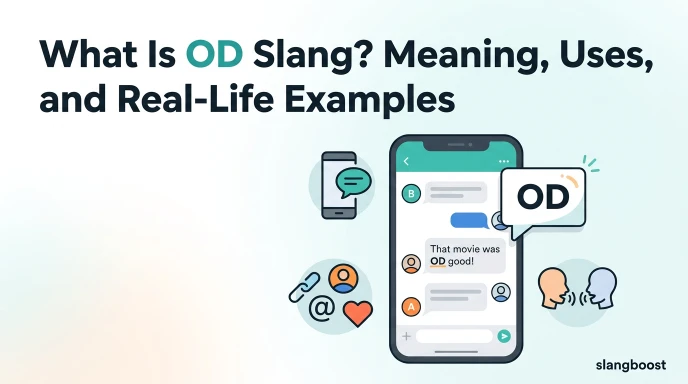
You may see OD in a text, comment, TikTok caption, or casual conversation and wonder what it means. In modern slang, OD often means something is extremely intense, excessive, or “too much.”
For example, someone might write, “That movie was OD funny.” This means the movie was extremely funny. A friend might also say, “You’re OD right now,” meaning you are doing too much or acting too dramatically.
There is another important meaning. OD can also mean “overdose,” especially in serious conversations about drugs or health. This is a completely different meaning.
That is why context matters when you see OD. A sentence like “OD funny” is casual slang, while “He had an OD” can refer to an overdose.
This guide explains the main slang meanings of OD, how people use it, where you may see it, and how to avoid confusing the meanings.
Quick Answer
| Question | Answer |
| Meaning | Too much, extremely, or overdoing it |
| Tone | Casual, informal, and often playful |
| Used By | Mostly people in casual and online conversations |
| Platforms | Texting, social media, chats, and casual posts |
| Offensive? | Usually no, but tone can make it critical |
| Other Meaning | OD can also mean overdose in a serious context |
What Does OD Mean in Slang?
In casual slang, OD can mean extremely, excessively, or too much.
It can describe a person’s behavior, a reaction, an emotion, or the level of something.
For example:
- “That food is OD good.” → That food is extremely good.
- “You are OD funny.” → You are extremely funny.
- “He is OD dramatic.” → He is being way too dramatic.
- “That game was OD hard.” → That game was extremely difficult.
- “You’re OD with the messages.” → You are sending too many messages.
OD can work like an intensifier. It makes the word or idea around it sound stronger.
Sometimes it also means overdoing it.
For example:
“Bro, you’re OD.”
This can mean:
“You’re doing too much.”
The exact meaning depends on the sentence and the speaker’s tone.
What Does OD Mean in Texting?
In texting, OD is usually used in a short and casual way.
Someone might send:
“That was OD 😂”
Depending on the conversation, this could mean something was extremely funny, intense, dramatic, or excessive.
Another example is:
“You OD for that.”
This can mean:
“You went too far with that.”
OD is useful in texting because it lets people express a strong reaction without writing a long sentence.
It is common in casual chats, but it is not a good choice for formal emails, school assignments, business writing, or official messages.
OD Meaning: “Too Much” or “Extremely”
One of the easiest ways to understand slang OD is to think of it as “very,” “extremely,” or “too much.”
Look at these examples:
| OD Example | Simple Meaning |
| OD funny | Extremely funny |
| OD tired | Extremely tired |
| OD expensive | Very expensive |
| OD good | Extremely good |
| OD annoying | Very annoying |
| OD dramatic | Way too dramatic |
The tone can be positive or negative.
For example, “That song is OD good” is positive.
But “That guy is OD annoying” is negative.
So OD itself does not always mean something bad. The word beside it usually tells you more about the speaker’s attitude.
OD Meaning as “Overdoing It”
Another common casual use is to say that someone is overdoing something.
For example:
“You’re ODing with these filters.”
This means:
“You’re using way too many filters.”
Someone might also say:
“She’s ODing over a small problem.”
That means:
“She is reacting too strongly to a small problem.”
In this form, you may see ODing, OD’d, or similar forms.
The meaning is usually about going beyond what seems normal or necessary.
OD vs. Overdose: Why Context Matters
This is the most important part of understanding OD.
OD can mean two very different things.
Casual Slang
In casual slang:
OD = extremely, excessively, or overdoing it
Example:
“That pizza was OD good.”
Here, there is no drug-related meaning.
Serious Meaning
In a health or drug-related context:
OD = overdose
Example:
“The news reported a fatal OD.”
Here, OD refers to an overdose and should be understood as a serious matter.
The dictionary meaning of OD as a drug overdose is well established, and dictionaries also record a broader use meaning having or experiencing too much of something.
Quick Comparison
| Phrase | Likely Meaning |
| “That movie was OD funny.” | Extremely funny |
| “You’re OD.” | You’re doing too much |
| “He OD’d on something.” | Could mean overdosing; context is serious |
| “There was an OD.” | Usually means an overdose |
| “This food is OD good.” | Extremely good |
When you are unsure, read the words around OD before deciding what it means.
Where OD Is Used
OD is mainly a casual expression, so you are more likely to see it in informal conversations than formal writing.
| Platform | How OD May Be Used | Example |
| Text Messages | Strong reaction or exaggeration | “That was OD funny.” |
| TikTok | Comments about something extreme | “Bro is OD 😂” |
| Captions or comments | “This outfit is OD good.” | |
| Snapchat | Casual friend-to-friend talk | “You’re OD today.” |
| Discord | Gaming or group conversations | “That boss is OD hard.” |
| Informal reactions | “That story is OD wild.” | |
| Casual texting | “You’re OD dramatic.” |
The exact frequency can vary by community, age group, and region. Do not assume that every person who uses social media uses OD in the same way.
OD in New York and Hip-Hop-Influenced Slang
OD is strongly associated with American informal slang and has been especially visible in New York and hip-hop-influenced language.
However, the exact history of the casual slang sense is not completely settled. It is safer to explain its modern use than to claim one definite person, song, or date created it.
The older OD = overdose meaning is well documented. The broader sense of having too much or overdoing something is also recorded in major dictionaries.
Over time, the casual meaning has appeared outside the communities where it became especially recognizable. That means someone may see OD online even if they are not familiar with its regional background.
Is OD Positive or Negative?
OD can be positive, negative, or neutral, depending on the sentence.
Positive
“That concert was OD good.”
The speaker means the concert was extremely good.
Negative
“You’re OD annoying today.”
The speaker thinks someone is being very annoying.
Playful
“Bro, you’re OD 😂.”
This can be a joking way to say someone is doing too much.
Tone matters a lot. Emojis, punctuation, and the relationship between the speakers can change how the message feels.
Is OD Rude or Offensive?
OD is not normally a swear word or an offensive slang term.
It is usually casual.
Still, the way you use it can sound rude. For example:
“You’re OD annoying.”
That directly criticizes someone.
Among friends, it may be playful. In a serious conversation, the same sentence could sound disrespectful.
It is best to use OD with people who understand casual slang.
Is OD Formal or Informal?
OD is informal slang when it is used to mean something is excessive or extreme.
Avoid it in:
- Job applications
- Business emails
- School essays
- Academic papers
- Official documents
- Professional reports
Instead of:
“The project was OD difficult.”
Use:
“The project was extremely difficult.”
Clear standard English is better when the audience may not know the slang.
How Do You Pronounce OD?
When OD is used as the abbreviation, it is normally pronounced:
“oh-dee”
The two letters are spoken separately.
For example:
OD funny
sounds like:
“oh-dee funny.”
The pronunciation is different from the ordinary word “odd.”
OD vs. Odd
These two can look or sound confusing.
| Term | Meaning |
| OD | Slang for extremely, excessively, or overdoing it |
| odd | Strange, unusual, or different |
Example:
“That movie was OD good.”
This means the movie was extremely good.
But:
“That movie was odd.”
This means the movie was strange or unusual.
The two terms should not be treated as the same word.
OD vs. Extra
OD and extra can sometimes describe similar behavior, but they are not always interchangeable.
Extra usually describes someone who is overly dramatic, emotional, or attention-seeking.
OD can have a broader meaning and may describe something as extremely intense, excessive, or too much.
For example:
“She is being extra.”
means she is acting overly dramatic.
“She is OD dramatic.”
means she is extremely dramatic.
The difference is small in some sentences, but the tone can change.
Real-Life Examples of OD Slang
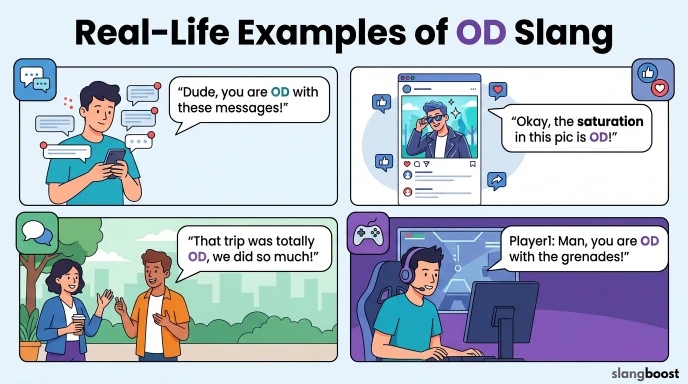
Text Message
Marcus: “Did you see the price of those shoes?”
Jordan: “Yeah, they’re OD expensive.”
Here, OD means extremely.
Social Media Comment
Nia: “This video has me crying 😂”
Kayla: “The ending was OD funny.”
Here, OD strengthens the word funny.
Friend Conversation
Damon: “You sent me 30 messages.”
Chris: “My bad 😂”
Damon: “Bro, you OD.”
Here, OD means you are doing too much.
Gaming Chat
Ethan: “That new boss is OD hard.”
Noah: “I know. I lost three times.”
Here, OD means extremely.
Everyday Conversation
Maya: “Why are you still talking about that small mistake?”
Avery: “I’m not!”
Maya: “You’re OD stressing about it.”
Here, OD suggests that the person is taking the situation too far.
Common Mistakes When Using OD
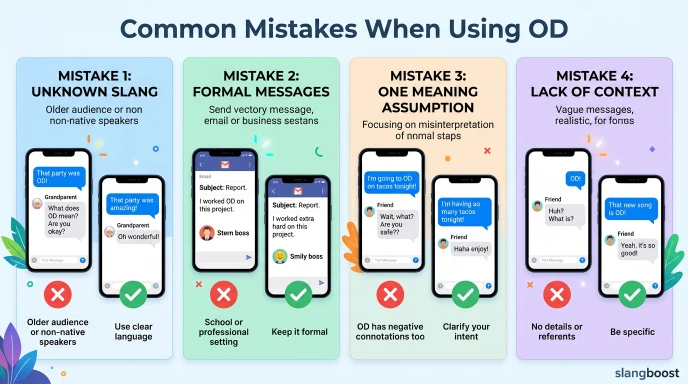
1. Assuming OD Always Means Overdose
This is one of the biggest mistakes.
If someone says:
“That movie was OD good.”
They are almost certainly using casual slang, not talking about an overdose.
2. Assuming OD Always Means “Overdoing It”
The opposite mistake can also cause confusion.
If the conversation is about drugs or a medical emergency, OD may refer to an overdose.
Always check the surrounding words.
3. Using OD in Formal Writing
OD is casual slang.
Writing “OD good” in a school essay or professional report can make your writing sound too informal.
4. Thinking OD Is Always Negative
OD can describe something positive.
“That food is OD good.”
This is a compliment.
5. Confusing OD With “Odd”
OD and odd are different.
OD is slang or an abbreviation.
Odd means strange or unusual.
Key Takeaways
- OD slang can mean extremely, excessively, or too much.
- It can also mean someone is overdoing something.
- OD can describe positive or negative situations.
- In serious drug-related contexts, OD can mean overdose.
- Context is the best way to understand which meaning is intended.
- OD is informal and is better suited to casual conversations than formal writing.
FAQs
What does “OD” mean in chat?
In chat, OD usually means “overdose” or “overdoing it,” depending on the context. For example, “You’re OD today” can mean “You’re doing too much.”
What does OD mean in slang Gen Z?
In Gen Z slang, OD often means “overdoing it” or “doing something excessively.” It can describe someone who is being too dramatic, excited, funny, or intense.
What is OD in New York slang?
In New York slang, OD commonly means “very,” “a lot,” or “extremely.” For example, “That food was OD good” means “That food was extremely good.”
What does OD mean on TikTok?
On TikTok, OD can mean “overdoing it” or “excessively,” depending on the video or caption. Context is important because OD can have other meanings too.
What does OD slang for?
In slang, OD can stand for or mean “overdoing it,” “overdose,” or “overly/excessively,” depending on the context and community using it.
What does OD mean on Snapchat?
On Snapchat, OD is often used to mean “overdoing it” or “a lot/extremely.” For example, “You’re OD funny” can mean “You’re extremely funny.”
Conclusion
OD slang is a short expression that can mean extremely, excessively, too much, or overdoing it. You may see it in texts, social media comments, casual conversations, and online chats.
The meaning can change with the sentence. “That food is OD good” means the food is extremely good, while “You’re OD” can mean someone is doing too much. The term can also have a serious meaning because OD is commonly used as an abbreviation for overdose.
That difference makes context especially important. Look at the words around OD before deciding what someone means.
For casual conversations, OD can be a quick way to add emphasis. For formal writing, standard words such as “extremely” or “excessively” are usually a better choice.
READ MORE!
- What Is a Blinker Slang? Meaning, Uses, and Examples
- What Is Fein Slang? The Meaning Behind This Popular Term
- Hooky Meaning Slang: What Does “Hooky” Mean in Text?

Hi, I’m Ryan Holden, a content writer with over 8 years of experience creating clear, engaging, and easy-to-understand content. I specialize in slang meanings, internet language, text abbreviations, and modern English expressions. My goal is to explain complex words in simple English with real-life examples so readers can quickly understand and use them correctly. I enjoy researching how language changes across social media, online communities, and everyday conversations, ensuring every article is accurate, helpful, and easy to read.