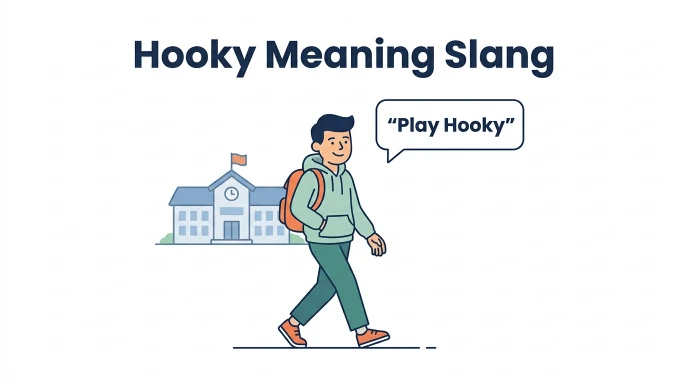
“Hooky meaning slang” usually refers to the informal expression “play hooky,” which means skipping school, work, or another responsibility without permission.
You may see it in casual conversations, texts, social posts, movies, or stories about taking an unplanned day off. The term is especially associated with American English and is generally playful rather than strongly offensive. Dictionaries identify play hooky as an informal way to say that someone stays away from school or work without permission.
However, hooky can have another meaning as an adjective. In music, for example, “hooky” can describe something catchy or easy to remember, such as a memorable chorus.
Quick Answer
Hooky is informal slang, usually used in “play hooky,” meaning to skip school, work, or another obligation without permission. In music, hooky can also mean catchy or memorable.
What Does Hooky Mean in Text?
In texting and casual conversation, hooky most often appears in the phrase “play hooky.”
When someone says:
“I’m thinking about playing hooky today.”
They usually mean:
“I’m thinking about skipping school or work today without permission.”
The phrase can describe a planned absence for something enjoyable, such as going to the beach, watching a movie, meeting friends, or simply relaxing.
For example:
- “We played hooky and went to the beach.”
- “He wants to play hooky from work tomorrow.”
- “I played hooky from class to hang out with my friends.”
The expression normally has a casual, slightly mischievous tone. It often makes skipping an obligation sound playful rather than serious.
Cambridge describes play hooky as staying away from school or work without permission and notes that it is mainly used in informal American English.
Hooky Slang Full Form
Hooky does not have a standard full form.
It is not an acronym like “LOL” or “BRB.” Instead, hooky is an informal word that developed into the expression “play hooky.”
So if someone asks:
“What does hooky stand for?”
The best answer is:
It does not stand for a set of words; it is an informal term used mainly in the phrase “play hooky.”
What Does “Play Hooky” Mean?
Play hooky means deliberately staying away from school, work, or another obligation without permission.
The important part is that the absence is usually intentional.
For example:
“Sarah played hooky from school to go shopping.”
This suggests Sarah was supposed to attend school but chose to go shopping instead.
Similarly:
“Tom played hooky from work to watch the game.”
This means Tom skipped work so he could watch the game.
The phrase can apply to both school and work, although school is one of its most traditional contexts. Oxford describes play hookey/play hooky as an informal expression for staying away from school without permission.
Is Hooky Rude or Offensive?
Usually, no.
“Hooky” is generally a mild, informal expression. It is not normally considered a profanity, slur, or offensive term.
However, the action it describes may still be viewed negatively.
For example, saying:
“I played hooky today.”
is casual and often humorous.
But saying:
“He always plays hooky and never does his work.”
can sound critical because the speaker is criticizing someone’s behavior.
So the word itself is not particularly offensive. The tone depends more on the situation and the speaker’s attitude.
Tone of “Hooky”
Depending on context, it can sound:
- Playful
- Casual
- Mischievous
- Humorous
- Slightly irresponsible
- Critical when used negatively
Where Is Hooky Commonly Used?
“Hooky” is most strongly associated with informal American English. Cambridge labels it mainly U.S. informal, while Collins also identifies the truancy sense as informal and mainly used in the U.S., with usage also found in some other varieties of English.
You may encounter it in:
- Text messages
- Casual conversations
- Social media captions
- Movies and TV shows
- School-related conversations
- Workplace jokes
- Online discussions
- Personal stories
On platforms such as TikTok, Instagram, Reddit, Snapchat, or Discord, someone might use “playing hooky” casually when talking about skipping an obligation.
For example:
“POV: You played hooky and spent the day at the beach.”
Here, the phrase is being used humorously to describe taking an unofficial day away from responsibilities.
Real-Life Examples of Hooky Slang
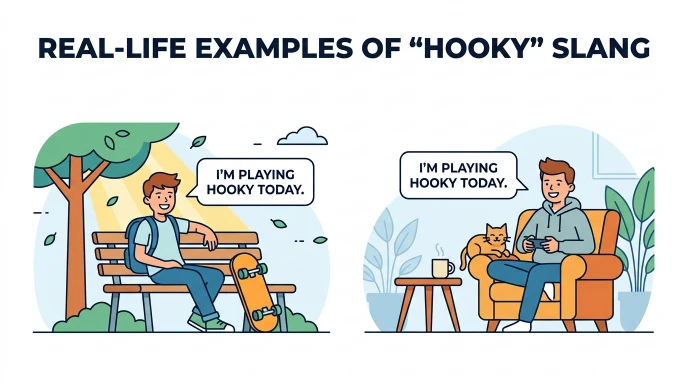
The easiest way to understand this slang is to see how it works in different situations.
1. Friendly Example
“Want to play hooky and grab lunch?”
This sounds like a friend jokingly suggesting that someone skip an obligation.
2. School Example
“They played hooky from class and went to the arcade.”
Here, “played hooky” clearly means they skipped class without permission.
3. Workplace Example
“I kind of want to play hooky from work today.”
The speaker is casually saying they want to skip work.
4. Social Media Example
“Played hooky today and went hiking instead.”
This could work as a casual caption describing an unofficial day away from normal responsibilities.
5. Humorous Example
“My alarm went off, but I decided to play hooky with my bed.”
This is a playful variation rather than a literal use of the traditional phrase.
6. Conversational Example
Person A: “Where were you yesterday?”
Person B: “I played hooky.”
The second person is saying they intentionally missed school, work, or another expected activity.
Hooky as an Adjective: A Different Meaning
There is another legitimate meaning of hooky that is unrelated to skipping school or work.
When describing music, hooky can mean catchy, memorable, or easy to remember. Cambridge gives this meaning for pop music that is particularly pleasing and memorable.
For example:
“That song is really hooky.”
This means the song has a catchy quality, often because its melody or chorus sticks in your mind.
Another example:
“The chorus is so hooky that I can’t stop singing it.”
Here, “hooky” has nothing to do with truancy.
Two Main Meanings
| Meaning | Example | Explanation |
| Play hooky | “I played hooky from school.” | Skip school or work without permission |
| Hooky music | “That song is really hooky.” | Catchy or easy to remember |
Context is therefore important.
Hooky vs. Skip
Skip is much broader than play hooky.
You can say:
“I skipped class.”
or
“I skipped breakfast.”
But “play hooky” specifically suggests intentionally staying away from an obligation, especially school or work.
| Term | Meaning | Tone |
| Play hooky | Skip school/work without permission | Casual, playful |
| Skip class | Miss a class | Neutral/informal |
| Skip work | Miss work intentionally | Casual |
| Play truant | Stay away from school without permission | More formal |
| Take a day off | Have approved or planned time away | Neutral |
The British English equivalent of play hooky is commonly play truant, although the expressions do not always have exactly the same casual feel.
Hooky vs. Truancy
These words are related but have different tones.
Truancy is the more formal term for unauthorized absence from school.
Playing hooky is informal and conversational.
For example:
- Formal: “The school reported repeated truancy.”
- Casual: “He played hooky again.”
The first sounds like something you might see in an official school report. The second sounds like everyday conversation.
Why Do People Say “Play Hooky”?
The expression gives an informal, almost playful name to skipping an obligation.
Compare:
“I was absent from work without permission.”
with:
“I played hooky from work.”
The second sentence sounds much more casual.
That is one reason the phrase works well in conversations and stories. It can describe irresponsible behavior without making the statement sound overly serious.
People may also use it jokingly when the absence is relatively harmless, such as taking an unofficial afternoon away from routine responsibilities.
Origin and Background of Hooky
The exact origin of hooky is not completely certain.
Merriam-Webster lists the noun sense as dating to the 1840s and gives a probable connection to slang hook / hook it, meaning to make off or leave.
Etymonline dates the truancy sense to 1848 American English and notes two proposed explanations: a connection with “hook it” meaning to escape or make off, or a possible connection to Dutch hoekje, associated with hide-and-seek.
Because the etymology is uncertain, it is better not to present one origin as proven fact.
What is clear is that hooky was established in American English in the 19th century, especially in the phrase “play hooky.” Historical sources also show the term in New York-area usage during that period.
Is Hooky Old Slang?
Yes, in the sense that the “play hooky” expression has been around for well over a century.
Oxford currently labels the term North American English and old-fashioned, while modern dictionaries still recognize it as an informal expression.
That means you can still encounter “play hooky” today, but it may sound more traditional than newer internet slang.
It remains familiar to many English speakers, particularly in American English.
When Should You Avoid Using Hooky?
There is nothing inherently offensive about the word, but it is still informal.
Avoid using “play hooky” when you need highly formal or precise language.
For example, in a professional report, instead of:
“The employee played hooky.”
you would normally write something like:
“The employee was absent without authorization.”
Similarly, a school document would generally use terms such as unauthorized absence or truancy rather than “playing hooky.”
Better Contexts for Hooky
Use it in:
- Casual conversations
- Text messages
- Friendly jokes
- Social media captions
- Informal storytelling
- Entertainment-related writing
Avoid it in:
- Legal documents
- Official school reports
- Formal business communication
- Academic writing
- Serious workplace documentation
Polite and Formal Alternatives
If you want to communicate the idea without slang, several alternatives are available.
Instead of “play hooky,” you can say:
- Skip school
- Miss class
- Miss work
- Be absent
- Take an unauthorized absence
- Stay away without permission
- Play truant
The best choice depends on the situation.
“Miss class” sounds neutral.
“Take an unauthorized absence” sounds formal.
“Play hooky” sounds casual and sometimes humorous.
Common Mistakes With Hooky
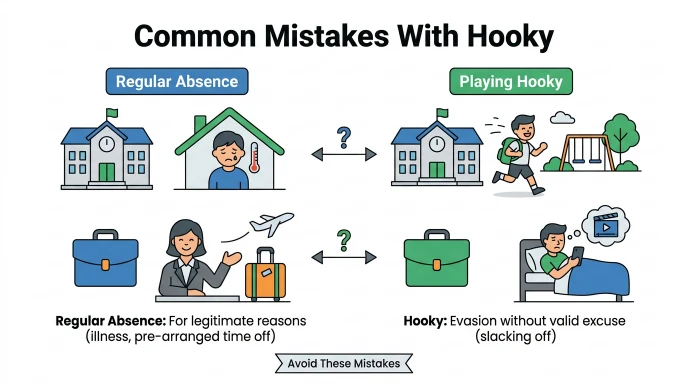
Mistake 1: Treating Hooky Like an Acronym
Hooky is not normally an abbreviation or acronym.
It does not have a standard “full form.”
Mistake 2: Forgetting the Phrase “Play Hooky”
People usually encounter the truancy meaning in the phrase “play hooky.”
Simply saying “hooky” without context can be less clear.
Mistake 3: Assuming It Always Means Skipping School
Context matters.
“Play hooky” relates to skipping an obligation, while “hooky song” can describe something catchy.
Mistake 4: Using It in Formal Writing
Because it is informal, “play hooky” is usually not the best choice for official or academic writing.
Mistake 5: Assuming It Is Offensive
“Hooky” is generally not a swear word or slur. It is an informal expression describing an absence.
Why People Search for “Hooky Meaning Slang”
People often encounter “play hooky” in American movies, TV shows, books, social media posts, or conversations and may not immediately understand what it means.
The confusion can come from the word itself.
If someone says:
“Let’s play hooky tomorrow.”
a learner may wonder if “hooky” is a game, activity, nickname, or abbreviation.
In reality, the expression usually means taking time away from school, work, or another obligation without permission.
Understanding the surrounding words is therefore important.
Is Hooky Safe for Social Media?
Generally, yes.
“Hooky” is a mild informal expression and is not inherently explicit or offensive. It can be used in ordinary social media captions and casual posts.
For example:
“Playing hooky for a beach day ☀️”
is a harmless casual use.
However, the context still matters. If the post is about serious misconduct or breaking important rules, the phrase may make the behavior sound more playful than it actually is.
Frequently Asked Questions
1. What does hooky mean in slang?
Hooky usually appears in “play hooky,” meaning to skip school, work, or another obligation without permission.
2. Is hooky a bad word?
No. Hooky is not generally considered a bad word. It is informal slang and can have a playful or humorous tone.
3. What does “playing hooky” mean?
“Playing hooky” means intentionally staying away from school, work, or another expected responsibility without permission.
4. Does hooky have another meaning?
Yes. As an adjective, hooky can describe music that is catchy and easy to remember.
5. Is hooky mainly American slang?
The “play hooky” sense is strongly associated with American English and is commonly labeled informal U.S. usage, although the term is also recognized elsewhere.
6. What is the British equivalent of play hooky?
A common British equivalent is “play truant.” It refers to staying away from school without permission.
Conclusion
Hooky meaning slang is mainly connected with the informal phrase “play hooky,” which means intentionally skipping school, work, or another obligation without permission. It is a casual expression that often carries a playful or mischievous tone rather than an offensive one.
The term is especially associated with American English and has been used for well over a century. Its exact origin is uncertain, with dictionaries noting more than one possible explanation.
Context is important because hooky can also describe music that is catchy or memorable. If you see “play hooky,” think “skip an obligation.” If you see “a hooky song,” think “catchy song.”
For everyday texting and casual conversation, “play hooky” is easy to understand. For formal writing, however, phrases such as unauthorized absence, miss class, or be absent are usually clearer and more appropriate.
Read more about!
- What Does AWL Mean in Slang? AWL Meaning in Text
- FTM Slang: What Does FTM Mean in Text?
- BNB Meaning Slang: What Does BNB Mean in Text?

Hi, I’m Zunaira Shafiq, a slang writer and language enthusiast. I enjoy exploring modern slang, internet expressions, texting abbreviations, and social media terms, then explaining them in simple, easy-to-understand English. My goal is to help readers understand the meaning, origin, and correct usage of popular slang words through clear definitions and real-life examples. I love making online language easier for students, language learners, and anyone who wants to stay updated with modern communication.