What does JFC mean in slang is a question many people ask after seeing the abbreviation in text messages, gaming chats, social media comments, or online forums.
Internet slang changes quickly, and abbreviations like JFC can be confusing if you are not familiar with modern online communication. Understanding what it means helps you avoid misunderstandings and respond appropriately.
In most cases, JFC is used to express strong emotions such as surprise, frustration, disbelief, excitement, or shock. While it is common in casual conversations, it contains profanity and may offend some people because it references a religious figure.
Knowing its meaning, origin, and the right situations to use it will help you communicate more confidently online.
Quick Answer:
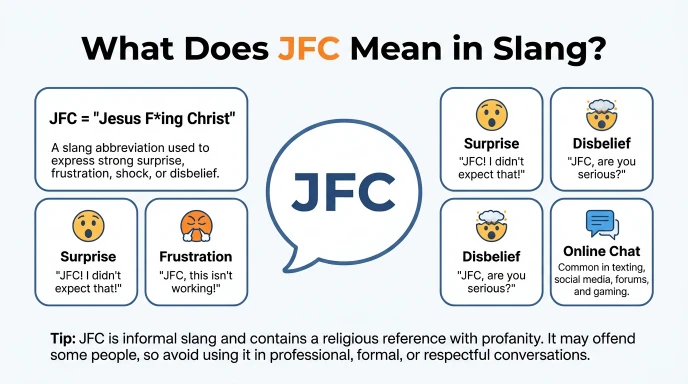
JFC usually stands for “Jesus F*ing Christ.”** It is a slang expression used to show strong surprise, frustration, shock, or disbelief in casual online conversations.
What Does JFC Mean in Slang?
What Does JFC Mean in Text?
When someone writes JFC in a text message, social media comment, or online chat, they are usually expressing a strong emotional reaction. It is not meant to be taken literally. Instead, it works as an exclamation, similar to saying “Wow!” but with much stronger emotion.
People often use JFC when they are shocked, amazed, annoyed, or frustrated by something unexpected.
Example:
- “JFC, I can’t believe that actually happened!”
- “JFC, this traffic is unbelievable.”
Because it contains profanity, it is considered informal and should only be used in casual conversations.
Full Form of JFC
The most common full form of JFC is:
JFC = Jesus F*ing Christ**
This expression is widely used across the internet as a reaction to surprising or frustrating situations.
Although JFC can sometimes represent company names, organizations, or personal initials, these meanings are uncommon. In texting and internet slang, the abbreviation almost always refers to the expression above.
Is JFC Rude, Offensive, or Neutral?
Is JFC Offensive?
Yes. Many people consider JFC offensive because it combines profanity with the name of Jesus Christ. Some users see it as casual internet slang, while others find it disrespectful or inappropriate.
If it is offensive depends on:
- Your audience
- The conversation
- Cultural and religious beliefs
- The platform where it is used
For these reasons, it is best to avoid using JFC in formal situations.
When Is It Acceptable?
Among close friends who understand internet slang, JFC is often used jokingly or casually.
For example:
Friend 1: “My phone fell into the pool.”
Friend 2: “JFC, seriously?”
Here, the abbreviation simply expresses surprise.
When Should You Avoid It?
Avoid using JFC in:
- Business emails
- Workplace communication
- School assignments
- Professional presentations
- Customer service conversations
- Formal social media posts
Using it in these situations can appear disrespectful or unprofessional.
Where Is JFC Commonly Used?
Text Messages
Friends frequently use JFC while chatting about unexpected events.
Example:
Alex: “I forgot my passport.”
Ryan: “JFC, your flight leaves tomorrow!”
Social Media
People often comment JFC on surprising news, viral videos, sports highlights, or celebrity posts.
Example:
“JFC, I didn’t expect that ending.”
Online Gaming
Gamers use JFC during exciting or frustrating moments.
Example:
“JFC, that boss battle was impossible.”
Online Forums
Communities on Reddit and discussion forums often use JFC to react to stories or opinions.
Example:
“JFC, that’s one of the craziest things I’ve ever read.”
Origin and Background of JFC
Where Did JFC Come From?
The phrase “Jesus Christ” has been used as an emotional exclamation in English for many years. Over time, people added stronger words to increase its emotional impact.
As texting and internet culture became popular, users shortened the phrase to JFC to type faster while keeping the same emotional meaning.
Today, it is widely recognized across:
- Online gaming communities
- Reddit discussions
- Social media platforms
- Text messaging
- Internet forums
Why Did It Become Popular?
There are several reasons why JFC became popular online.
- It is short and quick to type.
- It expresses strong emotions immediately.
- It is commonly understood by internet users.
- It fits fast-paced online conversations.
These advantages helped JFC become one of the most recognizable internet abbreviations.
Why People Use JFC
To Show Surprise
Many people type JFC when something unexpected happens.
Example:
“JFC, you actually won the lottery?”
To Express Frustration
It also shows annoyance when things go wrong.
Example:
“JFC, my internet stopped working again.”
To Show Disbelief
Sometimes users cannot believe what they have just seen or heard.
Example:
“JFC, that’s unbelievable.”
To React Quickly
Instead of typing a full sentence, people use JFC as a fast emotional response during online conversations.
Example:
Friend: “The meeting starts in five minutes.”
Reply: “JFC, I completely forgot!”
Comparison with Similar Slang
JFC vs OMG
| Slang | Full Form | Emotion | Offensive? | Best Used In |
| JFC | Jesus F***ing Christ | Strong surprise, frustration, disbelief | Yes | Casual chats with close friends |
| OMG | Oh My God | Surprise or excitement | Mildly offensive to some | Everyday texting and social media |
| WTF | What The F*** | Confusion, anger, shock | Yes | Informal conversations |
| SMH | Shaking My Head | Disappointment or frustration | No | Texting and social media |
| FFS | For F***’s Sake | Annoyance or impatience | Yes | Informal online chats |
When to Avoid Using JFC
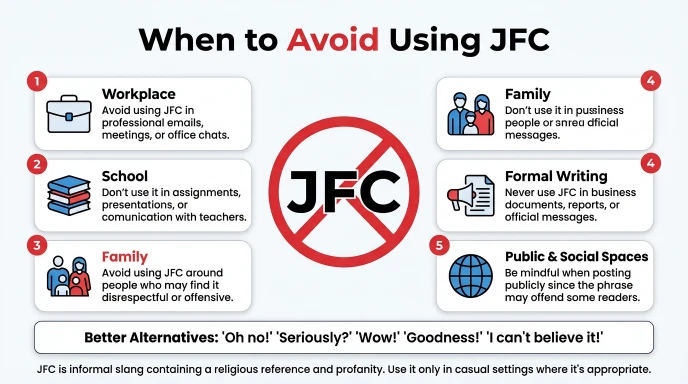
Professional Communication
Never use JFC in work emails, meetings, or messages with clients. It can make you appear unprofessional and may offend coworkers.
School or Academic Settings
Teachers and classmates may view the abbreviation as inappropriate because it contains profanity.
Public or Formal Social Media
If you’re posting on LinkedIn or representing a business or organization, avoid using JFC. A more neutral expression creates a better impression.
Conversations with Religious People
Some people find JFC disrespectful because it references Jesus Christ in a profane way. If you’re unsure how someone might react, choose a different expression.
Polite Alternatives to JFC
If you want to express surprise or frustration without using offensive language, consider these alternatives:
- Wow!
- Oh my goodness!
- Seriously?
- Unbelievable!
- That’s crazy!
- No way!
- I can’t believe it!
- Good grief!
These alternatives work well in both casual and professional conversations.
Real-Life Examples of JFC Usage
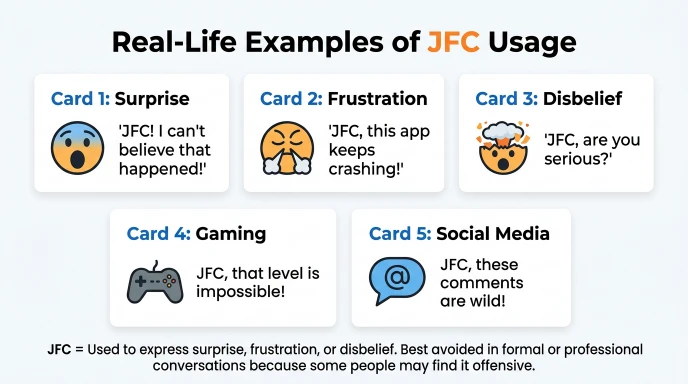
Friendly Conversation
Emma: “I finally passed my driving test.”
Sarah: “JFC, that’s awesome! Congratulations!”
Casual Texting
Jake: “My phone fell into the swimming pool.”
Chris: “JFC, are you serious?”
Argumentative Situation
Alex: “You deleted the entire project?”
Ryan: “JFC, I thought it was the old file.”
Gaming Chat
Player 1: “We defeated the final boss!”
Player 2: “JFC, that was intense!”
Social Media Comment
A user watches a shocking sports highlight and comments:
“JFC, that has to be the best goal of the season!”
Impact of Using Slang in Communication
Makes Conversations More Expressive
Slang helps people quickly express emotions such as excitement, surprise, or frustration.
Creates a Casual Tone
Internet slang like JFC makes conversations feel more relaxed among friends and online communities.
Saves Time
Typing JFC is much faster than writing a longer emotional reaction.
Can Cause Misunderstandings
Not everyone knows internet slang. Some readers may misunderstand the abbreviation or interpret it differently.
May Offend Others
Because JFC contains profanity and a religious reference, some people may find it offensive. Understanding your audience is essential.
Is JFC Safe for Social Media?
Yes, but only in the right context.
Using JFC in private chats or casual discussions with friends is generally acceptable if everyone understands the slang. However, avoid using it:
- On professional social media accounts
- In business-related posts
- When communicating with clients
- In educational communities
- If your audience may find it offensive
If you’re unsure, using a neutral expression is always the safer choice.
FAQs
What does JFC mean in slang?
JFC usually stands for “Jesus F*ing Christ.”** It is an internet slang expression used to show surprise, frustration, disbelief, or shock.
What does JFC stand for in text messages?
In texting, JFC almost always stands for “Jesus F*ing Christ.”**
Is JFC considered rude?
Yes. Many people consider it rude because it includes profanity and a religious reference.
Is JFC commonly used online?
Yes. It is popular on social media, Reddit, gaming platforms, online forums, and text messages.
Can I use JFC at work?
No. It is not appropriate for professional or formal communication.
What is a polite alternative to JFC?
You can use Wow!, Oh my goodness!, Seriously?, or Unbelievable! instead.
Conclusion
What does JFC mean in slang is a common question among people who encounter the abbreviation in text messages, gaming chats, and social media. In most situations, JFC stands for “Jesus F*ing Christ”** and is used to express strong emotions such as surprise, frustration, excitement, or disbelief. Although it is widely understood in casual online conversations, it contains profanity and may offend some people because of its religious reference.
Before using JFC, always consider your audience and the situation. It may be acceptable among close friends who understand internet slang, but it should be avoided in workplaces, schools, formal writing, and professional communication. Knowing its meaning, origin, and appropriate usage will help you communicate more effectively while showing respect for others.
Read more about!
- Alcohol Slang Names: A Complete Guide to Popular Drinking Slang
- Pinky Meaning Slang: Definition, Texting Examples & Uses
- LMR Slang: Modern Meaning Explained Simply

Hi, I’m Zunaira Shafiq, a slang writer and language enthusiast. I enjoy exploring modern slang, internet expressions, texting abbreviations, and social media terms, then explaining them in simple, easy-to-understand English. My goal is to help readers understand the meaning, origin, and correct usage of popular slang words through clear definitions and real-life examples. I love making online language easier for students, language learners, and anyone who wants to stay updated with modern communication.