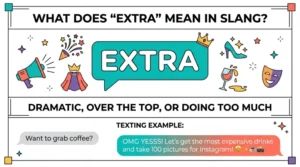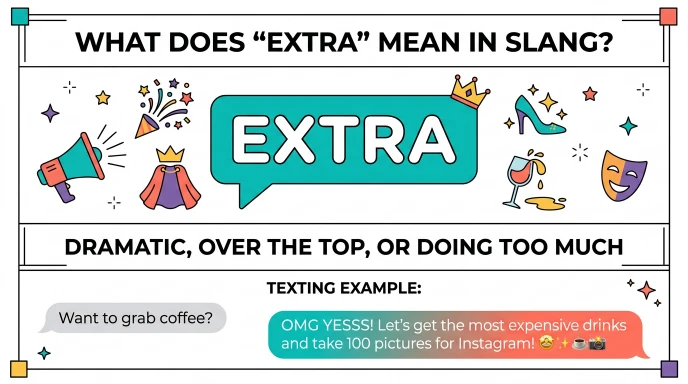
What does extra mean in slang? If someone calls you “extra,” they usually mean you are being overly dramatic, emotional, loud, flashy, or doing more than the situation requires.
The word is common in casual conversations, texting, social media, and online communities.
For example, if a friend turns a small problem into a huge reaction, someone might jokingly say, “You’re being so extra!” It can be playful, teasing, or mildly critical depending on the tone.
The extra meaning in slang is not always negative. Sometimes it describes someone who enjoys attention, fashion, excitement, or making a situation bigger and more entertaining.
Quick Answer:
In slang, extra usually means acting overly dramatic, excessive, or doing more than necessary. It can also describe someone who is very flashy or attention-seeking.
What Does Extra Mean in Slang?
In everyday slang, extra describes behavior that seems excessive or more dramatic than needed.
Someone might be called extra because they:
- Overreact to a small situation
- Make a simple event very dramatic
- Want a lot of attention
- Dress in a very flashy way
- Put too much effort into something
- Make their feelings very obvious
The meaning depends heavily on context.
If a friend says, “You’re so extra 😂,” it may simply be playful teasing. But if someone says, “He is always extra at work,” it could be criticism of behavior that seems unnecessary or distracting.
Extra Meaning in Text
When extra appears in a text message, it usually means over-the-top, dramatic, or excessive.
For example:
“Why did you send 20 messages? You’re extra.”
Here, “extra” means the person did more than necessary.
Another example is:
“She brought decorations, gifts, and a cake for a small meeting. She’s so extra!”
In this case, the speaker may be teasing rather than insulting the person.
Because text messages do not always show facial expressions or voice tone, emojis and surrounding words can help reveal if “extra” is meant positively or negatively.
Extra Full Form and Definition
Extra does not have a special slang full form. It is an ordinary English word that developed an informal slang use.
In standard English, “extra” can mean additional or more than what is needed. In slang, that basic idea is applied to a person’s behavior.
So, what does extra stand for? It does not stand for a longer phrase. It simply means someone or something is excessive, over-the-top, or unusually dramatic in a particular situation.
Is Extra Rude, Offensive, or Neutral?
Usually, extra is not an offensive slang word.
Its tone depends on how and where it is used.
Playful
“You wore sunglasses indoors? You’re extra 😂.”
This sounds like friendly teasing.
Mildly Negative
“He always makes everything about himself. He’s so extra.”
Here, the word is clearly criticism.
Positive
“Her birthday party was extra, and I loved every second of it.”
In this example, “extra” means exciting, elaborate, or wonderfully over-the-top.
The safest approach is to consider the relationship between the speakers and the situation.
Where Is Extra Commonly Used?
The slang use of extra is common in informal communication, especially online and among younger speakers.
You may see it in:
- Text messages
- Instagram comments and captions
- TikTok discussions
- Snapchat messages
- Reddit conversations
- Discord chats
- Gaming communities
- Everyday conversations
Social media can make the word especially noticeable because people often use “extra” to describe dramatic reactions, elaborate outfits, big celebrations, or attention-grabbing behavior.
However, the word is not limited to the internet. People also use it in normal spoken English.
Why Do People Say Someone Is Extra?
People use extra because it is a short and flexible way to describe excessive behavior.
Instead of saying:
“Your reaction seems much stronger than the situation requires,”
someone can simply say:
“You’re being extra.”
It can also be humorous. Calling a friend “extra” may turn an ordinary observation into a joke.
The word can describe both personality and individual actions. Someone does not have to be an “extra person” all the time. They might simply act extra in one situation.
Real-Life Examples of Extra Slang
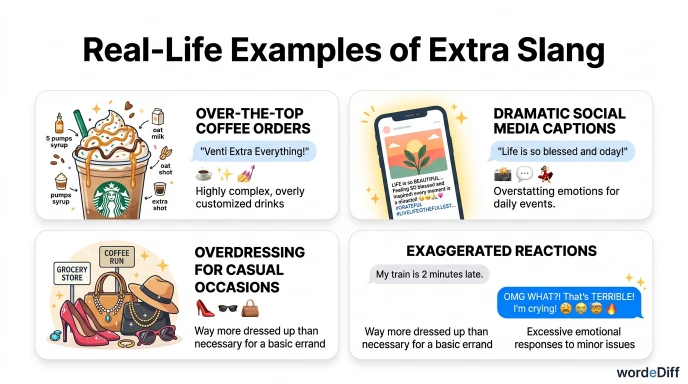
Friendly Example
Friend: “I bought matching outfits for our movie night.”
You: “You’re so extra!”
Here, the word is playful.
Social Media Example
“She made a full photoshoot for her coffee. So extra 😂.”
The speaker thinks the person put a lot of unnecessary effort into something simple.
Argument Example
“It was just a small mistake. Why are you being so extra?”
Here, “extra” has a more negative tone because the speaker thinks the reaction is excessive.
Fashion Example
“That outfit is extra, but honestly, I love it.”
The word can describe something bold, flashy, or dramatic.
Gaming Example
“Bro, you used your strongest move on a beginner. That was extra.”
In gaming, the term can suggest that someone used more effort or power than the situation required.
Extra vs. Dramatic vs. Over-the-Top
These words are similar, but they are not exactly the same.
| Term | Common Meaning | Typical Tone |
| Extra | Doing or showing more than necessary | Playful or negative |
| Dramatic | Showing strong emotions or reactions | Often teasing or negative |
| Over-the-top | Extremely excessive or elaborate | Can be positive or negative |
| High-maintenance | Requiring a lot of attention or effort | Usually negative |
| Flashy | Very noticeable or attention-grabbing | Neutral or positive |
For example, a person can be dramatic without being flashy. Someone can also be extra because they put too much effort into an event without being emotionally dramatic.
When Should You Avoid Using Extra?
Although “extra” is generally harmless, it is still informal slang.
Avoid using it in situations where professional and precise language is expected, such as:
- Formal business emails
- Academic writing
- Official reports
- Job applications
- Legal documents
- Professional presentations
Instead of writing:
“The customer was being extra.”
A professional description could be:
“The customer appeared dissatisfied and expressed strong concerns.”
This explains the behavior without relying on informal slang.
Polite Alternatives to Extra
If you want to communicate the same idea more politely, you can use:
- Overly dramatic
- Excessive
- Over-the-top
- Unnecessarily elaborate
- Very expressive
- More than necessary
- Attention-seeking
The best alternative depends on what you actually mean.
For example, if someone has an elaborate outfit, “bold” or “flashy” may be kinder than “extra.” If someone is overreacting, “dramatic” may communicate the idea more clearly.
Is Extra Always a Negative Word?
No. This is one of the most important things to understand about extra slang.
The word can be negative, neutral, or positive.
Someone might say:
“He is extra.”
That could mean the person is annoying or overly dramatic.
But someone could also say:
“Give me an extra-large cake. I want to go all out!”
Or:
“Her decorations were extra in the best way.”
In modern casual speech, being “extra” can sometimes be part of someone’s style. It may suggest confidence, creativity, humor, or a willingness to stand out.
Why Context Matters With Extra
Context changes the meaning more than the word itself.
Compare these two sentences:
“You are so extra 🙄.”
This likely sounds annoyed or critical.
“You are so extra 😂❤️.”
This is much more likely to be affectionate teasing.
The speaker’s relationship with the listener also matters. Close friends may call each other “extra” without intending any insult. The same word from a stranger could feel more judgmental.
Is Extra Safe for Social Media?
Yes. Extra is generally considered ordinary, mild slang and is not inherently offensive.
People commonly use it in captions, comments, chats, memes, and casual posts.
Still, the surrounding message matters. Calling someone “extra” can become rude if it is used to mock, embarrass, or attack them repeatedly.
As with most slang, understanding the audience is important. A casual Instagram comment and a professional LinkedIn post have very different expectations.
Common Misunderstandings About Extra
Extra Does Not Mean “Bad”
Being extra can be positive, negative, or simply funny.
Extra Is Not an Acronym
There is no standard slang phrase that the letters E-X-T-R-A represent.
Extra Does Not Always Mean Emotional
Someone can be extra because of their clothes, spending, decorations, behavior, or effort not just because they are dramatic.
The Meaning Can Change With Tone
Words, emojis, and the relationship between speakers can completely change how “extra” sounds.
Frequently Asked Questions
What does extra mean in slang?
Extra usually means acting excessive, dramatic, flashy, or doing more than necessary. It can be positive or negative depending on context.
What does extra mean in texting?
In texting, “extra” often describes someone who is overreacting, seeking attention, or putting more effort into something than the situation requires.
Is calling someone extra an insult?
Not necessarily. Friends often use it as playful teasing, but it can be insulting when used in a critical or disrespectful way.
What does “you’re so extra” mean?
It usually means “you are being overly dramatic or doing too much.” The phrase can be humorous or critical.
Is extra Gen Z slang?
“Extra” is widely associated with modern internet and youth slang, but the word itself is much older and is used by people across different age groups.
What is another word for extra slang?
Depending on the context, similar terms include dramatic, excessive, over-the-top, flashy, and doing too much.
Conclusion
So, what does extra mean in slang? It usually describes someone who is acting over-the-top, dramatic, excessive, flashy, or more involved than necessary. The exact meaning depends on the situation and the speaker’s tone.
In texting and social media, “extra” is often used as a quick way to tease someone who is making a big deal out of something small. It can also be positive when someone is stylish, creative, enthusiastic, or intentionally over-the-top.
The most important point is that extra does not always mean something bad. A phrase such as “You’re being extra” may sound critical, while “That party was extra in the best way” is clearly positive.
If you see extra meaning slang in a message, comment, TikTok, Reddit post, Discord chat, or conversation, look at the surrounding words before deciding what the speaker means. Context and tone are what give this simple word its slang meaning.
Read more about!
- What Does IKR Mean in Slang? A Complete Guide
- NW Slang: What Does “NW” Mean in Messages?
- Flute Meaning Slang: What Does “Flute” Mean in Text?

Hi, I’m Ryan Holden, a content writer with over 8 years of experience creating clear, engaging, and easy-to-understand content. I specialize in slang meanings, internet language, text abbreviations, and modern English expressions. My goal is to explain complex words in simple English with real-life examples so readers can quickly understand and use them correctly. I enjoy researching how language changes across social media, online communities, and everyday conversations, ensuring every article is accurate, helpful, and easy to read.