TFTI slang is a common texting abbreviation that can confuse people when they first see it in a message, comment, or social media post.
You may see someone write “TFTI” after being left out of an event, conversation, game, or plan. Depending on the situation, it can sound friendly, sarcastic, or slightly annoyed.
The abbreviation is popular because it lets people express a reaction in just four letters. Friends may use it jokingly when someone forgets to invite them somewhere. People can also use it seriously when they feel excluded.
Understanding the tone is important because TFTI does not always carry the same emotion. The message usually shows if they are being thankful or sarcastic.
Quick Answer:
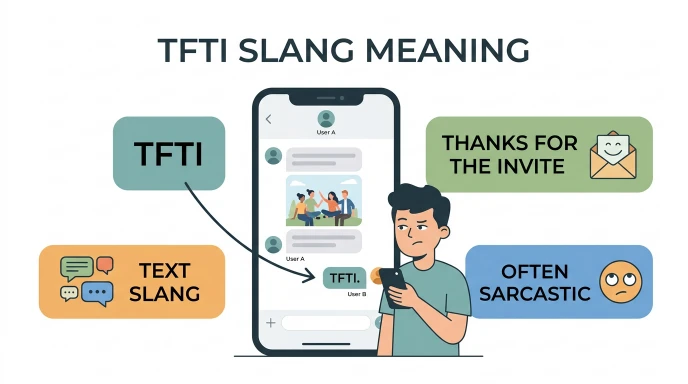
TFTI usually means “Thanks for the Invite.” People often use it sarcastically when they were not invited or included in something.
What Does TFTI Mean in Text?
In texting and online slang, TFTI usually stands for “Thanks for the Invite.”
It is often used when someone sees that friends or other people did something without including them.
For example:
“You guys went to the movies without me? TFTI 😂”
Here, the person is probably not actually thanking their friends. They are joking about being left out.
The abbreviation can also be used more literally:
“TFTI! I had a great time.”
In this case, the person may genuinely mean “Thanks for the invite.”
TFTI Full Form
The most common TFTI full form is:
TFTI = Thanks for the Invite
The phrase is usually written in capital letters, but lowercase tfti has the same meaning.
You may see it in:
- Text messages
- Group chats
- Instagram comments
- Snapchat messages
- TikTok comments
- Discord chats
- Gaming conversations
- Social media posts
The exact tone depends on the context.
TFTI Slang Meaning
The basic TFTI slang meaning is “Thanks for the invite.”
However, people often use it as a humorous or sarcastic response when someone did not invite them.
For example:
“Everyone went out for dinner last night. TFTI.”
The speaker is probably pointing out that they were excluded.
This sarcastic use is one of the main reasons people search for TFTI meaning slang. The words look positive, but the message can actually express annoyance or disappointment.
Is TFTI Rude or Offensive?
TFTI is not normally offensive. It is usually a mild and informal expression.
However, it can sound sarcastic or passive-aggressive depending on the situation.
For example:
“TFTI.”
This short message could sound annoyed if the person was clearly left out.
On the other hand:
“TFTI 😂”
The emoji can make the message feel more playful.
Because TFTI is informal, use it in casual chats, not professional communication.
Where Is TFTI Commonly Used?
People commonly use TFTI in casual online spaces and private messages.
You may encounter it in:
- Texting
- Group chats
- Snapchat
- TikTok
- Discord
- Gaming chats
- Casual social media posts
It is especially useful when someone wants to make a quick joke about being excluded.
For example, a friend posts a picture from a party, and someone comments:
“Looks fun. TFTI 😂”
The comment usually means, “Thanks for inviting me,” but the person is joking because they were not invited.
Real-Life Examples of TFTI Usage
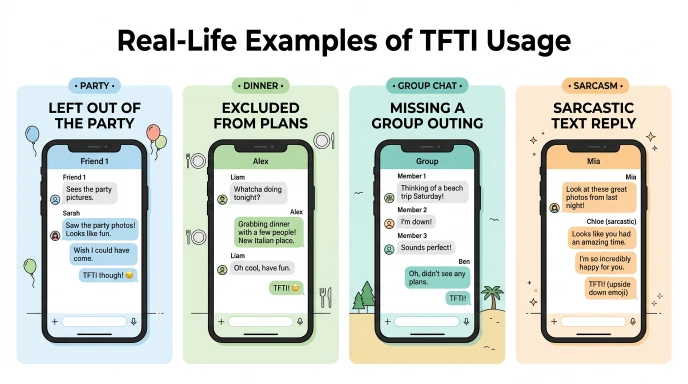
Friendly Example
“You guys went bowling without me? TFTI 😂”
This is a playful way to say that the speaker wishes they had been invited.
Casual Example
“TFTI, guys. I see how it is.”
The speaker is teasing their friends for leaving them out.
Sarcastic Example
“Oh, you had a party? TFTI.”
Here, the speaker is probably expressing mild annoyance.
Gaming Example
“You all started the match without me. TFTI!”
The player is joking about being left out of the game.
Social Media Example
“Everyone’s at the beach today. TFTI 😭”
The person is playfully complaining that they were not included.
Genuine Example
“TFTI! Dinner was amazing.”
In this situation, TFTI can simply mean “Thanks for the invite.”
How to Know If TFTI Is Sarcastic
Context is the easiest way to understand the intended meaning.
Look at:
- What happened before the message
- Who is speaking
- If the person was invited
- Emojis
- Punctuation
- The rest of the conversation
For example:
“Thanks for inviting me! TFTI ❤️”
This may be playful.
But:
“You went without telling me. TFTI.”
This sounds more annoyed.
The same abbreviation can therefore express different emotions.
Why Do People Use TFTI?
People use TFTI because it is short, easy, and expressive.
Instead of writing:
“Thanks for the invite, even though you didn’t invite me.”
Someone can simply write:
“TFTI 😂”
The abbreviation also adds humor to casual conversations.
People often use it to:
- Joke with friends
- Point out that they were excluded
- Express mild annoyance
- Make sarcastic comments
- React to social media posts
- Keep messages short
TFTI and Sarcasm
Sarcasm is one of the most common features of TFTI.
The phrase sounds thankful on the surface, but the speaker may actually mean the opposite.
For example:
“You guys had a party without me? Thanks for the invite!”
The abbreviated version is:
“You guys had a party without me? TFTI 😂”
The meaning becomes clear from the situation.
This is why simply translating TFTI as “Thanks for the invite” may not fully explain what someone means.
TFTI vs. TY
TFTI and TY are both related to thanking someone, but they have different meanings.
| Slang | Meaning | Common Use |
| TFTI | Thanks for the Invite | Thanking someone or joking about not being invited |
| TY | Thank You | General thanks |
| TYSM | Thank You So Much | Stronger or warmer thanks |
| THX | Thanks | Short casual thanks |
The main difference is that TFTI specifically refers to an invitation.
TFTI vs. Thanks for Nothing
In some cases, it can have a sarcastic feeling similar to “thanks for nothing,” but the two expressions are not identical.
TFTI focuses on being left out of an invitation.
Thanks for nothing shows disappointment when someone does not help or do what was expected.
For example:
“You all went to dinner without me. TFTI.”
This is about being excluded.
“You said you’d help me, but you didn’t. Thanks for nothing.”
This is about someone failing to help.
TFTI vs. FOMO
TFTI and FOMO can appear in similar situations.
FOMO means “Fear of Missing Out.”
Someone may feel FOMO after seeing pictures from an event they did not attend.
For example:
“Everyone is at the concert. Major FOMO.”
They might then jokingly comment:
“TFTI 😂”
So, FOMO describes the feeling of missing out, while TFTI is a reaction to being left out or not invited.
Is TFTI Used in Gaming?
Yes. TFTI can work well in gaming chats.
Imagine a group of friends starts playing without another friend:
“You started without me? TFTI!”
The player is usually jokingly complaining about not being included.
It can also appear after someone joins a game late:
“TFTI for waiting.”
The exact meaning depends on the conversation.
Is TFTI Used on Social Media?
Yes. Social media is one of the places where TFTI can work especially well.
Someone might upload pictures from a trip, dinner, party, concert, or other event. A friend who was not invited may comment:
“TFTI 😂”
The comment is usually playful rather than genuinely angry.
Because social media posts are public, however, readers who do not know the people involved may not understand the joke.
Is TFTI Safe to Use Online?
Generally, yes. TFTI is not a dangerous or offensive abbreviation.
Still, tone matters.
A sarcastic TFTI can sometimes make someone feel criticized or excluded. If you are talking to someone you do not know well, a clearer and more polite message may be better.
For example, instead of:
“TFTI.”
You could say:
“Looks like you guys had fun! I wish I could have joined.”
This communicates the same feeling more clearly.
When Should You Avoid Using TFTI?
Avoid TFTI when the situation is serious or when the other person may not understand internet slang.
It is better to avoid it in:
- Professional emails
- Job applications
- Business communication
- Formal messages
- Serious discussions
- Conversations with unfamiliar people
The abbreviation is mainly designed for casual communication.
Polite Alternatives to TFTI
If you want to express the same idea more clearly, you can say:
- “I wish I had been invited.”
- “Looks like you had fun!”
- “I would have loved to join.”
- “Next time, invite me!”
- “I wish I could have come.”
These options work better when you want to avoid sarcasm.
Why TFTI Can Be Misunderstood
Text messages do not show facial expressions or voice tone.
When someone says “TFTI 😂” in person, their voice may clearly show that they are joking. A short text such as “TFTI.” can look much more serious.
The receiver may wonder:
- Is this person angry?
- Are they joking?
- Are they actually thanking me?
- Do they feel left out?
Adding context or an emoji can sometimes make the intended tone easier to understand.
Is TFTI a Gen Z Slang Term?
TFTI is better understood as an internet and texting abbreviation rather than a word exclusive to Gen Z.
People of different ages can understand and use texting abbreviations in casual chats.
Its meaning is straightforward because it shortens the phrase “Thanks for the invite.”
Therefore, you should not assume that every person using TFTI belongs to a particular generation.
Origin and Background of TFTI
TFTI comes from the broader tradition of shortening common phrases in text and online communication.
As texting and online messaging grew, people started using short forms to communicate faster. Expressions such as LOL, OMG, BRB, TY, and TFTI became part of informal digital communication.
The exact history of the abbreviation is less important than its established modern use: “Thanks for the invite.”
Today, people can use it literally or sarcastically depending on the situation.
Common Mistakes When Using TFTI
One common mistake is assuming that TFTI always expresses genuine gratitude.
It often works as sarcasm when someone was not invited.
Another mistake is using it in formal communication. Most professional readers would prefer the full phrase or a clearer sentence.
It is also easy to misunderstand the tone if you send only:
“TFTI.”
If you are joking, adding context can make your meaning clearer.
TFTI Meaning in Different Contexts
| Context | Possible Meaning |
| Texting | Thanks for the invite |
| Friend group | Playful complaint about being left out |
| Social media | Sarcastic reaction to an event or post |
| Gaming | Joke about not being invited to play |
| Formal communication | Usually not appropriate |
| Genuine invitation | Actual thanks for being invited |
FAQs
What does TFTI mean in texting?
TFTI usually means “Thanks for the Invite.” It can be genuine or sarcastic.
What does TFTI mean in slang?
In slang, TFTI often means “Thanks for the invite,” especially as a joke when someone was not invited.
What does TFTI stand for?
TFTI stands for “Thanks for the Invite.”
Is TFTI rude?
TFTI is not inherently rude, but it can sound sarcastic or passive-aggressive depending on the situation.
Can TFTI be used as a joke?
Yes. Friends often use TFTI to jokingly complain about being left out of an event or activity.
Is TFTI used on social media?
Yes. People can use TFTI in comments, posts, group chats, and other casual online conversations.
Conclusion
TFTI slang usually means “Thanks for the Invite.” People use it in texts, social media, gaming chats, group conversations, and other casual online spaces.
The phrase can have two main tones. Someone may use it genuinely after receiving an invitation, or they may use it sarcastically when they were not invited. Context, emojis, and the relationship between the people usually reveal the intended meaning.
If a friend posts pictures from an event without inviting you, saying “TFTI 😂” can be a playful way to point it out. In formal situations, however, writing the full phrase or using a clearer sentence is a better choice.
Read more about!
- gagged meaning slang: What Does Gagged Mean in Slang?
- Fire Slang: What Does “Fire” Mean in Slang?
- POS Slang: What Does POS Mean?

Hi, I’m Ryan Holden, a content writer with over 8 years of experience creating clear, engaging, and easy-to-understand content. I specialize in slang meanings, internet language, text abbreviations, and modern English expressions. My goal is to explain complex words in simple English with real-life examples so readers can quickly understand and use them correctly. I enjoy researching how language changes across social media, online communities, and everyday conversations, ensuring every article is accurate, helpful, and easy to read.