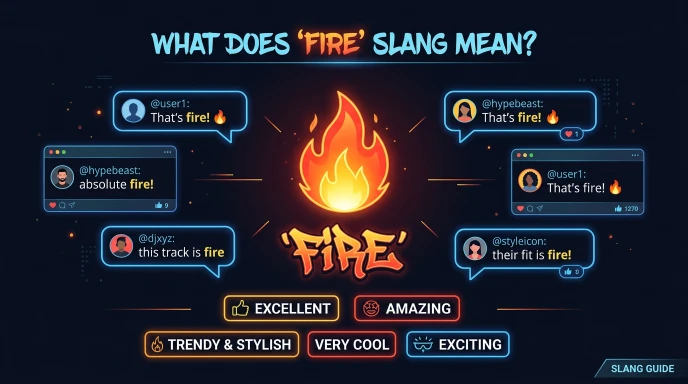
Fire slang is a popular way to say that something is really good, impressive, exciting, or excellent.
If you see someone comment “This is fire!” on TikTok, Instagram, YouTube, or a group chat, they usually mean they strongly like what they see, hear, or experience.
The word can describe music, food, clothes, photos, videos, ideas, performances, and many other things. Unlike the literal meaning of fire, the slang meaning has nothing to do with flames.
People mainly use it in casual conversations because it sounds energetic and positive. Understanding the context is important because fire can also have its normal dictionary meaning.
Quick Answer:
Fire in slang means something is excellent, exciting, impressive, or very good. People often use it as a strong compliment online and in casual speech.
What Does Fire Mean in Text?
In texting and online conversations, fire usually means really good, impressive, or exciting.
For example:
“That new song is fire!”
The person is saying that they think the song is excellent.
You can use fire for many different things:
- Music
- Food
- Clothes
- Movies
- Games
- Sports performances
- Photos
- Videos
- Ideas
- Social media posts
The word usually carries a positive and enthusiastic tone.
Simple Meaning of Fire Slang
Fire = extremely good, cool, impressive, or exciting.
The meaning can change slightly depending on what someone describes as fire, but the basic idea stays the same: they really like it.
What Does Fire Stand For?
Fire does not have a full form.
It is not an acronym like LOL or BTW. The slang simply uses the ordinary word fire in a figurative way.
The idea connects to fire being powerful, intense, and exciting. Over time, people began using the word to describe things that felt equally impressive or exciting.
So, if someone asks “What does fire stand for in slang?”, the simple answer is that it does not stand for anything. It is a slang expression meaning excellent or impressive.
Fire Meaning Slang in Different Situations
The meaning stays positive, but the exact use depends on the situation.
Fire for Music
Music is one of the most common things people describe as fire.
“This album is fire!”
This means the speaker really enjoys the album.
You might also see:
“That beat is fire.”
Here, the person is praising the beat.
Fire for Food
People also use fire to describe delicious food.
“These tacos are fire!”
The speaker means the tacos taste extremely good.
It does not mean that the tacos are literally burning.
Fire for Clothes
Someone might compliment another person’s outfit by saying:
“Your fit is fire!”
This means the outfit looks stylish or impressive.
Fire for Videos
On social media, users may comment:
“This video is fire 🔥”
They are saying that they enjoyed the video or found it impressive.
Fire for Gaming
Gamers may use the word when they like a character, weapon, update, play, or gaming moment.
“That clutch was fire!”
The speaker thinks the player’s performance was excellent.
Is Fire Slang Rude or Offensive?
Fire is generally not rude or offensive when people use it as slang.
It usually works as a positive compliment.
For example:
“Your new haircut is fire.”
This is simply a friendly compliment.
However, slang can sound too casual in certain situations. You may want to avoid it in formal or professional writing.
Instead, use words such as:
- Excellent
- Impressive
- Outstanding
- Great
- Exceptional
- Very good
The meaning itself is not offensive. The main issue is formality and context.
Where Is Fire Slang Commonly Used?
People use fire in many casual online spaces.
TikTok
TikTok users often write fire in comments when reacting to music, dances, outfits, edits, or funny videos.
Instagram users may use it under photos, Reels, fashion posts, and other content they enjoy.
YouTube
You may see comments such as:
“This track is fire!”
or
“That performance was fire.”
Reddit users can use fire when discussing music, games, movies, food, or other topics.
Discord
Friends may use it casually while chatting about games, videos, memes, or entertainment.
Texting
In private messages, someone might simply text:
“That idea is fire 🔥”
The message means they think the idea is excellent.
Real-Life Examples of Fire Usage
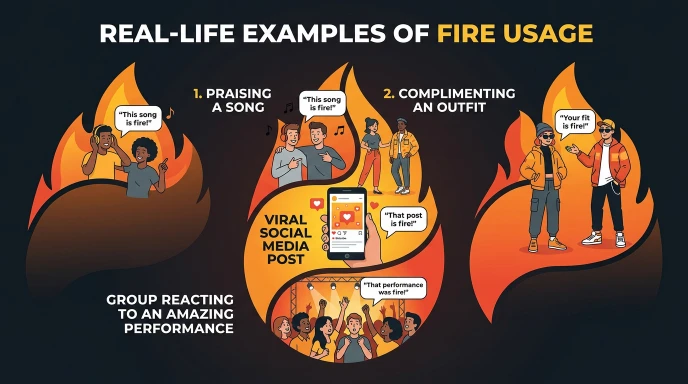
The phrase can work in different tones depending on the situation.
Friendly Example
Friend: “Check out my new playlist.”
You: “Bro, this playlist is fire!”
This sounds enthusiastic and friendly.
Casual Example
“That burger was fire.”
The speaker means the burger tasted really good.
Social Media Example
“This edit is straight fire 🔥”
The person strongly likes the video edit.
Gaming Example
“Your final move was fire!”
Here, the speaker is praising someone’s gaming performance.
Music Example
“This new song is fire.”
The speaker thinks the song is excellent.
Fashion Example
“Your outfit is fire!”
This means the outfit looks very stylish.
Argumentative Example
The slang can even appear during a disagreement:
“You can hate the song, but that beat is fire.”
The speaker strongly defends their opinion that the beat is good.
Why Do People Use Fire Slang?
People use fire because it expresses strong approval in a short and memorable way.
Instead of saying:
“I think this song is extremely good.”
Someone can simply say:
“This song is fire.”
The shorter expression feels more natural in casual online communication.
People also use the 🔥 emoji with the slang because it reinforces the meaning.
For example:
“That performance was fire 🔥”
The emoji adds extra excitement and emphasis.
Fire vs. Lit
Fire and lit can have similar meanings, but they are not always interchangeable.
| Slang | Common Meaning | Typical Tone |
| Fire | Very good or impressive | Casual and enthusiastic |
| Lit | Exciting, fun, or energetic | Casual and energetic |
| Dope | Cool or excellent | Casual |
| Sick | Extremely cool or impressive | Informal |
| Awesome | Very good or impressive | Casual |
For example:
“That song is fire.”
means the song is excellent.
“The party was lit.”
usually means the party was exciting or full of energy.
So, fire often focuses on how good something is, while lit can focus more on excitement or atmosphere.
Fire vs. Hot
Fire and hot can both mean attractive or impressive, but their slang uses are different.
In slang, fire usually means:
“This is really good.”
Hot can mean:
“This is attractive, stylish, or currently popular.”
For example:
“That song is fire.”
means the song is excellent.
“That new trend is hot.”
means the trend is popular or fashionable.
Context determines the exact meaning.
The Origin and Background of Fire Slang
The slang meaning of fire comes from fire’s energy, power, and excitement.
English speakers have used fire-related words figuratively for a long time. Youth culture, music, entertainment, and online communities made fire a common compliment.
Social media helped it spread through posts, memes, and messages.
The 🔥 emoji also helped strengthen the connection between the word and its slang meaning.
Today, people can communicate the same idea with either:
“That song is fire.”
or simply:
“That song 🔥”
The exact history varies, but modern fire comes from using heat to describe excitement or something great.
Literal Meaning vs. Slang Meaning of Fire
The word fire still has its normal literal meaning.
Literal Meaning
“The house caught fire.”
Here, fire refers to actual flames.
Slang Meaning
“That song is fire.”
Here, fire means the song is excellent.
The surrounding words and topic usually make the intended meaning clear.
When Should You Avoid Fire Slang?
Although fire is generally harmless slang, it may not fit every situation.
Avoid using it when you need a formal or professional tone, such as:
- Job applications
- Business emails
- Academic assignments
- Formal reports
- Professional presentations
- Official documents
For example, instead of:
“Your presentation was fire.”
you could say:
“Your presentation was excellent.”
The second sentence sounds more professional.
Polite and Formal Alternatives to Fire
If you want to express the same positive idea in a more formal way, use:
- Excellent
- Impressive
- Outstanding
- Exceptional
- Fantastic
- Well done
- Very effective
- Remarkable
In casual chats, fire works well when people understand the slang.
How Fire Slang Works on Social Media
Social media favors short expressions that communicate strong emotions quickly.
That makes fire especially useful.
A person does not need to write a long comment like:
“I really enjoyed this performance because it was energetic and impressive.”
They can simply write:
“This is fire 🔥”
The shorter comment communicates excitement immediately.
The slang also works well with emojis, hashtags, captions, and memes.
Is Fire Slang Safe for Social Media?
Yes, fire is generally safe and harmless when used to mean excellent or impressive.
It does not normally contain offensive or sexual meaning in this context.
Still, context matters because fire can have many literal and figurative meanings.
For example:
“Fire!”
could refer to an actual emergency rather than a compliment.
A sentence like:
“This pizza is fire!”
clearly uses the slang meaning.
Common Mistakes With Fire Slang
Mistake 1: Taking It Literally
If someone says:
“That song is fire.”
they are usually not saying the song is burning.
They are complimenting the song.
Mistake 2: Assuming It Always Means Attractive
Fire can describe attractive people or stylish outfits, but it can also describe food, music, games, ideas, and performances.
Its meaning is broader than physical attractiveness.
Mistake 3: Using It in Formal Writing
Even though the slang is common online, it may sound too casual in professional or academic writing.
Mistake 4: Confusing Fire With Lit
Both are positive, but lit means exciting, while fire means great or impressive.
Why Is the Fire Emoji Used With the Slang?
The 🔥 emoji often appears alongside fire because it visually reinforces the slang meaning.
For example:
“That outfit is fire 🔥”
The emoji adds excitement and emphasis.
People may also use the emoji by itself:
“That beat 🔥🔥🔥”
In this case, the emojis usually mean that the person thinks the beat is extremely good.
FAQs
What does fire mean in slang?
Fire means something is very good, impressive, exciting, or excellent.
What does fire mean in texting?
In texting, fire usually works as a compliment. Someone may use it to say they really like a song, outfit, idea, video, or other content.
Does fire have a full form?
No. Fire is not an acronym, so it does not have a full form.
Is fire a positive slang word?
Yes. People generally use fire as a positive expression to show strong approval.
What does 🔥 mean in texting?
The 🔥 emoji can mean something is excellent, exciting, attractive, or impressive. Its exact meaning depends on the context.
Is fire slang appropriate for work?
It is usually better to avoid slang in formal workplace communication. Words such as excellent, impressive, or outstanding sound more professional.
Conclusion
Fire slang means something is really good, impressive, exciting, or excellent. People often use it in texts, social media, gaming, music talks, and casual chats. You can describe a song, meal, outfit, video, performance, idea, or gaming moment as fire when you strongly like it.
The word does not have a full form because it is not an acronym. Its slang meaning comes from the idea of fire as a sign of energy, intensity, and excitement.
In casual conversations, fire is usually positive and harmless. However, formal situations call for clearer words such as excellent, impressive, or outstanding.
The key is simple: when someone says “That’s fire!”, they usually mean “That’s really good!”
Read more about!
- Slang for Poop: Funny, Common, and Popular Terms Explained
- Rizzler Meaning Slang: What Does Rizzler Mean in Text?
- Amped Meaning Slang: What Does “Amped” Mean in Text?

Hi, I’m Ryan Holden, a content writer with over 8 years of experience creating clear, engaging, and easy-to-understand content. I specialize in slang meanings, internet language, text abbreviations, and modern English expressions. My goal is to explain complex words in simple English with real-life examples so readers can quickly understand and use them correctly. I enjoy researching how language changes across social media, online communities, and everyday conversations, ensuring every article is accurate, helpful, and easy to read.