Sike slang is a casual word people use to show that they were joking, teasing, or intentionally saying something that was not true.
You may see someone make a surprising statement and then quickly add, “Sike!” The word tells the other person that the previous statement should not be taken seriously.
For example, someone might text, “I’m deleting your number. Sike 😂.” They are not actually deleting the number. They are using the word to create a joke or surprise.
The term is mostly found in informal conversations, texting, memes, social media, and chats between friends. Its meaning is usually easy to understand from the tone and the sentence around it.
Quick Answer:
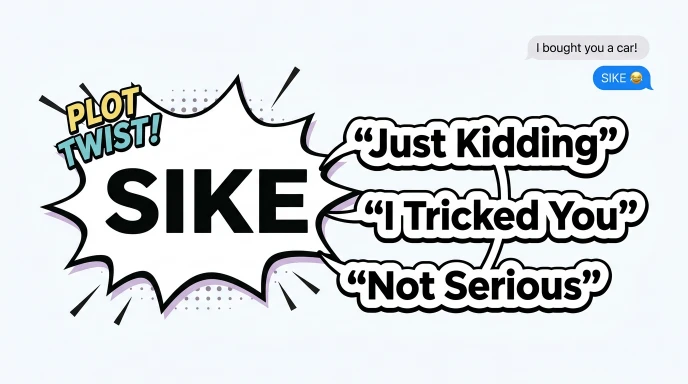
Sike is slang for “just kidding” or “I tricked you.” It is used after a statement to reveal that the speaker was joking or deliberately misleading someone.
What Does Sike Mean in Text?
In texting, sike usually means “just kidding,” “not really,” or “I fooled you.”
The word is often placed at the end of a sentence to suddenly change its meaning.
For example:
“I bought you a new phone. Sike!”
The first part makes the person think they received a phone. Then “sike” reveals that it was only a joke.
This makes sike a type of playful slang. It works because the speaker creates a short moment of surprise before revealing the joke.
You may also see it written as:
- Sike!
- SIKE!
- Psych!
- Syk! in some informal messages
“Sike” is the spelling commonly seen in modern casual internet and texting language.
Sike Slang Full Form
There is no full form for “sike” because it is not an acronym.
The word is an informal form of “psych,” meaning someone was fooled or tricked.
So if you search for “sike slang full form” or “what does sike stand for,” there is no official letter-by-letter expansion.
The important meaning is:
Sike = I’m joking / I tricked you / Not really.
How Is Sike Used?
The basic pattern is simple:
Statement + Sike!
For example:
- “I’ll give you my last pizza slice. Sike!”
- “You passed the test. Sike, you failed.”
Sike can also be used alone:
“Sike 😂”
It shows that the previous statement was a joke or trick.
Is Sike Rude, Offensive, or Neutral?
Sike is generally informal and not offensive.
It is usually used for jokes, teasing, and playful conversations. However, the way it is used can make someone feel annoyed or embarrassed.
For example:
“I was joking. Sike!”
This may be harmless between close friends.
But repeated use of sike can become annoying, especially about serious things.
Sike can sound:
- Playful between friends
- Funny in memes
- Teasing in casual chats
- Annoying if used repeatedly
- Insensitive if used after a serious statement
The word itself is not normally a swear word or slur. The context determines if the joke is appropriate.
Where Is Sike Commonly Used?
You can find sike mainly in informal communication.
Common places include:
- Text messages
- Group chats
- Snapchat
- TikTok
- Discord
- Gaming chats
- Memes
- Casual conversations
It is especially useful online because short slang words can quickly communicate tone.
For example, someone might write:
“I’m quitting the game forever. Sike 😂”
The word immediately tells readers that the statement was not serious.
Avoid using sike in formal or professional communication.
Real-Life Examples of Sike Usage
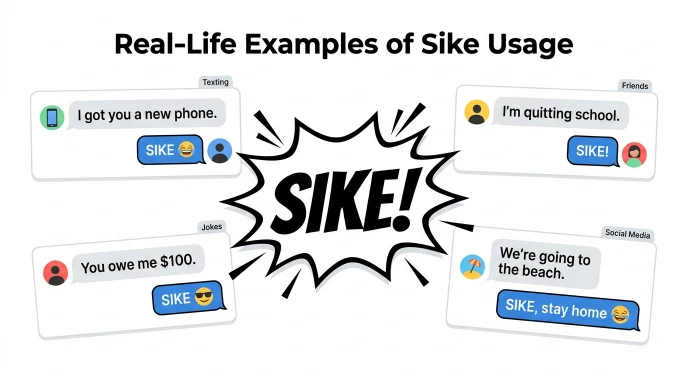
Friendly Example
“I got you your favorite candy. Sike, I ate it already!”
This is a playful joke between friends.
Casual Example
“I’m staying home tonight. Sike, let’s go out!”
The speaker changes their original statement for fun.
Teasing Example
“You look amazing today. Sike 😂”
This can be playful teasing, although the tone depends heavily on the relationship between the people.
Surprise Example
“Guess what? I’m moving to another city. Sike!”
The speaker creates a moment of surprise and then reveals that it was not true.
Gaming Example
“We’re definitely losing this match. Sike! We just won!”
Here, sike changes the meaning of the previous statement and adds excitement.
Social Media Example
“No more posting for me. Sike, I’ll be back tomorrow.”
This style is common in casual online posts and captions.
Argumentative Example
“I actually believed you. Then you said ‘sike.’ Seriously?”
This shows that the word can become annoying when someone uses it at the wrong time.
Sike vs. Similar Slang
Several expressions can communicate a similar idea, but they are not exactly the same.
| Expression | Meaning | Typical Use |
| Sike | I’m joking or I tricked you | Casual teasing |
| Just kidding | I was not serious | General conversations |
| JK | Just kidding | Texting |
| Psych! | I fooled you | Playful teasing |
| Not really | The previous statement was not true | Casual conversation |
| Gotcha | I tricked or caught you | Jokes and playful situations |
Sike is usually more dramatic and playful than simply saying “just kidding.”
For example:
“I bought you a car. Just kidding.”
is straightforward.
But:
“I bought you a car. SIKE!”
feels more like a prank or playful reveal.
Sike vs. Psych
One common question is if sike and psych mean the same thing.
In casual slang, they are generally used in the same way.
Psych! has been used as an expression meaning that someone was fooled or that the previous statement was a joke. Sike became a common informal spelling in modern slang and internet communication.
For most casual conversations:
“Psych!”
and
“Sike!”
can communicate essentially the same idea.
However, sike is much more likely to appear in modern texting, memes, and social media slang.
Origin and Background
The slang sike is associated with the older expression “psych!”
“Psych!” developed as an informal way of telling someone that they had been fooled or that a previous statement was not genuine.
The word often means tricking someone before revealing the joke.
Over time, sike became a popular spelling in casual speech and online communication.
The exact history of the spelling is less important for everyday use. Today, when someone writes “sike,” most readers understand it as a playful way of saying:
“Got you!”
or:
“Just kidding!”
Why Do People Use Sike?
People use sike because it makes a joke quick and clear.
Instead of explaining:
“I was only pretending to say that because I wanted to surprise you.”
someone can simply write:
“Sike!”
It also creates a small twist in the conversation.
The person reading the message may believe the first statement for a moment. The word sike then changes the situation.
This is why it works especially well in:
- Memes
- Short videos
- Text messages
- Gaming chats
- Friend groups
- Social media comments
When Should You Avoid Using Sike?
Although sike is harmless in many situations, it is not appropriate for every conversation.
Avoid using it when discussing:
- Death or serious illness
- Emergencies
- Important personal problems
- Serious financial matters
- Workplace issues
- Sensitive relationship topics
- Safety concerns
For example, saying:
“I got fired. Sike!”
may be a joke among friends.
But saying “sike” after falsely claiming that someone has been seriously hurt could upset people.
The more serious the subject, the less appropriate this type of joke becomes.
Polite Alternatives
If you want to make it clear that you were joking without sounding overly playful, you can use:
- Just kidding
- I’m joking
- Not really
- I was only joking
- I’m just messing with you
- I’m only teasing
For example:
“I’m moving to Canada. Just kidding!”
This is clearer and more suitable for a wider range of people.
Impact of Sike in Communication
Slang can make communication feel more relaxed and personal.
Using sike can show that the speaker is joking and can make a conversation more entertaining. It can also help friends build a playful style of communication.
However, written messages do not always show facial expressions or voice tone.
That means a joke can sometimes be misunderstood.
For example:
“I hate you. Sike.”
A close friend may understand it as a joke. Someone who does not know the speaker well may take it literally.
Emojis can sometimes make the playful intention clearer:
“I hate you. Sike 😂”
Still, context is more important than the emoji itself.
Is Sike Safe for Social Media?
Yes, sike is generally safe for normal social media use.
It is not normally considered offensive language, and it frequently appears in casual posts, comments, memes, and videos.
However, the joke attached to the word matters.
A harmless statement followed by “sike” is usually fine. A harmful or offensive statement is not okay just because you add “sike” afterward.
Always consider how the other person may interpret the joke.
Common Mistakes When Using Sike
Using It in Serious Situations
The biggest mistake is using sike after a serious claim.
Assuming Everyone Knows the Slang
Older readers or people who do not use internet slang may not immediately understand it.
Overusing It
If every message ends with “sike,” the joke can quickly become annoying.
Using It to Hide Hurtful Comments
Adding “sike” does not automatically make an insulting statement harmless.
For example:
“You’re ugly. Sike!”
The person may still feel insulted, even if the speaker intended it as a joke.
FAQs
What does sike mean in slang?
Sike means “just kidding,” “not really,” or “I fooled you.” It is usually added after a statement to reveal that the speaker was joking.
What does sike mean in texting?
In texting, sike is commonly used to take back a previous statement or reveal that it was only a joke.
Is sike short for something?
No. Sike is not an acronym. It is generally associated with the informal expression “psych!”
Is sike a bad word?
No. Sike is generally not considered a bad or offensive word. It is casual slang used for jokes and teasing.
What is the difference between sike and just kidding?
Both can show that a statement was not serious. Sike usually has a more playful “I tricked you” feeling, while just kidding is more direct.
Can I use sike on social media?
Yes. It is commonly used in casual online communication, including comments, posts, memes, and chats. It should still be avoided when joking about serious or sensitive subjects.
Conclusion
Sike slang is a casual expression used to tell someone that a previous statement was a joke, not true, or intended to trick them. It is similar to saying “just kidding,” “not really,” or “got you.” The word is especially common in texting, social media, gaming chats, memes, and conversations between friends.
The tone is usually playful, but context matters. A funny “sike” can make a chat fun, but using it after a serious statement may upset someone.
If you see “sike” at the end of a message, look at the sentence before it. In most casual situations, the speaker is telling you that they were jok
Read more about!
- Amped Meaning Slang: What Does “Amped” Mean in Text?
- Whipped Slang: What Does It Mean in Text?
- What Does FML Mean in Slang? Meaning & Examples

Hi, I’m Zunaira Shafiq, a slang writer and language enthusiast. I enjoy exploring modern slang, internet expressions, texting abbreviations, and social media terms, then explaining them in simple, easy-to-understand English. My goal is to help readers understand the meaning, origin, and correct usage of popular slang words through clear definitions and real-life examples. I love making online language easier for students, language learners, and anyone who wants to stay updated with modern communication.