RBF slang meaning in text usually refers to “resting bitch face,” a phrase used when someone naturally looks serious, annoyed, or unfriendly even when they are not upset. You may see RBF on TikTok, Instagram, Snapchat, Reddit, or in everyday conversations between friends.
People often use this slang to describe their own facial expressions humorously or to tease someone whose face looks serious when they are simply relaxed. For example, a person might say, “I promise I’m nice. I just have RBF.”
Although the expression is common in informal online conversations, it contains profanity and can sound insulting when used to describe someone else. The meaning also depends on the relationship between the people talking and the tone of the conversation.
Quick Answer: RBF stands for “resting bitch face.” It describes a naturally serious, annoyed, or unapproachable-looking facial expression that does not necessarily reflect how someone actually feels.
What Does RBF Mean in Text?
RBF is an abbreviation for “resting bitch face.” It describes a person’s neutral facial expression when they appear angry, bored, irritated, or unhappy even though they may feel completely fine.
In texting, people commonly use RBF as a joke, a self-description, or a comment about someone’s appearance. The expression is not necessarily connected to a person’s mood or personality.
For example, imagine someone sitting quietly in class with a neutral expression. Another student might think they are upset, but they are actually just concentrating. Someone could describe that expression as RBF.
Here are a few examples:
- “I have RBF, so people think I’m mad all the time.”
- “She looks serious in every picture. Total RBF.”
- “Sorry if I look annoyed. It’s just my RBF.”
- “My RBF makes people think I don’t want to talk.”
In each example, RBF refers to how a person looks rather than what they are actually feeling.
What Is the RBF Full Form?
The RBF full form is “resting bitch face.”
The phrase combines three words to describe a naturally serious-looking expression:
- Resting: A person’s relaxed or neutral state.
- Bitch: A profanity used here as part of an informal, often humorous expression.
- Face: The person’s visible facial expression.
Together, the phrase describes a face that appears annoyed or unfriendly without any deliberate effort to look that way.
Because the full expression contains profanity, RBF is generally more suitable for casual conversations than professional or formal settings.
What Does RBF Stand for on Social Media?
On social media, RBF usually has the same meaning: resting bitch face.
People use it in captions, memes, comments, and short videos about facial expressions. It often appears when someone wants to explain why they look serious in photographs or why strangers sometimes assume they are angry.
For example:
Instagram caption: “Not mad, just dealing with my natural RBF.”
TikTok comment: “The way she looks annoyed while doing absolutely nothing 😭”
Snapchat message: “Why does everyone think I’m angry? It’s literally just my RBF.”
The abbreviation makes the phrase quicker to type and easy to recognize among people familiar with internet slang.
Is RBF Rude, Offensive, or Neutral?
RBF can be playful, mildly insulting, or offensive depending on how it is used.
The abbreviation itself is informal, but the full phrase includes a swear word. Some people use it comfortably among friends, while others find it disrespectful, especially when someone comments on their appearance without permission.
When RBF Is Used as a Joke
RBF is often harmless when people use it to describe themselves.
For example:
“My RBF is so bad that people apologize to me when they haven’t done anything.”
Here, the speaker is making fun of their own facial expression rather than criticizing another person.
When RBF Can Be Insulting
The phrase can sound rude when someone uses it to judge another person’s appearance or personality.
For example:
“Why do you always look so miserable? You have serious RBF.”
Depending on the relationship, the comment might feel like teasing or an unnecessary personal criticism.
It is also unfair to assume that someone is angry, unfriendly, or arrogant just because their face looks serious.
Tip: If you do not know someone well, avoid commenting on their facial expression with RBF. A neutral expression does not tell you how someone feels or what kind of person they are.
Where Is RBF Commonly Used?
RBF appears in several informal online and everyday settings. Its meaning generally stays the same, although the tone can change.
RBF on TikTok
On TikTok, RBF may appear in comedy videos, facial-expression trends, personal stories, and relatable content.
A creator might make a video about people assuming they are angry when they are actually relaxed. The caption could say, “Living with RBF is exhausting.”
The phrase is often used for humor rather than as a serious description of someone’s emotional state.
RBF on Instagram
On Instagram, people may use RBF in selfies, photo captions, reels, or comments.
For example:
“Everyone says I look intimidating in pictures, but I’m actually shy. RBF problems.”
Here, the person is explaining the difference between their appearance and personality.
RBF on Snapchat
On Snapchat, RBF may appear in messages between friends or in captions attached to selfies.
For example:
“Don’t mind my face today, it’s just RBF 😂”
The abbreviation helps communicate that the sender is not necessarily upset, even if their expression looks serious.
RBF on Reddit
On Reddit, people may discuss RBF when sharing personal experiences about being misunderstood because of their appearance.
Someone might explain that coworkers, classmates, or strangers often assume they are annoyed when they are simply quiet.
In these discussions, RBF can be part of a broader conversation about first impressions, facial expressions, and social expectations.
RBF in Text Messages
In everyday texting, RBF is usually a casual way to describe a serious-looking face.
For example:
Person A: “You looked so mad at lunch.”
Person B: “I wasn’t mad. I just have RBF.”
The reply clarifies that the person’s expression did not necessarily match their mood.
Real-Life Examples of RBF in Different Situations
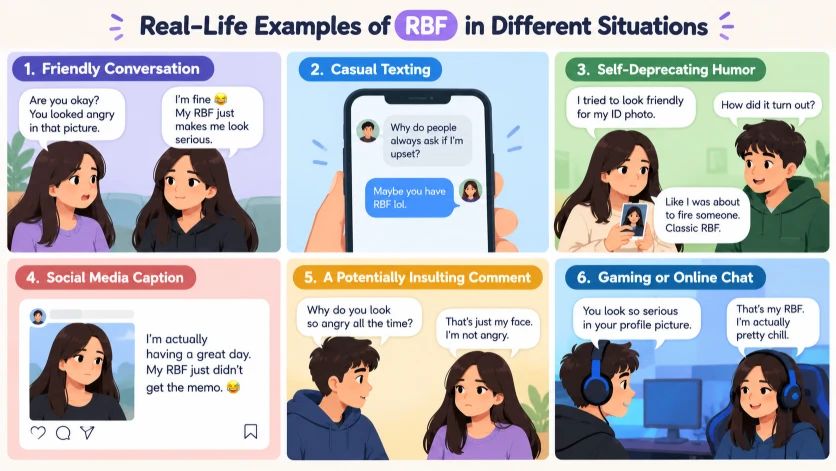
Understanding RBF becomes easier when you see how people use it in different contexts.
1. Friendly Conversation
Friend A: “Are you okay? You looked angry in that picture.”
Friend B: “I’m fine 😂 My RBF just makes me look serious.”
In this conversation, the abbreviation is used casually to clear up a misunderstanding.
2. Casual Texting
Person A: “Why do people always ask if I’m upset?”
Person B: “Maybe you have RBF lol.”
This is an informal response between people who are comfortable joking with each other.
3. Self-Deprecating Humor
A: “I tried to look friendly for my ID photo.”
B: “How did it turn out?”
A: “Like I was about to fire someone. Classic RBF.”
The speaker uses RBF to make fun of their own serious expression.
4. Social Media Caption
“I’m actually having a great day. My RBF just didn’t get the memo.”
This caption humorously contrasts the person’s positive mood with their neutral facial expression.
5. A Potentially Insulting Comment
Person A: “Why do you look so angry all the time?”
Person B: “That’s just my face. I’m not angry.”
If the first person continues by calling it RBF, the comment might feel disrespectful rather than funny.
This example shows why context matters. A phrase that works between close friends may not be appropriate with someone you barely know.
6. Gaming or Online Chat
Player A: “You look so serious in your profile picture.”
Player B: “That’s my RBF. I’m actually pretty chill.”
Although RBF is not specifically gaming slang, it can appear in gaming chats, community servers, and online discussions about profile pictures.
What Is the Origin of RBF Slang?
RBF developed from the expression “resting bitch face,” which became widely recognized in popular culture and internet conversations during the 2010s.
The phrase describes the perception that some people look annoyed or unfriendly when their faces are relaxed. Online discussions, humor articles, memes, and social media helped spread the expression.
The abbreviation RBF became a convenient shorthand because the full phrase is longer and contains profanity.
There is no single confirmed person or moment that can be credited with inventing the expression. It is more accurate to describe it as an informal phrase that gained popularity through widespread cultural and online use.
Today, RBF is commonly understood in many English-language internet communities. However, not everyone knows the abbreviation, and its interpretation can vary depending on the conversation.
RBF vs. Similar Slang Terms
RBF is sometimes confused with other expressions about facial expressions, mood, or attitude. However, these terms do not mean exactly the same thing.
| Term | Meaning | Main Difference |
| RBF | Resting bitch face | A neutral face that appears annoyed or unfriendly |
| TBH | To be honest | Introduces an honest opinion or statement |
| IDC | I don’t care | Expresses indifference |
| SMH | Shaking my head | Shows disappointment, disbelief, or frustration |
| IMO | In my opinion | Introduces a personal viewpoint |
| AF | As f*** | Intensifies a description or statement |
For example, “I have RBF” describes how someone appears, while “IDC” communicates how little they care about something.
These abbreviations may appear in the same online spaces, but their meanings and purposes are different.
When Should You Avoid Using RBF?
Although RBF is common in casual conversation, it is not suitable for every situation.
Consider avoiding it in the following circumstances:
- Professional communication: Avoid using profanity-based slang in formal emails, job interviews, or workplace documents.
- Conversations with strangers: Someone may interpret a comment about their face as criticism.
- Sensitive discussions: If someone is upset, calling their expression RBF may dismiss their feelings.
- Respectful feedback: Focus on the actual situation instead of judging someone’s natural facial expression.
- Unfamiliar audiences: Some people may not know what RBF means or may dislike the wording.
The main issue is not the abbreviation alone. It is how the phrase can make someone feel when it is directed at their appearance.
Polite Alternatives to RBF
If you want to explain that someone looks serious without using profanity, several alternatives may work better.
| Alternative | Example |
| Serious expression | “I naturally have a serious expression.” |
| Neutral expression | “My face looks neutral when I’m relaxed.” |
| Resting serious face | “I think I have a resting serious face.” |
| Focused expression | “I look focused even when I’m not concentrating.” |
| Unintentional expression | “I don’t mean to look annoyed; that’s just my natural expression.” |
These alternatives communicate the same general idea without using an insulting word.
For example, instead of saying, “You have RBF,” you could say, “You look serious in that picture, but I know you’re probably fine.”
The second version is more considerate because it does not label the other person’s appearance negatively.
Why Do People Use RBF?
People use RBF for several reasons, particularly in online conversations.
To Explain Their Facial Expression
Some people are frequently asked if they are angry or upset when they are actually feeling normal. RBF gives them a quick way to explain the misunderstanding.
To Make Jokes About Themselves
Self-deprecating humor is a common use of the phrase. Someone might joke about looking intimidating in photos even though they are friendly in person.
To Create Relatable Social Media Content
RBF can help people describe experiences that others recognize, such as being mistaken for unfriendly because they are quiet or have a serious-looking face.
To Keep Conversations Short
Abbreviations are convenient in messaging. Typing RBF is quicker than writing the entire phrase, especially when the conversation is casual.
To Describe First Impressions
People sometimes use RBF when discussing how others perceive them before getting to know them. The term highlights the difference between outward appearance and actual personality.
However, facial expressions alone cannot reliably reveal someone’s intentions, emotions, or character.
Does RBF Affect Communication?
RBF can influence communication because people often make quick judgments based on facial expressions.
Someone with a naturally serious-looking face might be perceived as angry, bored, or unapproachable even when they are comfortable and happy. Describing this experience with RBF can help explain the misunderstanding.
At the same time, the phrase can create new misunderstandings if it is used carelessly. A person may feel criticized when someone labels their face, particularly if they have heard similar comments repeatedly.
In digital conversations, the absence of facial expressions and vocal tone can make slang even more ambiguous. A message such as “You have RBF” might be intended as a joke, but the receiver may read it as an insult.
To communicate clearly:
- Consider your relationship with the other person.
- Avoid assuming that someone’s expression reveals their feelings.
- Use emojis or additional words when they help clarify a joke.
- Choose respectful wording when discussing another person’s appearance.
- Ask questions instead of making assumptions about someone’s mood.
Good communication depends on context, respect, and understanding—not simply knowing what an abbreviation stands for.
Is RBF Safe to Use on Social Media?
RBF is generally an ordinary slang expression used in memes, captions, comments, and everyday conversation. It is not inherently dangerous, and using the abbreviation does not automatically mean someone is insulting another person.
However, the full phrase contains profanity. If it is appropriate depends on the platform, audience, and setting.
A humorous caption about your own facial expression is different from repeatedly using the term to mock another person.
Keep these points in mind:
- Use it carefully around younger audiences or people who dislike profanity.
- Avoid using it to bully or embarrass someone.
- Remember that jokes about appearance may not be received as intended.
- Consider using a milder alternative in public or professional settings.
The abbreviation itself does not guarantee that a comment is friendly. Its tone and purpose matter more than the letters alone.
Frequently Asked Questions
What Does RBF Mean in Slang?
In slang, RBF stands for “Resting Bitch Face.” It describes a person’s naturally serious, annoyed, or unfriendly-looking facial expression when they are not actually feeling that way. People often use it jokingly in texts, memes, and social media posts.
Is RBF an Insult?
RBF can be a joke among friends, but it can also sound insulting because the word “bitch” is considered offensive. If it feels rude depends on the situation, the relationship between the people, and how it is said. A more polite alternative is “naturally serious expression.”
What Is RBF for a Guy?
When RBF describes a guy, it means his face naturally looks serious, angry, or unapproachable even when he feels relaxed or happy. For example, someone might say, “He has RBF, but he’s actually really friendly.” It describes his facial expression, not his personality.
Is RBF Autism?
No, RBF is not autism and is not a medical diagnosis. It is an informal slang term for a facial expression. A serious or neutral expression alone does not indicate autism. Autism is a neurodevelopmental condition with a much broader range of characteristics.
What Is RBF in Chat?
In chat, RBF usually means “Resting Bitch Face.” People use it when talking about selfies, profile pictures, or situations where someone looks angry without intending to. For example:
- Friend: “Why do I look mad in every picture?”
- You: “Maybe it’s your RBF 😂”
The term is generally informal and is most appropriate in casual conversations with people who understand the joke.
When Did RBF Become a Saying?
RBF became widely recognized in popular culture and online conversations during the 2000s and especially the early 2010s, when memes and social media helped spread the expression. It became a common way to describe a naturally serious-looking face, even when the person was in a perfectly good mood.
Conclusion
RBF slang meaning in text refers to “resting bitch face,” an informal expression for a neutral facial expression that appears serious, annoyed, or unfriendly. People commonly use it in texting, social media captions, memes, and casual conversations to explain their appearance or make a joke about themselves.
The abbreviation is usually easy to understand in online conversations, but its tone depends on how and where it is used. It can be playful among friends and hurtful when directed at someone as a criticism.
If you encounter RBF in a message, consider the surrounding conversation before deciding what the sender means. And if you want to describe someone’s expression respectfully, phrases such as “serious expression” or “neutral face” are useful alternatives.
READ MORE!
- RD Mean in Text: Simple Meaning Explained With Examples
- Rii Mean in Text: Simple Meaning Explained
- RCS Mean in Text Message: Meaning, Uses & Examples

Hi, I’m Zunaira Shafiq, a slang writer and language enthusiast. I enjoy exploring modern slang, internet expressions, texting abbreviations, and social media terms, then explaining them in simple, easy-to-understand English. My goal is to help readers understand the meaning, origin, and correct usage of popular slang words through clear definitions and real-life examples. I love making online language easier for students, language learners, and anyone who wants to stay updated with modern communication.