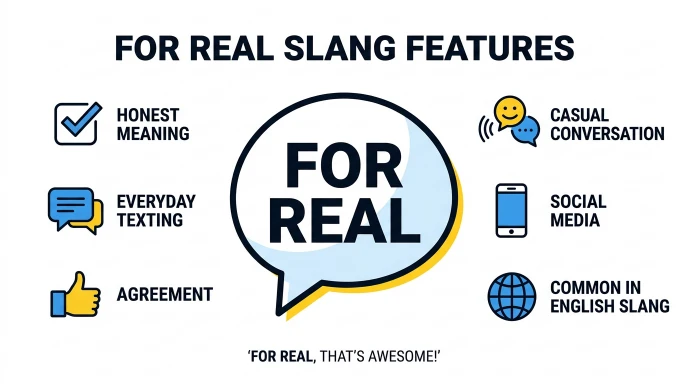
In slang, “for real” means genuinely, honestly, or seriously, and it is used to confirm that something is true or sincere.
For real slang is a popular everyday expression used in texting, social media, and face-to-face conversations. You may have seen someone reply with “for real,” “FR,” or “for real?” on TikTok, Instagram, Reddit, Discord, Snapchat, or in text messages.
While the phrase looks simple, its meaning changes depending on the conversation. It can express agreement, confirm that something is true, show surprise, or ask if someone is being serious.
Because it is so common in modern English, understanding for real slang helps you communicate more naturally and recognize its meaning in different situations. The tone is usually friendly and informal, making it one of the most widely used slang expressions today.
Quick Answer:
For real means “seriously,” “truthfully,” or “I’m not joking.” It is used to confirm something is genuine, agree with someone, or ask if something is actually true.
What Does For Real Mean in Text?
In texting, for real usually means that someone is being honest or serious.
It can also be used to:
- Confirm that something is true.
- Show strong agreement.
- Express surprise.
- Ask if someone is telling the truth.
- Add emphasis to a statement.
For example:
“I’m moving to New York.”
“For real?”
Here, the second person is asking if the statement is true.
Another example:
“That movie was amazing, for real.”
In this sentence, the speaker is emphasizing that they genuinely enjoyed the movie.
For Real Slang Full Form
For real is not an abbreviation, so it does not have a full form.
It is simply an informal English phrase that means:
- Seriously
- Honestly
- Truly
- Genuinely
- No joke
Related search terms include:
- for real meaning slang
- what does for real mean in text
- for real meaning in chat
- what does for real stand for
Although some people shorten it to FR, the original phrase itself has no expanded form.
Different Meanings of For Real Slang
1. Confirming Something Is True
This is the most common use.
Example:
“I’m quitting my job.”
“For real?”
Meaning: “Are you serious?”
2. Showing Agreement
People often use for real to agree with someone’s opinion.
Example:
“That game was difficult.”
“For real!”
Meaning: “I completely agree.”
3. Adding Emphasis
Sometimes the phrase strengthens a statement.
Example:
“She’s one of the nicest people I know, for real.”
Meaning: The speaker genuinely believes this.
4. Expressing Surprise
The phrase can also show disbelief or excitement.
Example:
“You won the contest?”
“For real?”
Here, the listener is surprised by the news.
Is For Real Rude, Offensive, or Neutral?
For real is generally neutral and friendly.
Positive
It helps conversations sound natural.
Example:
“You’re one of my best friends, for real.”
Casual
Most people use it in everyday conversations.
Example:
“That pizza was so good, for real.”
Slightly Challenging
Occasionally, saying “For real?” may sound skeptical if spoken with a certain tone.
Example:
“For real? You forgot again?”
The wording is still polite, but the tone may suggest doubt.
Where Is For Real Commonly Used?
You’ll commonly see for real slang on:
- TikTok
- Snapchat
- Discord
- X (formerly Twitter)
- YouTube comments
- Gaming chats
- Text messages
- Everyday conversations
Because it’s simple and easy to understand, people of different age groups use it regularly.
Real-Life Examples of For Real Usage
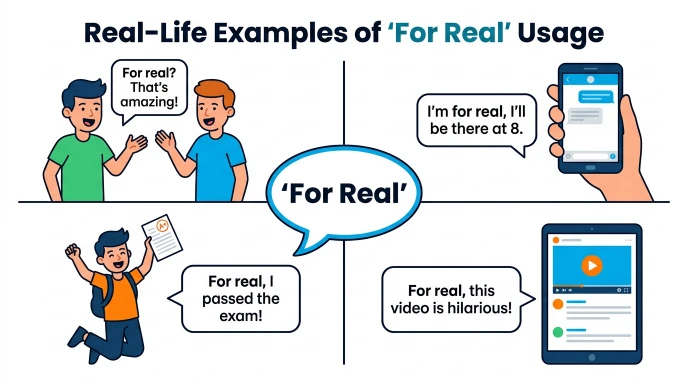
Friendly
“You’re the best friend ever, for real.”
Casual
“That burger was incredible, for real.”
Agreement
Person A: “This weather is perfect.”
Person B: “For real.”
Surprise
“You met your favorite singer?”
“For real?”
Gaming
“That boss fight was impossible, for real.”
Social Media
“This is the funniest video I’ve seen today, for real.”
Origin and Background of For Real Slang
The phrase for real has existed in spoken English for many decades.
It became especially popular in American English during the late 20th century and later spread through:
- Hip-hop culture
- Movies
- Television
- Internet forums
- Text messaging
- Social media
As online communication grew, users also began shortening the phrase to FR, especially in text messages and social media comments.
Today, both for real and FR are widely recognized across English-speaking communities.
Why People Use For Real Slang
People use for real because it quickly communicates sincerity or agreement.
Common reasons include:
- Showing honesty
- Confirming facts
- Agreeing with someone
- Reacting naturally
- Expressing surprise
- Making conversations sound friendly
It feels less formal than words like truly or indeed, making it ideal for casual communication.
Comparison with Similar Slang
| Slang | Meaning | Tone | Common Use |
| For Real | Seriously or honestly | Neutral | Texting, speech, social media |
| FR | Short for “For Real” | Neutral | Texting, TikTok, Snapchat |
| No Cap | I’m telling the truth | Casual | Social media, texting |
| Seriously | Truly or honestly | Neutral | Formal and informal conversations |
| Honestly | Speaking truthfully | Neutral | Everyday English |
While all these expressions relate to honesty, for real is generally more conversational and relaxed.
When Should You Avoid Using For Real?
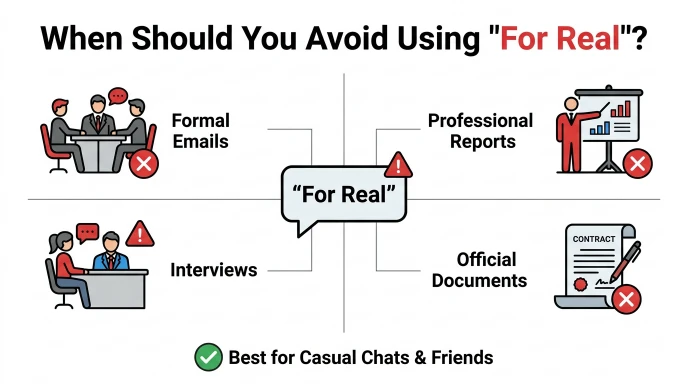
Although it’s widely accepted, there are situations where more formal language is better.
Avoid using for real in:
- Business emails
- Academic papers
- Legal documents
- Professional presentations
- Official reports
Instead, use:
- Seriously
- Truly
- Indeed
- Honestly
- In fact
Polite Alternatives to For Real
If you prefer a more formal tone, try:
- Seriously
- Honestly
- Truly
- Indeed
- Certainly
- Absolutely
- Without a doubt
- Genuinely
These alternatives work well in professional and academic writing.
Impact of Using Slang in Communication
Using for real makes conversations sound friendly and natural.
Benefits
- Easy to understand.
- Makes messages feel genuine.
- Builds casual connections.
- Common across many age groups.
Drawbacks
- Too informal for business writing.
- May sound repetitive if overused.
- Tone can sometimes seem skeptical.
Using it in moderation keeps conversations balanced.
Is For Real Safe for Social Media?
Yes. For real is completely safe to use on social media.
It is not offensive, contains no profanity, and is commonly used in comments, captions, and direct messages.
If you’re posting on TikTok, Instagram, Reddit, or Discord, the phrase is generally appropriate for casual conversations.
Real-Life Examples in Different Contexts
Friendly
“I’m proud of you, for real.”
Casual
“That restaurant is amazing, for real.”
Argumentative
“For real? You’re blaming me again?”
Gaming
“That update made the game so much better, for real.”
Social Media
“This creator deserves more followers, for real.”
Texting
Friend: “I finally passed my driving test.”
You: “For real? Congratulations!”
Comparison: For Real vs. No Cap
These two expressions often confuse learners because both relate to honesty.
| Feature | For Real | No Cap |
| Main Meaning | Seriously, honestly | I’m telling the truth |
| Formality | Casual | Very casual |
| Popular on Social Media | Yes | Yes |
| Common in Speech | Very common | Mostly younger speakers |
| Suitable for All Ages | Yes | Mostly informal conversations |
While both can express sincerity, for real is more universally understood across different age groups.
FAQs
What does for real mean in slang?
It means seriously, honestly, or truthfully. People use it to confirm something, agree with someone, or express surprise.
Is for real the same as FR?
Yes. FR is simply the shortened version of for real used in texting and social media.
Is for real rude?
No. It is generally a neutral and friendly expression.
Does for real have a full form?
No. For real is already the complete phrase and does not stand for anything else.
Where is for real commonly used?
You’ll often see it on TikTok, Instagram, Reddit, Discord, Snapchat, gaming chats, and text messages.
Can for real be used in professional writing?
It’s better to avoid it in formal communication. Use words like seriously, truly, or indeed instead.
Conclusion
Understanding for real slang makes it easier to follow modern conversations both online and offline. If someone is confirming a fact, agreeing with a statement, or asking if something is true, for real is a simple way to express sincerity and authenticity.
The phrase is friendly, widely understood, and commonly used across texting, social media, gaming, and everyday speech. While it works perfectly in casual conversations, choosing more formal alternatives is a better option in professional settings. By paying attention to the context and tone, you can use for real slang naturally and confidently in your own conversations.
Read more about!
- Kangaroo Meaning in Slang: Simple Meaning & Texting Examples
- Mustache Slang: Meaning, Origin & Everyday Usage
- Guap Slang Meaning: Simple Definition, Origin & Texting Examples

Hi, I’m Zunaira Shafiq, a slang writer and language enthusiast. I enjoy exploring modern slang, internet expressions, texting abbreviations, and social media terms, then explaining them in simple, easy-to-understand English. My goal is to help readers understand the meaning, origin, and correct usage of popular slang words through clear definitions and real-life examples. I love making online language easier for students, language learners, and anyone who wants to stay updated with modern communication.