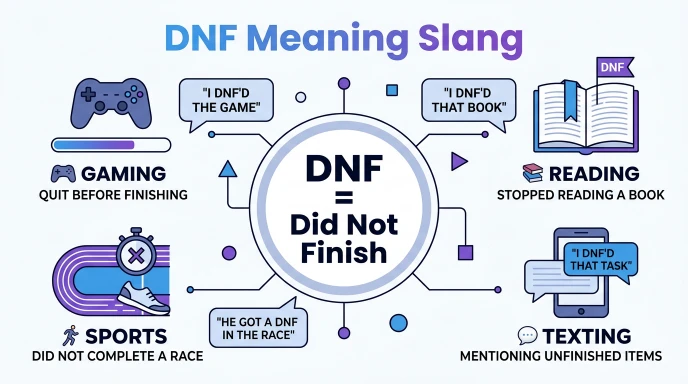
DNF meaning slang usually stands for “Did Not Finish,” meaning someone started but didn’t complete a game, book, race, or other activity.
DNF meaning slang is a popular search because the abbreviation appears in gaming, texting, social media, sports, and online reading communities. Since it has more than one meaning, many people look it up to understand what it means in different situations.
Depending on the context, DNF usually means “Did Not Finish.” For example, someone might say, “I DNFed the book,” “The runner got a DNF,” or “Our team DNFed the match.” Although the abbreviation stays the same, its meaning depends on the activity being discussed.
Understanding DNF meaning slang makes it easier to follow online conversations and avoid confusion. If you’re chatting with friends, playing games, tracking a race, or reading book reviews, knowing the context helps you interpret and use DNF correctly.
Quick Answer:
DNF most commonly stands for “Did Not Finish.” It means someone did not complete a race, game, book, challenge, or other activity before it ended.
What Does DNF Mean in Text?
In text messages and online conversations, DNF usually means “Did Not Finish.” People use it to explain that they stopped before completing something.
For example:
- A reader may stop reading a novel halfway.
- A gamer may leave a match before it ends.
- A runner may be unable to finish a marathon.
- A student may not complete a challenge.
Because DNF has several uses, it’s important to look at the conversation to understand its intended meaning.
DNF Full Form
The most common DNF full form is:
DNF = Did Not Finish
This meaning is widely used in:
- Texting
- Gaming
- Sports
- Reading communities
- Social media
- Online forums
Other Meanings of DNF
Although less common, DNF can also refer to:
| Meaning | Context |
| Did Not Finish | Gaming, sports, books, texting |
| Dungeon & Fighter (DNF) | Online video game title |
| Dynamic Network Framework | Technical or software discussions |
When discussing slang, “Did Not Finish” is almost always the intended meaning.
Is DNF Rude, Offensive, or Neutral?
DNF is neutral.
It simply describes that something wasn’t completed.
It is commonly used to:
- Share personal experiences
- Explain unfinished tasks
- Discuss games
- Review books
- Report race results
Sometimes it may express disappointment, but it is not considered offensive.
Where Is DNF Commonly Used?
DNF appears in many online communities.
You’ll commonly see it on:
- TikTok
- Discord
- X (formerly Twitter)
- Goodreads
- Gaming forums
- Twitch chats
- Sports websites
- Text messages
Book reviewers especially use DNF when they stop reading a book before reaching the end.
Different Meanings of DNF by Context
DNF in Gaming
Gamers use DNF when a player quits or fails to complete a match, race, or mission.
Example:
“Our teammate DNFed before the final round.”
DNF in Reading
Book lovers often use DNF when they stop reading a book because they don’t enjoy it.
Example:
“I DNFed the novel after chapter five.”
DNF in Sports
In racing and athletics, DNF means a competitor started but did not finish the event.
Example:
“The cyclist received a DNF after a mechanical problem.”
DNF in Casual Texting
Friends may use DNF to describe leaving any task unfinished.
Example:
“I totally DNFed my homework yesterday.”
Real-Life Examples of DNF Usage
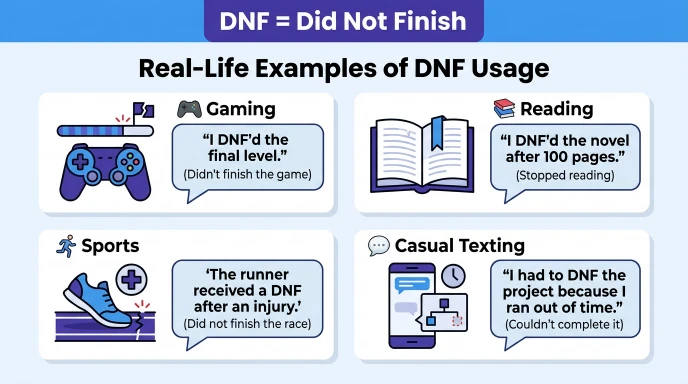
Friendly
“I DNFed that TV series because it got boring.”
Casual
“Sorry, I DNFed the challenge.”
Gaming
“Our whole squad almost DNFed the raid.”
Reading
“I rarely DNF books, but this one wasn’t for me.”
Sports
“She trained hard but unfortunately recorded a DNF.”
Social Media
“Another fantasy novel DNF… maybe next time.”
Origin and Background of DNF
The phrase “Did Not Finish” has existed in competitive sports for many years.
Race organizers used DNF in official results whenever participants failed to complete an event.
As internet culture expanded, gamers, readers, and online communities adopted the abbreviation because it was short and easy to understand.
Today, DNF has become common across multiple online platforms and hobbies.
Comparison with Similar Slang
| Slang | Meaning | Common Use |
| DNF | Did Not Finish | Gaming, books, sports |
| AFK | Away From Keyboard | Gaming |
| GG | Good Game | Gaming |
| Rage Quit | Leaving a game in frustration | Gaming |
| DNS | Did Not Start | Sports |
Although DNF and DNS look similar, they have different meanings:
- DNS: Never started.
- DNF: Started but didn’t finish.
Why People Use DNF
People use DNF because it quickly explains an unfinished activity.
It helps users:
- Save time while texting
- Write shorter book reviews
- Discuss gaming results
- Report race outcomes
- Share honest experiences
The abbreviation is widely understood in many online communities.
When to Avoid Using DNF
Although DNF is common online, it may confuse readers in formal settings.
Avoid using it in:
- Business reports
- Academic papers
- Professional emails
- Official presentations
Instead, write the complete phrase:
- Did not finish
- Was not completed
- Left unfinished
Polite Alternatives
If you prefer clearer language, consider these alternatives:
| DNF | Alternative |
| DNF | Did not finish |
| DNF | Couldn’t complete |
| DNF | Left unfinished |
| DNF | Stopped before finishing |
| DNF | Didn’t complete |
These expressions are especially useful in professional writing.
Impact of Using DNF in Communication
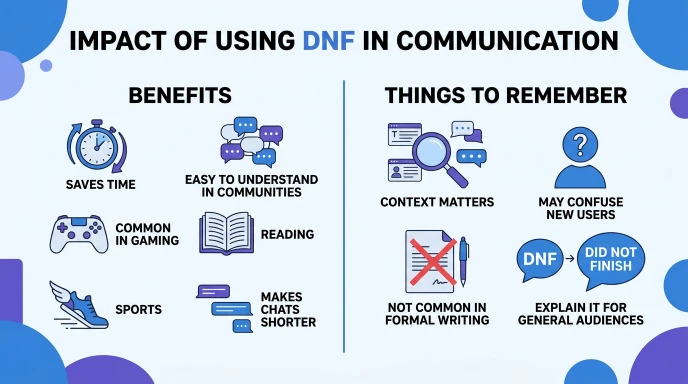
DNF makes online conversations shorter and easier to read.
Benefits include:
- Faster communication
- Clear status updates
- Simple book reviews
- Easy gaming discussions
However, not everyone recognizes the abbreviation. If you’re speaking with someone unfamiliar with internet slang, writing “did not finish” may be clearer.
Is DNF Safe for Social Media?
Yes.
DNF is generally safe on:
- TikTok
- Discord
- Snapchat
- X (formerly Twitter)
It is a neutral abbreviation and does not contain offensive language.
Examples in Different Situations
Friendly
“I DNFed that movie after 30 minutes.”
Casual
“We DNFed the puzzle because it was too difficult.”
Argumentative
“You can’t review it fairly if you DNFed it.”
Gaming
“Half the lobby DNFed before the final boss.”
Social Media
“First DNF book of the year not my favorite.”
Common Mistakes About DNF
| Mistake | Correct Explanation |
| Thinking DNF only relates to gaming | It is also common in books, sports, and texting. |
| Confusing DNF with DNS | DNS means “Did Not Start,” while DNF means “Did Not Finish.” |
| Assuming DNF is rude | It is generally neutral. |
| Using DNF in formal documents | Writing the full phrase is usually more appropriate. |
Frequently Asked Questions
What does DNF mean in slang?
DNF usually means “Did Not Finish.” It describes something that was started but not completed.
What is the DNF full form?
The full form of DNF is Did Not Finish.
What does DNF mean in gaming?
It means a player left or failed to complete a match, mission, or race.
What does DNF mean in books?
Readers use DNF when they stop reading a book before finishing it.
Is DNF offensive?
No. It is a neutral abbreviation commonly used online.
Is DNF the same as DNS?
No. DNS means Did Not Start, while DNF means Did Not Finish.
Conclusion
DNF meaning slang most commonly refers to “Did Not Finish.” If you’re talking about a book you stopped reading, a game you didn’t complete, or a race that ended early, DNF is a simple and widely recognized abbreviation. Its meaning is neutral, easy to understand in context, and commonly used across gaming, sports, reading communities, texting, and social media. By understanding when and where to use DNF, you’ll be able to follow online conversations more confidently and communicate more clearly with others.
Read more about!
- What Is a NIC Slang? Complete Guide with Examples and Uses
- What Does JFC Mean in Slang? Simple Meaning & Examples
- Poggers Meaning Slang: Simple Guide & Examples

Hi, I’m Zunaira Shafiq, a slang writer and language enthusiast. I enjoy exploring modern slang, internet expressions, texting abbreviations, and social media terms, then explaining them in simple, easy-to-understand English. My goal is to help readers understand the meaning, origin, and correct usage of popular slang words through clear definitions and real-life examples. I love making online language easier for students, language learners, and anyone who wants to stay updated with modern communication.