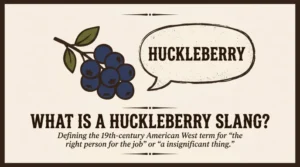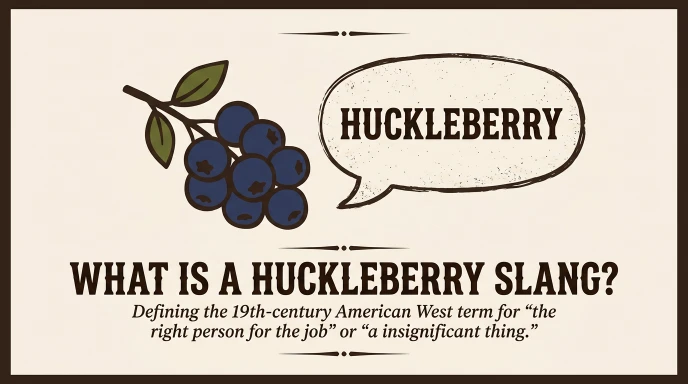
What is a huckleberry slang is a common question because the word huckleberry has both a literal meaning and an informal cultural meaning. In slang, “huckleberry” can describe someone who is just right for a particular task, situation, or challenge.
The phrase “I’m your huckleberry” is especially well known and can mean “I’m the person you’re looking for” or “I’m willing to take on that challenge.”
The word is also strongly connected with American literature and Western culture. You may see it in books, movies, social media captions, or casual conversations. However, the exact meaning depends on the sentence and context. This guide explains the huckleberry slang meaning, its origin, tone, examples, and how people use it today.
Quick Answer:
Huckleberry slang usually refers to someone who is the right person for a particular job, challenge, or situation. In “I’m your huckleberry,” it means something like “I’m the one you need” or “I’m ready.”
Example: “Need someone to fix that old bike? I’m your huckleberry.”
What Does Huckleberry Mean in Slang?
In informal American English, huckleberry can describe a person who is suitable for a specific role or task.
The most recognizable expression is:
“I’m your huckleberry.”
In simple words, it can mean:
- I’m the person you need.
- I’m the right person for this.
- I’m ready to help.
- I’m willing to take the challenge.
The expression can sound confident, playful, old-fashioned, or humorous depending on how it is used.
For example:
“Looking for someone brave enough to try this recipe? I’m your huckleberry.”
Here, the speaker is jokingly saying that they are willing to take on the task.
Huckleberry Slang Full Meaning
Unlike texting abbreviations such as LOL or BRB, huckleberry does not have a “full form.” It is a normal English word that developed an informal figurative use.
There are two important meanings to understand:
| Meaning | Explanation |
| Literal | A small edible berry found in parts of North America |
| Slang/idiom | Someone who is suitable, willing, or ready for a particular task or challenge |
So, when someone asks “what does huckleberry stand for?”, the answer depends on context. It does not stand for a set of initials.
What Does “I’m Your Huckleberry” Mean?
“I’m your huckleberry” means “I’m the person for the job” or “I’m ready to take on the challenge.”
It can be used seriously, but today it is often playful.
For example:
Friend: “We need someone to organize the camping trip.”
You: “I’m your huckleberry.”
This means you are volunteering to handle it.
The phrase can also have a confident tone:
“Think you can beat me at chess? I’m your huckleberry.”
Here, the speaker is accepting the challenge.
Is Huckleberry Slang Rude or Offensive?
Generally, huckleberry is not rude or offensive when used in its common slang or idiomatic sense.
It usually has a:
- Friendly tone
- Playful tone
- Confident tone
- Informal tone
- Sometimes old-fashioned tone
The expression “I’m your huckleberry” may sound unusual to someone unfamiliar with American idioms, but it is not normally an insult.
However, context still matters. A speaker could use huckleberry sarcastically or create a personal joke around the word. In that situation, the surrounding conversation determines the meaning.
Where Is Huckleberry Slang Used?
Huckleberry slang is not one of the most common modern texting terms. You are more likely to encounter it in cultural references, movies, books, jokes, or informal American English than in everyday text messages.
It may appear in:
- Casual conversations
- Movies and television
- Books
- Social media captions
- Memes
- Online discussions
- Western-themed content
- Humorous posts
- American pop culture
The phrase “I’m your huckleberry” is much more recognizable than simply calling someone a “huckleberry.”
Why Is “Huckleberry” Associated With American Culture?
The word has a strong connection with American literature.
Mark Twain used the name Huckleberry Finn for the central character of his 1884 novel Adventures of Huckleberry Finn. The character became one of the best-known figures in American literature.
This literary connection helped make Huckleberry a familiar cultural word. It is important, however, not to assume that every modern use of huckleberry slang comes directly from Huckleberry Finn. The figurative phrase “I’m your huckleberry” has its own history and later became strongly associated with Western-style dialogue.
The “Huckleberry” Meaning in Tombstone
Many modern speakers recognize “I’m your huckleberry” because of the 1993 Western film Tombstone, in which the line is famously associated with the character Doc Holliday.
That movie helped make the expression especially recognizable in popular culture.
As a result, someone using “I’m your huckleberry” today may be intentionally giving their sentence a Western, dramatic, humorous, or confident feel.
For example:
“Who wants to challenge the champion? I’m your huckleberry.”
The speaker is not talking about a berry. They are playfully accepting the challenge.
Huckleberry Slang vs “Huckleberry Finn”
These two uses should not automatically be treated as the same thing.
Huckleberry Finn is a fictional character and the title character of Mark Twain’s novel.
“I’m your huckleberry” is an idiomatic expression meaning that someone is suitable or willing for a particular task or challenge.
The shared word creates an obvious cultural connection, but the expressions serve different purposes.
Huckleberry Slang vs “The Right Person for the Job”
These expressions can communicate a similar idea, but their style is different.
| Expression | Meaning | Tone |
| I’m your huckleberry | I’m the person for this | Playful, confident |
| I’m the right person | I can handle this | Neutral |
| Count me in | I want to participate | Casual |
| I’m up for it | I accept the challenge | Casual |
| Leave it to me | I can handle it | Confident |
The advantage of “I’m your huckleberry” is its personality. It sounds more colorful than simply saying, “I can do it.”
Real-Life Examples of Huckleberry Slang
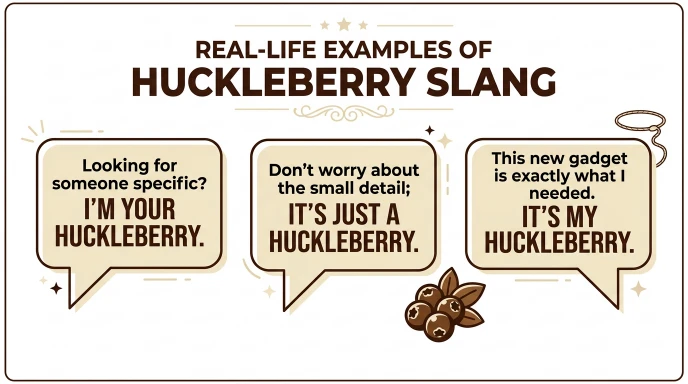
Friendly Example
“Who wants to make homemade pizza tonight?”
“I’m your huckleberry!”
The speaker is volunteering to help or take responsibility.
Casual Example
“We need someone to test this new game.”
“I’m your huckleberry.”
The person is saying they are ready to do it.
Challenge Example
“Think you can beat me in a race?”
“I’m your huckleberry.”
Here, the phrase shows confidence and willingness to compete.
Funny Example
“Who wants to eat the last slice of cake?”
“I’m your huckleberry.”
This is a playful way to volunteer.
Social Media Example
Someone might post:
“Need someone brave enough to try my extra-spicy wings. I’m your huckleberry.”
The phrase adds humor and personality to the caption.
Can Huckleberry Be Used in Texting?
Yes, but it is not among the most common modern texting slang terms.
If someone texts:
“Need help moving tomorrow?”
You could reply:
“I’m your huckleberry.”
The message means that you are willing to help.
Because the phrase is less common than expressions such as “I’m in” or “count me in,” some readers may not immediately understand it. The context usually makes the meaning clear.
Why Do People Use “Huckleberry” Instead of “I’m In”?
The main reason is style.
Saying “I’m in” is simple and modern. Saying “I’m your huckleberry” is more colorful.
People may choose the expression because it:
- Sounds humorous
- Shows personality
- Feels confident
- Adds a Western flavor
- Makes a message more memorable
- Creates a playful tone
It can be especially effective when someone wants to make an ordinary response sound more entertaining.
Is Huckleberry Slang Still Used Today?
Yes, but it is better described as a known idiomatic or cultural expression rather than everyday mainstream slang.
You are more likely to see it in a joke, movie reference, social media post, or playful conversation than in a typical text such as “What are you doing?”
Its popularity also depends on the speaker’s familiarity with American culture and older expressions.
For younger internet users, the phrase may feel intentionally humorous or dramatic rather than like ordinary slang.
When Should You Avoid Using Huckleberry Slang?
There is usually no major safety concern with the word itself, but it may not be the clearest choice in formal communication.
Avoid relying on “I’m your huckleberry” when you need to communicate very clearly, such as in:
- Business emails
- Academic writing
- Official documents
- Formal instructions
- Professional reports
Instead, use a direct phrase such as:
- “I can handle this.”
- “I would be happy to help.”
- “I am available for the task.”
- “I am willing to take this on.”
The slang expression works best when the audience understands informal American English.
Common Mistakes When Using Huckleberry Slang
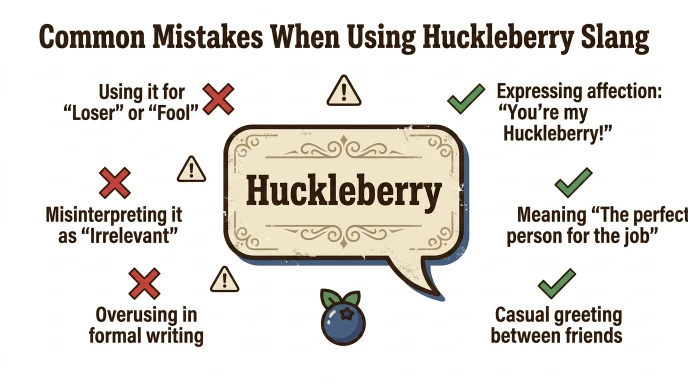
Mistake 1: Thinking It Always Means the Fruit
Huckleberry can literally refer to a berry, but in “I’m your huckleberry,” it has a figurative meaning.
Fix: Read the whole sentence before deciding what it means.
Mistake 2: Treating It Like an Acronym
Huckleberry does not have a slang “full form” like LOL or IDK.
Fix: Understand it as a word used in an idiomatic expression.
Mistake 3: Assuming It Is an Insult
In its common idiomatic use, huckleberry is not normally an insult.
Fix: Look at the speaker’s tone and surrounding words.
Mistake 4: Using It in Every Text
The phrase is less common than modern expressions such as “I’m in.”
Fix: Use it when you want a playful, confident, or humorous style.
Mistake 5: Assuming Everyone Knows the Reference
Some people may never have heard the phrase.
Fix: Use a clearer expression if your audience may not recognize it.
Polite Alternatives to Huckleberry Slang
If you want to communicate the same idea more directly, try:
- I’m in.
- Count me in.
- I can do it.
- I’m up for it.
- Leave it to me.
- I’m happy to help.
- I can handle that.
For casual conversations, “I’m in” is probably the easiest alternative.
For professional communication, “I can handle that” or “I’d be happy to help” is clearer.
Why Is Huckleberry Sometimes Confusing?
The word is confusing because it has several cultural layers.
First, huckleberry is the name of a real fruit. Second, it is connected with Huckleberry Finn, one of America’s famous literary characters. Third, “I’m your huckleberry” has an idiomatic meaning. Finally, movies and popular culture have helped give the phrase a recognizable Western feel.
That combination can make the word difficult to understand if you encounter it without context.
The easiest rule is simple:
If someone says “I’m your huckleberry,” they are usually saying they are ready, willing, or suitable for the situation.
How to Understand Huckleberry in a Sentence
When you see huckleberry in a message, ask three questions:
- Is the speaker talking about food or fruit?
If yes, it probably means the actual berry. - Is it connected to a person or cultural reference?
It may refer to Huckleberry Finn or another proper name. - Does someone say “I’m your huckleberry”?
It most likely means “I’m the person for this” or “I accept the challenge.”
This simple context check can prevent most misunderstandings.
FAQs
What does huckleberry mean in slang?
Huckleberry can informally refer to someone who is right for a particular task or challenge, especially in the phrase “I’m your huckleberry.”
What does “I’m your huckleberry” mean?
It means “I’m the person you need” or “I’m ready to take on the challenge.”
Is huckleberry a rude word?
No. The common slang or idiomatic use is generally friendly, playful, or confident rather than offensive.
Is huckleberry a texting abbreviation?
No. Huckleberry is not an abbreviation. It is a regular word that can have a figurative meaning in certain expressions.
Does huckleberry mean friend?
Not usually. Although the word can appear in friendly contexts, “huckleberry” does not directly mean “friend.”
Where did “I’m your huckleberry” come from?
The expression has a history in American English and became especially recognizable through popular Western culture, including the 1993 film Tombstone.
Is huckleberry slang still used?
Yes, but it is not among the most common everyday slang terms. Today, it is often used for humor, cultural references, or a playful old-fashioned style.
Can I use “I’m your huckleberry” online?
Yes. It is generally safe for casual social media, texting, and online conversations when the audience understands the expression.
Conclusion
So, what is a huckleberry slang? In its best-known informal use, huckleberry refers to someone who is right for a particular task, situation, or challenge. The phrase “I’m your huckleberry” is the clearest example and usually means “I’m the person for the job,” “I’m ready,” or “I accept the challenge.”
The word can be confusing because huckleberry also refers to a real fruit and has strong connections to American literature and Western popular culture. Today, the idiomatic expression is often used in a playful, confident, or humorous way rather than as everyday texting slang.
When you see the word online, always check the surrounding sentence. If someone says “I’m your huckleberry,” they are most likely volunteering, accepting a challenge, or confidently saying they can handle the situation.
Read more about!
- Masturbation Slang: A Simple Guide to Common Terms
- Skinny Slang: A Simple Guide to Its Uses
- Bar Slang: What Does “Bar” Mean in Slang?

Hi, I’m Zunaira Shafiq, a slang writer and language enthusiast. I enjoy exploring modern slang, internet expressions, texting abbreviations, and social media terms, then explaining them in simple, easy-to-understand English. My goal is to help readers understand the meaning, origin, and correct usage of popular slang words through clear definitions and real-life examples. I love making online language easier for students, language learners, and anyone who wants to stay updated with modern communication.